Verona Hills in Kansas City in Jackson County, Missouri — The American Midwest (Upper Plains)
Trail Remnants
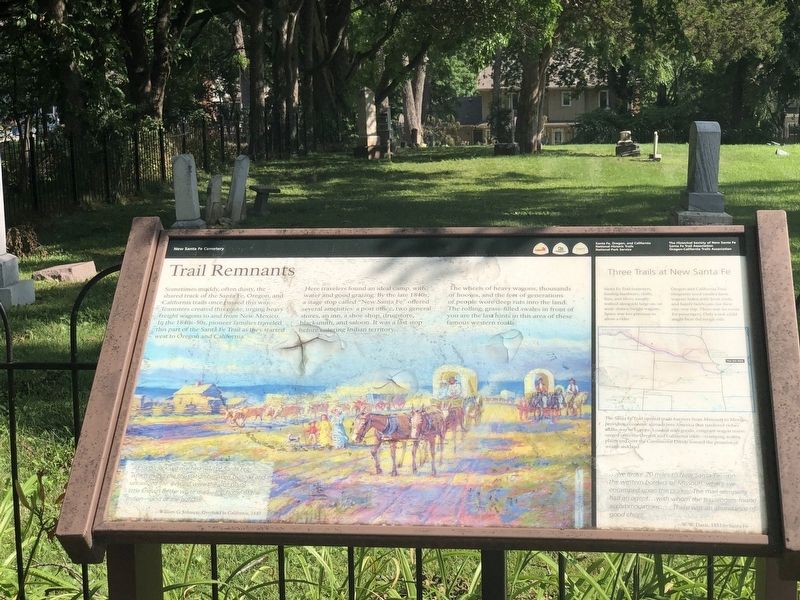
Photographed by Duane and Tracy Marsteller, June 30, 2024
1. Trail Remnants Marker
Here travelers found an ideal camp, with water and good grazing. By the late 1840s, a stage stop called “New Santa Fe” offered several amenities: a post office, two general stores, an inn, a shoe shop, drugstore, blacksmith, and saloon. It was a last stop before entering Indian territory.
The wheels of heavy wagons, thousands of hooves, and the feet of generations of people wore deep ruts into the land. The rolling, grass-filled swales in front of you are the last hints in this area of these famous western roads.
At six o'clock we reached … (Little Santa Fe), which marks the separation between civilized and uncivilized life. Beyond were the vast plains … little known to the white man – the home of the Indian – land of the buffalo. – William G. Johnson, Overland to California, 1849Three Trails at New Santa Fe
Santa
this page online
Oregon and California Trail emigrants used smaller farm wagons laden with food, tools, and family heirlooms for their one-way trip. There was no room for passengers. Only a sick child might bear the rough ride.
The Santa Fe Trail opened trade barriers from Missouri to Mexico, providing economic inroads into America that tendered riches all the way to Europe. Loaded with goods, emigrant wagon trains surged onto the Oregon and California trails – tramping across plains and over the Continental Divide toward the promise of wealth and land.
… we drove 20 miles to New Santa Fe … on the western borders of Missouri, where we encamped upon the prairie. The mail company had an agent … with whom the passengers found accommodations. … There was an abundance of good cheer. – W.W. Davis, 1853 to Santa Fe
Erected by National Park Service • The Historical Society of New Santa Fe • Santa Fe Trail Association • Oregon-California Trails Association.
Topics and series.

Photographed by Duane and Tracy Marsteller, June 30, 2024
2. Trail Remnants Marker
Location. 38° 54.419′ N, 94° 36.355′ W. Marker is in Kansas City, Missouri, in Jackson County. It is in Verona Hills. It can be reached from West Santa Fe Trail west of Madison Avenue, on the right when traveling west. Marker is at New Santa Fe Cemetery. Touch for map. Marker is at or near this postal address: 902 W Santa Fe Trail, Kansas City MO 64145, United States of America. Touch for directions.

Regionally, this marker is in the American Midwest, in the Lewis & Clark Corridor, in the Corn Belt, and on the Santa Fe Trail Corridor. Globally, it is in North America, the Western Hemisphere, the Western World, and the Anglosphere. Historically, it finds itself in what was once the territory of the Mississippian Culture, the Louisiana Purchase, and the Antebellum South.
Other nearby markers. At least 8 other markers are within 3 miles of this marker, measured as the crow flies: New Santa Fe (a few steps from this marker); Santa Fe Christian Church (a few steps from this marker); a different marker also named New Santa Fe (a few steps from this marker); Santa Fe Trail (about 600 feet away, measured in a direct line); Trail Hazards (approx. 2.1 miles away); Amache Prowers (approx. 2.1 miles away); James Beckwourth (approx. 2.2 miles away); Jim Bridger (approx. 2.2 miles away). Touch for a list and map of all markers in Kansas City.
Other markers no longer nearby. Trail Remnants (was here, next to this marker but has been permanently removed); Oregon and California National Historical Trails / Santa Fe National Historic Trail (was here, next to this marker but has been confirmed missing).
Credits. This page was last revised on July 19, 2024. It was originally submitted on July 19, 2024, by Duane and Tracy Marsteller of Murfreesboro, Tennessee. This page has been viewed 223 times since then and 31 times this year. Photos: 1, 2. submitted on July 19, 2024, by Duane and Tracy Marsteller of Murfreesboro, Tennessee.
