Greenville in Darke County, Ohio — The American Midwest (Great Lakes)
Early Wildlife
Photographed by Craig Doda, July 7, 2024
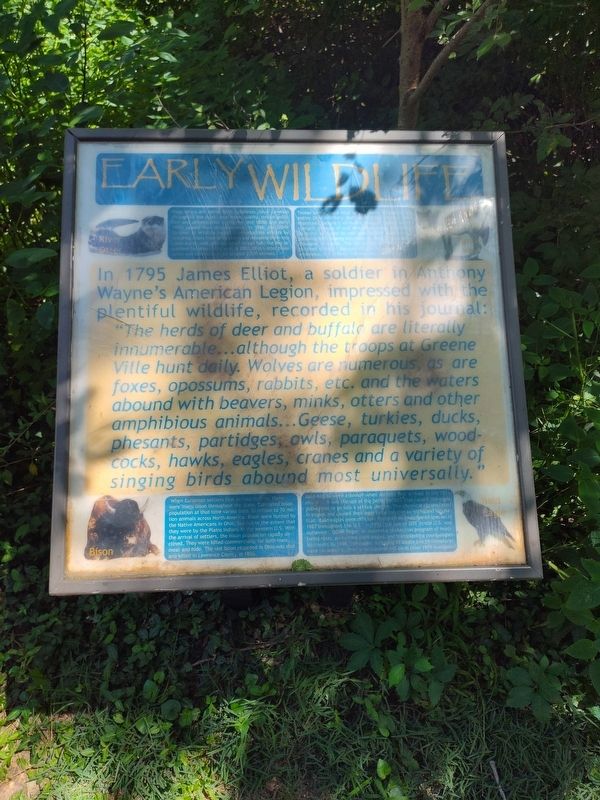
1. Early Wildlife Marker
In 1795 James Elliot, a soldier in Anthony Wayne's American Legion, impressed with the plentiful wildlife, recorded in his journal: "The herds of deer and buffalo are literally innumerable...although the troops at Greene Ville hunt daily. Wolves are numerous, as are foxes, opossums, rabbits, etc. and the waters abound with beavers, minks, otters and other amphibious animals...Geese, turkies, ducks, phesants, partidges, owls, paraquets, wood- cocks, hawks, eagles, cranes and a variety of singing birds abound most universally."
[Captions:]
River Otter
River otters are native Ohio furbearers. Once common throughout the state, poor water quality, stream pollution and deforestation during the late 1800s and early 1900s caused their disappearance. In 1986, the ODNR Division of Wildlife began reintroduction efforts by acquiring otters from other states and releasing them into clean watersheds with abundant forage fish; the key ingredient for otters to survive. In 2002, Ohio's otter population was estimated to be, at least 2, 100 animals.
Timber Wolf
Timber wolves were once common throughout the entire Ohio territory. But, as farming became more important, people's attitudes towards timber wolves changed. Because of wolf attacksion on sheep. Bounties of up to $15 were paid for wolf skins in Ohio. Mass hunting, poisoning and trapping occurred resulting in the death of thousands of wolves. The last killing of a wolf in Ohio accurred in 1842. Because Ohio lacks large blocks of wilderness, it is unlikely that they will ever return.
Bison
When European settlers first arrived in Ohio, there were many bison throughout the state. Estimated bison population at that time varied from 30 million to 70 million animals across North America. Bison were hunted by the Native Americans in Ohio, but not to the extent that they were by the Plains Indians in the western U.S. With the arrival of settlers, the bison population rapidly declined. They were killed commercially, for both their meat and hide. The last bison recorded in Ohio was shot and killed in Lawrence County in 1803.
Bald Eagle
Bald eagles were common when settlers first arrived in the Ohio country. It was the use of the pesticide DDT that caused the eagle population to go into a serious decline. The chemical accumulated in eagles and caused their eggs to be too thin to withstand incubation. Bald eagles were officially declared an endangered species in 1967 throughout the US. In 1972 the use of DDT in the U.S. was outlawed. ODNR began an extensive protection program of monitoring nests, protecting adult eagles, and transplanting young eagles into nests! By 1998, 149 cases including 95 adults and 54 immatures were recorded in Ohio, a increase of 145 birds from 1979 numbers.
Erected by Darke
this page online
Topics. This historical marker is listed in these topic lists: Animals • Indigenous Peoples and Communities • Industry & Commerce • Settlements & Settlers. A significant historical year for this entry is 1795.
Location. 40° 6.197′ N, 84° 38.177′ W. Marker is in Greenville, Ohio, in Darke County. It can be reached from North Boundary Stree (Route 49) 0.1 miles north of West Water Street, on the right when traveling south. Touch for map. Marker is at or near this postal address: 126 W Water St, Greenville OH 45331, United States of America. Touch for directions.

Regionally, this marker is in the Till Plains. It is also in the American Midwest and in the Corn Belt. Globally, it is in North America, the Western Hemisphere, the Western World, and the Anglosphere. Historically, it finds itself in what was once the Haudenosaunee (Iroquois) Confederacy, the territory of the Mississippian Culture, and the Northwest Territory.
Other nearby markers. At least 8 other markers are within walking distance of this marker: Tecumseh Point (within shouting distance of this marker); The Fort at Greenville (about
Photographed by Craig Doda, July 7, 2024
2. Early Wildlife Marker
Credits. This page was last revised on July 27, 2024. It was originally submitted on July 20, 2024, by Craig Doda of Napoleon, Ohio. This page has been viewed 270 times since then and 66 times this year. Photos: 1, 2. submitted on July 20, 2024, by Craig Doda of Napoleon, Ohio. • Devry Becker Jones was the editor who published this page.
