Robbinsdale in Hennepin County, Minnesota — The American Midwest (Upper Plains)
The Great War

Photographed by McGhiever, June 7, 2024
1. The Great War Marker
June 1914: WWI begins
August 1914: Germany wins Battle of Tennenberg
September 1914: German invasion of France is stopped at Marne
January 1915: Germans use zeppelins to bomb England
May 1915: Germans sink Lusitania and provoke USA
December 1915: Allies withdraw from Gallipoli in Turkey
February-December 1916: Longest battle of the war, Battle of Verdun, begins
June 1916: Only major naval battle is fought at Jutland
July-November 1916
1,000,000 die at the Battle of the Somme
April-May 1917: USA enters WWI and begins draft in May
July 1917: 700,000 die at the Third Battle of Ypres, Belgium
October 1917: Americans begin fighting from trenches
April 1918: Allies stop German advance at Amiens
May 1918: Germans attack Paris
September 1918: Allies break through German line at Hindenburg
November 1918: Armistice ends World War I on the 11th of November at 11:00am
June 1919: Treaty of Versailles is signed; Construction of Victory Memorial Drive begins
The Great War
On June 28, 1914 a man seeking independence for Serbia assassinated Archduke Franz Ferdinand of Austria-Hungary. Austria-Hungary and its ally,
this page online
Russia attacked Germany from the east while Germany invaded Belgium, hoping to reach Paris. France attacked Germany along their mutual border. Soon the entire Western Front was caught in stalemate and millions of soldiers lived in trenches that stretched for hundreds of miles along the borders of France, Belgium, and Germany.
During 1915 the conflict truly became a world war as Turkey joined Germany and Austria-Hungary, and colonial nations fought for Britain and France. Poison gas, barbed wire, and trench warfare made the lengthy battles incredibly deadly and left many men who survived with devastating wounds.
[Caption:] Great Britain, France, and Russia allied themselves against Germany and Austria-Hungary.
Many Americans viewed the war as a European conflict and resisted joining the fight, but the United States was jarred by Germany's provocations, including the sinking of the British liner Lusitania which killed more than 100 Americans. In April of
Photographed by McGhiever, June 7, 2024
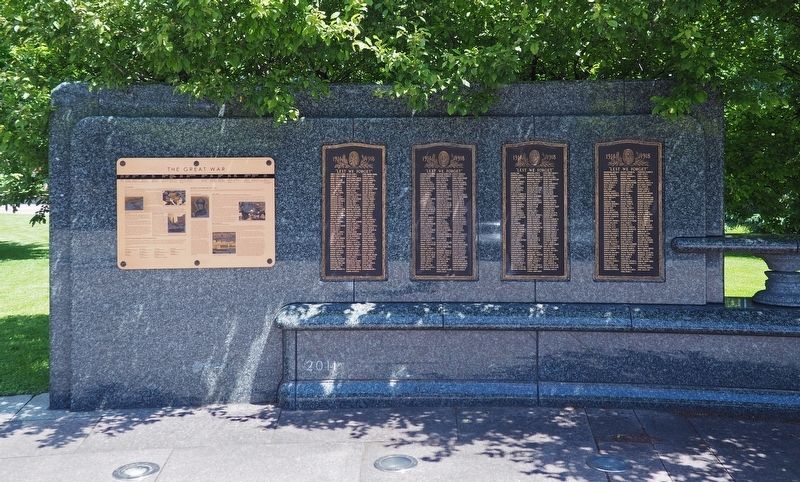
2. The Great War Marker (left) at the northeast edge of the plaza
[Caption:] Local recruits trained at Fort Snelling.
The United States had only a small standing army when it entered the war. But after the passage of the Selective Service Act, four million men were quickly drafted into the military. American women served at home and in Europe as nurses and in other vital roles.
The addition of U.S. troops proved overwhelming and the German Army began surrendering along the Western Front. In the fall of 1918, the German Navy revolted, the German leader abdicated, and on November 11, 1918, the Great War ended.
During World War I, 9,000,000 soldiers died, four empires dissolved, Lenin gained control of Russia, and large swathes of Europe were devastated. Despite President Wilson's effort to provide a humane end to the war, blockades and other punishments against Germany caused starvation and desperation. The War to End All Wars eventually proved only to be the cruel basis for an even more devastating second World War, just 21 years later.
The War at Home
Even those Americans not fighting overseas were involved. Bond drives were used to raise funds, Red Cross volunteers made and packaged supplies, and the Boy Scouts helped raise money and support. Mass manufacturing expanded rapidly and women and African-Americans joined the workforce to produce military equipment. By the time Armistice was declared on November 11, 1918, 116,000 Americans were killed and 204,000 were wounded. The "Great War" had affected every small town, city, and rural area of the country.
[Caption:] In 1918, the War Chest Drive in Minneapolis raised money for the war.
2010-2011 Improvements to Victory Memorial Drive
The most recent improvements to Victory Memorial Drive were directed by the Victory Memorial Drive Task Force. The Task Force—made up of elected officials, representatives from veterans groups and local community leaders—was established by the Minnesota Legislature and first met in 2007. With their leadership, a new flag plaza, granite gateway markers at the entrances to Victory Memorial Drive, improvements to the Grand Army of the Republic Circle, and upgraded roadway, and new street and pathway lights were designed and constructed.
Victory Memorial Drive Task Force (2007-2010)
Mike Opat (Chair, Hennepin County Board)
Linda Higgins (State Senator)
Ann Rest (State Senator)
Mark Stenglein (Chair, Hennepin County Board)
Lyndon Carlson (State Representative)
Joe Mullery (State Representative)
Pat Schon (Veterans' Representative)
Steve Fiscus (Veterans' Representative)
Barb Johnson (President, Minneapolis City Council)
Dan Rogan (Robbinsdale City Council)
Jon Olson (Minneapolis Park Commissioner)
Nina Archabal (President, Minnesota Historical Society)
Bob Zagaros (Citizen Representative)
Patrick Burns (Citizen Representative)
Hennepin County Citizens Rise to the Cause
The men and women who served in World War I came from many backgrounds and from all areas of Hennepin County. They described their experiences in letters, scrapbooks, and personal memoirs. Those materials are available from the Minnesota Historical Society and the Hennepin History Museum. The following are some of their stories:
Colonel George Leach
Commander of the 151st Field Artillery
[Caption:] Colonel George Leach
George Leach attended Central High School in Minneapolis and joined the Minnesota National Guard in 1905. He ultimately rose to command the 151st Field Artillery, nicknamed the "Gopher Gunners" for its many Minnesotans. Colonel Leach's unit became the first federally recognized unit in the United States in April 1917. Soon the Gopher Gunners were combined into the 42nd Division that included Guard units from over two dozen states. In June 1917, Leach departed with 1,260 men from Fort Snelling to Camp Mills, New York. In October 1917, the division embarked for France and was one of the first American units to reach the front.
On May 8, 1919, Minnesota's Gopher Gunners returned to Minnesota to be honored with parades in Minneapolis and Saint Paul. In 1921, several civic leaders urged Colonel Leach to run for mayor of Minneapolis—which he did successfully, winning by 10,000 votes. He served until being defeated for re-election in 1929. Two years later, Colonel Leach and his family moved to Washington, DC where he served as Chief of the National Guard Bureau. He returned to Minneapolis in 1935 and served two more terms as mayor, leaving office in 1941.
David J. Winton
Ambulance Driver and volunteer in the French Army; later served in the American Army
Even before the nation entered the war, some idealistic men saw the conflict in Europe as a cause worth fighting for. One of these, David J. Winton of Minneapolis, joined the French Expeditionary Force in 1917 as an ambulance driver while still in college. Six months later, with the United States entering the War, Winton transferred to the American Army and was later wounded. His self-published memoir, "Recollections of the Great War," describes the excitement and danger of crossing the Atlantic with other American volunteers. About ten days out from New York, they encountered empty and battered lifeboats from a passenger ship torpedoed by the Germans "a day or so before." Arriving in France and seeing the casualties of war made its horrors real for this privileged college student who, like most Americans, had been isolated from the War. He wrote:
When we land at Bordeaux we are badly shocked by the exorbitant number of one-legged and one-armed men, and men with crippled bodies and scarred faces. We are shocked by the number of women dressed in black mourning for their men who have already died in the War. The little children wear black aprons over their worn clothing. It all adds to the somber atmosphere and apprehensive attitude of the French people, for they live somberly and fearfully....
The chapters that follow in Winton's memoir tell stories of the War and the wounded, of travel and return home. Winton's memories weave a tale of youthful idealism and the young men and women who volunteered for service before the nation officially entered the global conflict.
[Caption:] American ambulance workers assisting a wounded soldier.
Marion Zella Backus
Red Cross nurse who served in France
At home and in hospitals at the front, women played an invaluable role as factory workers, fund-raisers for bond drives, makers of bandages, and as nurses for soldiers and orphaned children. Marion Backus was born in 1891, and grew up in South Minneapolis, and enlisted as a Red Cross nurse in April 1918. Her letters home tell a story of dedication, courage, and the horrors of trench warfare and chemical gas. Backus, like her fellow Minnesotan, David Winton, described the shock of seeing the many wounded and mourning French citizens behind the lines.
Early in June 1918, Backus was sent to a field hospital in Beauvais, France to care for American soldiers. She describes a day trip to Paris, all-night blackouts, and complains of body lice and fleas. Backus goes on to thank the women at home who sewed and knit many of the supplies that the nurses use to care for the soldiers:
And then I can feel all my friends around me here for I am using R.C. [Red Cross] supplies and every time I put on a shirt I see the women over home working to make more of them, the sheets, towels and everything all remind me of home and the work there.
In July, she was transferred to an emergency mobile hospital in the American sector near Chantilly. Her letters of October and early November, just before Armistice, include accounts of long hours and her duty in the shack known as the "graveyard" for the gravity of the conditions of the patients within. In a letter from November 8, three days before Armistice, Backus describes that in this ward, with its array of critically wounded, the gas patients donated blood for transfusions and "through these methods," she wrote, "we save about 60% of the cases that come in generally pulseless." Backus returned to Minneapolis in 1932 to supervise a club for unemployed girls at the height of the Great Depression. During World War II, she served in the Red Cross in Minneapolis.
[Caption:] At home in Minnesota, Red Cross volunteers sewed bandages and other essentials.
Erected 2011.
Topics. This historical marker is listed in these topic lists: Charity & Public Work • War, World I • Women. A significant historical month for this entry is June 1914.
Location. 45° 2.231′ N, 93° 19.163′ W. Marker is in Robbinsdale, Minnesota, in Hennepin County. It can be reached from the intersection of Memorial Parkway and Xerxes Avenue N., on the right when traveling west. The marker is on the northeast edge of the Victory Flagpole plaza. Touch for map. Marker is in this post office area: Minneapolis MN 55422, United States of America. Touch for directions.

Regionally, this marker is in the Twin Cities Metropolitan Area. It is also in the American Midwest, in the Corn Belt, and in the Great River Road Region. Globally, it is in North America, the Western Hemisphere, the Western World, and the Anglosphere. Historically, it finds itself in what was once Rupert’s Land, the territory of the Mississippian Culture, and the Louisiana Purchase.
Other nearby markers. At least 8 other markers are within 2 miles of this marker, measured as the crow flies: "Lest We Forget" (here, next to this marker); Victory Memorial Drive (a few steps from this marker); a different marker also named Victory Memorial Drive (a few steps from this marker); To Our Comrades Who "Went West" (a few steps from this marker); Grand Army of the Republic (about 400 feet away, measured in a direct line); Maple Leaf and Humboldt Heights (approx. 1.1 miles away); Garden Dedicated to Frances Pollard (approx. 1.2 miles away); The "Lumberman" (approx. 1.4 miles away). Touch for a list and map of all markers in Robbinsdale.
Credits. This page was last revised on August 26, 2024. It was originally submitted on July 20, 2024, by McGhiever of Minneapolis, Minnesota. This page has been viewed 158 times since then and 31 times this year. Photos: 1, 2. submitted on July 20, 2024, by McGhiever of Minneapolis, Minnesota.
