Near Wilson in Ellsworth County, Kansas — The American Midwest (Upper Plains)
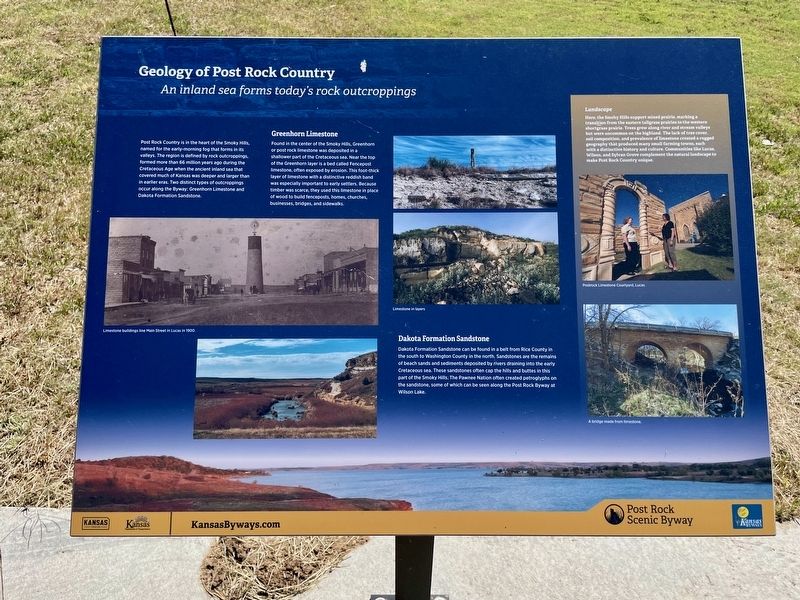
Geology of Post Rock Country
An inland sea forms today's rock outcroppings
| — | Post Rock Scenic Byway | — |
Photographed by Mark Hilton, July 1, 2024
1. Geology of Post Rock Country Marker
Post Rock Country is in the heart of the Smoky Hills, named for the early-morning fog that forms in its valleys. The region is defined by rock outcroppings, formed more than 66 million years ago during the Cretaceous Age when the ancient inland sea that covered much of Kansas was deeper and larger than in earlier eras. Two distinct types of outcroppings occur along the Byway: Greenhorn Limestone and Dakota Formation Sandstone.
Greenhorn Limestone
Found in the center of the Smoky Hills, Greenhorn or post rock limestone was deposited in a shallower part of the cretaceous sea. Near the top of the Greenhorn layer is a bed called Fencepost limestone, often exposed by erosion. This foot-thick layer of limestone with a distinctive reddish band was especially important to early settlers. Because timber was scarce, they used this limestone in place of wood to build fenceposts, homes, churches, businesses, bridges, and sidewalks.
Dakota Formation Sandstone
Dakota Formation Sandstone can be found in a belt from Rice County in the south to Washington County in the north. Sandstones are the remains of beach sands and sediments
this page online
Landscape
Here, the Smoky Hills support mixed prairie, marking a transition from the eastern tallgrass prairies to the western shortgrass prairie. Trees grew along river and stream valleys but were uncommon on the highland. The lack of tree cover, soil composition, and prevalence of limestone created a rugged geography that produced many small farming towns, each with a distinctive history and culture. Communities like Lucas, Wilson, and Sylvan Grove complement the natural landscape to make Post Rock Country unique.
Erected by Kansas Tourism, Kansas Department of Transportation.
Topics. This historical marker is listed in this topic list: Natural Features.
Location. 38° 51.114′ N, 98° 28.044′ W. Marker is near Wilson, Kansas, in Ellsworth County. It is on 2nd Road (Kansas Route 232) 0.2 miles north of Interstate
Photographed by Mark Hilton, July 1, 2024
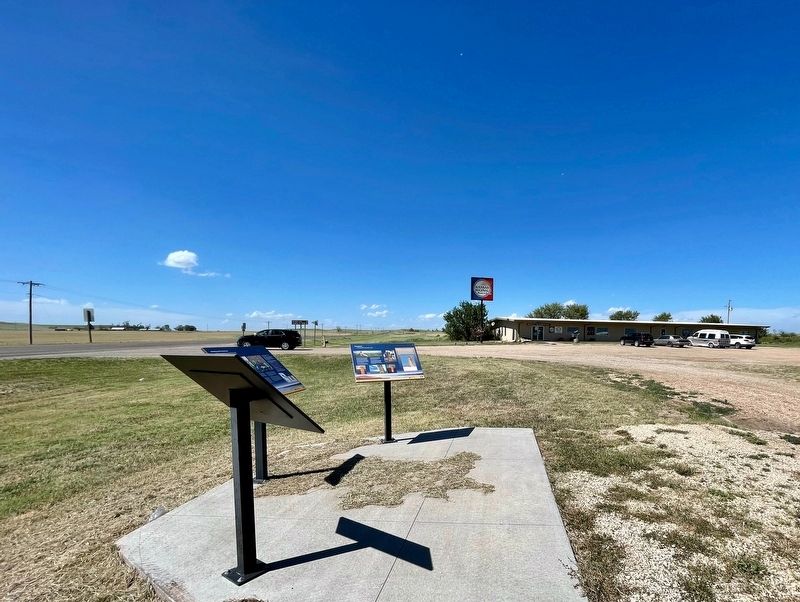
2. Geology of Post Rock Country Marker (with its back to you).

Regionally, this marker is in Kansas’ Smoky Hills. It is also in the American Midwest, in the Corn Belt, on the prairies, and on the Southern Plains. Globally, it is in North America, the Western Hemisphere, the Western World, and the Anglosphere. Historically, it finds itself in what was once the Louisiana Purchase.
Other nearby markers. At least 8 other markers are within 9 miles of this marker, measured as the crow flies: Building with Limestone (here, next to this marker); Fenceposts (here, next to this marker); War Memorial (approx. 1.9 miles away); World's Largest Czech Egg (approx. 1.9 miles away); Post Rock Architecture (approx. 1.9 miles away); Czech Capital of Kansas (approx. 1.9 miles away); A Culture Lives On (approx. 1.9 miles away); Post Rock Scenic Byway (approx. 8.3 miles away). Touch for a list and map of all markers in Wilson.
Also see . . . Post Rock Scenic Byway, Kansas. (Submitted on July 22, 2024, by Mark Hilton of Montgomery, Alabama.)
Credits. This page was last revised on July 22, 2024. It was originally submitted on July 22, 2024, by Mark Hilton of Montgomery, Alabama. This page has been viewed 138 times since then and 20 times this year. Photos: 1, 2. submitted on July 22, 2024, by Mark Hilton of Montgomery, Alabama.
