Hillsborough in Orange County, North Carolina — The American South (South Atlantic)
Historic Corner
Hillsborough
Photographed by Mark Parker, July 22, 2024
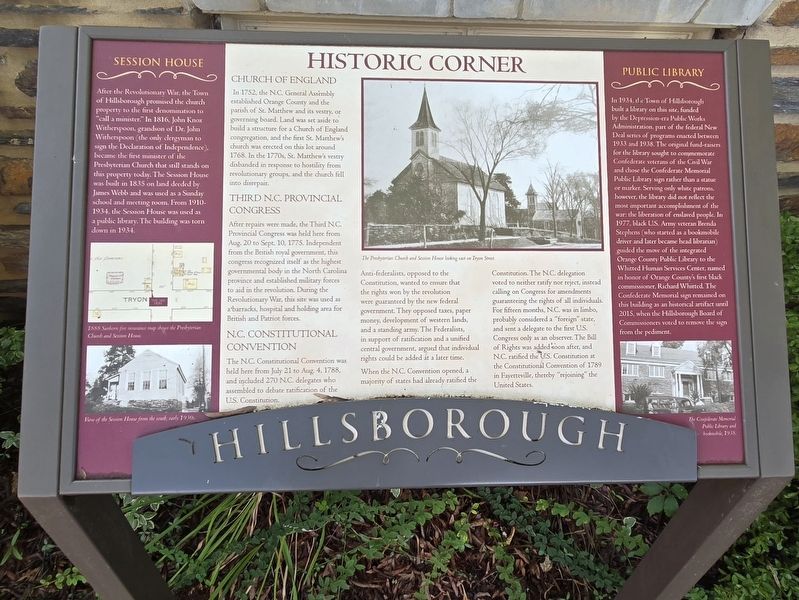
1. Historic Corner Marker
Session House
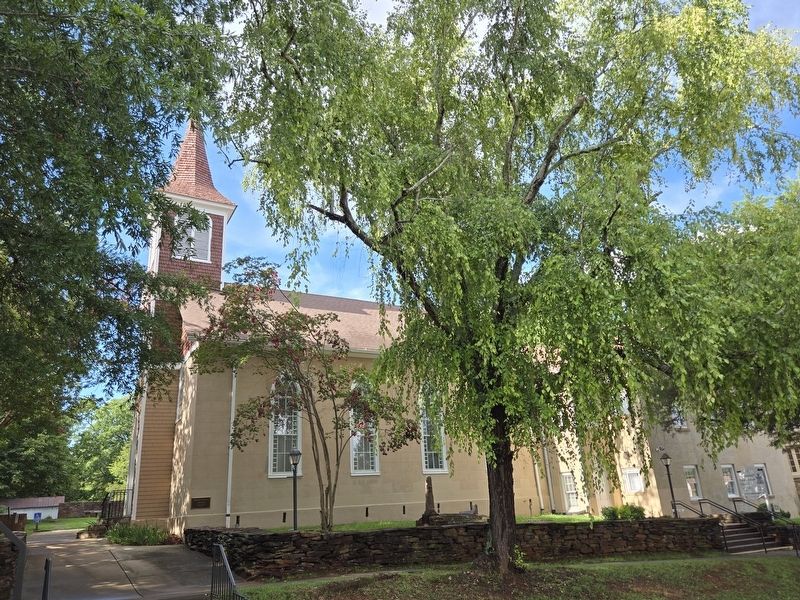
After the Revolutionary War, the Town of Hillsborough promised the church property to the first denomination to "call a minister". In 1816 John Knox Witherspoon, grandson of Dr. John Witherspoon (the only clergyman to sign the Declaration of Independence) became the first minister of the Presbyterian Church that still stands on this property today. The Session House was built in 1835 on land deeded by James Webb and was used as a Sunday school and meeting room. From 1910-1934. the Session House was used as a public library. The building was torn down in 1934.
Church of England
In 1752, the N.C. General Assembly established Orange County and the parish of St. Matthew and its vestry, or governing board. Land was set aside to build a structure for a Church of England congregation, and the first St. Matthew's church was erected on this lot around 1768. In the 1770s, St. Matthew's vestry disbanded in response to hostility from revolutionary groups, and the church fell into disrepair.
Third N.C. Provincial Congress
After repairs were made, the Third N.C. Provincial Congress was held here from Aug. 20
this page online
N.C. Constitutional Convention
The N.C. Constitutional Convention was held here from July 21 to Aug. 4, 1788, and included 270 N.C. delegates who assembled to debate ratification of the U.S. Constitution. Anti-federalists, opposed to the Constitution, wanted to ensure that the rights won by the revolution were guaranteed by the new federal government. They opposed taxes, paper money, development of western lands, and a standing army. The Federalists, in support of ratification and a unified central government, argued that individual rights could be added at a later time.
When the N.C. Convention opened, a majority of states had already ratified the Constitution. The N.C. delegation voted to neither ratify nor reject, instead calling on Congress for amendments guaranteeing the rights of
Photographed by Mark Parker, July 22, 2024
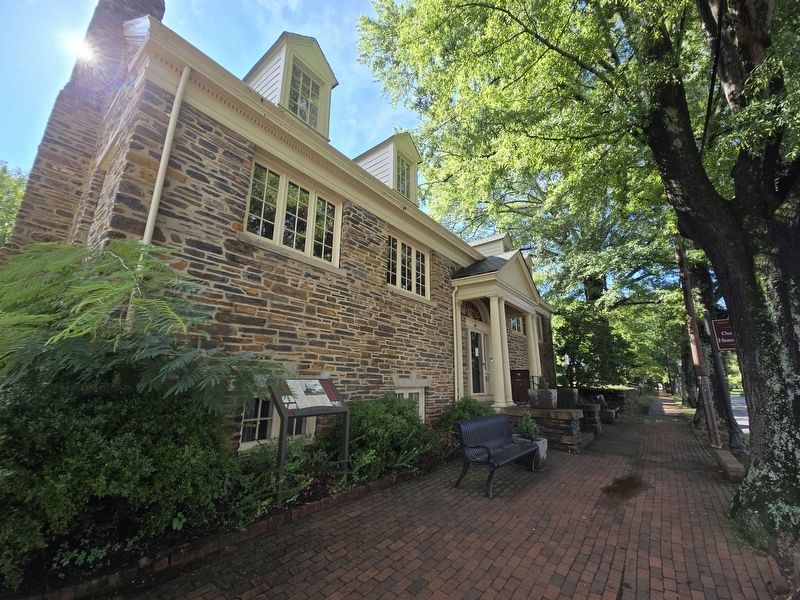
2. Historic Corner Marker in front of the Orange County Historical Museum
Public Library
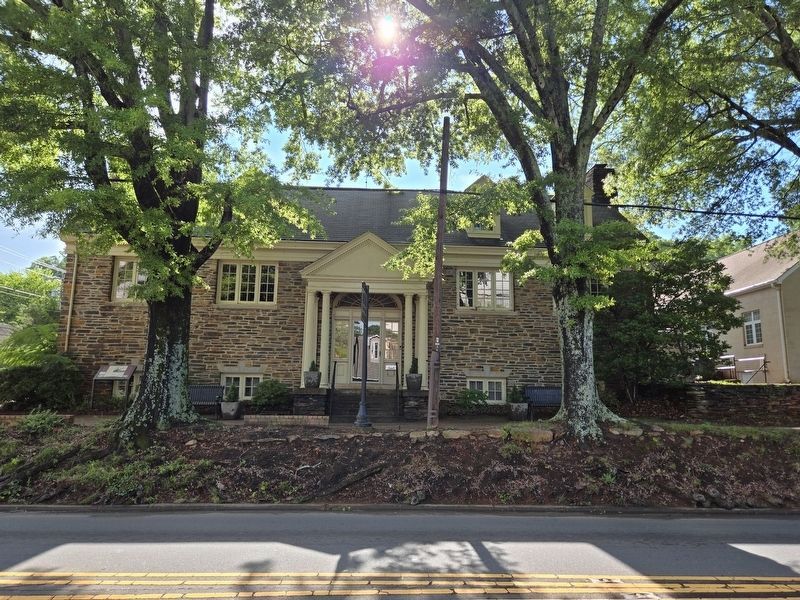
In 1934. the Town of Hillsborough built a library on this site, funded by the Depression-era Public Work Administration, part of the federal New Deal series of programs enacted between 1933 and 1938. The original fund-raisers for the library sought to commemorate Confederate veterans of the Civil War and chose the Confederate Memorial Public Library sign rather than a statue or marker. Serving only white patrons, however, the library did not reflect the most important accomplishment of the war: the liberation of enslaved people. In 1977, black U.S. Army veteran Brenda Stephens (who started as a bookmobile driver and later became head librarian) guided the move of the integrated Orange County Public Library to the Whitted Human Services Center, named in honor of Orange County's first
Photographed by Mark Parker, July 22, 2024
3. Orange County Historical Museum formerly the Confederate Memorial Public Library
Marker is to the far left of the building
(captions)
1888 Sanborn Fire Insurance map shows the Presbyterian Church and Session House.
View of the Session House from the south, early 1930s.
The Presbyterian Church and Session House looking east on Tryon Street.
The Confederate Memorial Public Library and bookmobile 1938.
Topics. This historical marker is listed in these topic lists: Colonial Era • Religion & Religious Structures • Settlements & Settlers • War, US Revolutionary. A significant historical year for this entry is 1752.
Location. 36° 4.63′ N, 79° 5.976′ W. Marker is in Hillsborough, North Carolina, in Orange County. It can be reached from the intersection of North Churton Street (Business U.S. 70) and West Tryon Street, on the right when traveling south. Located in front of the Orange County Historical Museum. Touch for map. Marker is at or near this postal address: 201 N Churton St, Hillsborough NC 27278, United States of America.
Photographed by Mark Parker, July 22, 2024
4. First Presbyterian Church built in 1816

Regionally, this marker is in North Carolina’s Piedmont and in the Research Triangle. It is also in the American South and specifically in the Upper South. Globally, it is in North America, the Western Hemisphere, the Western World, and the Anglosphere. Historically, it finds itself in what was once the territory of the Mississippian Culture, one of the original Thirteen Colonies, one of the Confederate States of America, and the Antebellum South.
Other nearby markers. At least 8 other markers are within walking distance of this marker: Francis Nash (here, next to this marker); J. G. de Roulhac Hamilton (within shouting distance of this marker); William A. Graham (within shouting distance of this marker); Thomas Ruffin (within shouting distance of this marker); Site of First North Carolina Convention 1788 (within shouting distance of this marker); Moses A. Curtis (within shouting distance of this marker); Old Town Cemetery (within shouting distance of this marker); William Hooper (within shouting distance of this marker). Touch for a list and map of all markers in Hillsborough.
Another marker is no longer nearby. Archibald Debow Murphey (was here, next to this marker but has been permanently removed).
Also see . . . Orange County Historical Museum. (Submitted on July 25, 2024.)
Credits. This page was last revised on July 25, 2024. It was originally submitted on July 23, 2024, by Mark Parker of Hickory, North Carolina. This page has been viewed 274 times since then and 35 times this year. Photos: 1, 2, 3, 4. submitted on July 23, 2024, by Mark Parker of Hickory, North Carolina. • Bernard Fisher was the editor who published this page.
