River Market in Kansas City in Jackson County, Missouri — The American Midwest (Upper Plains)
Town of Kansas
Photographed by Duane and Tracy Marsteller, June 30, 2024
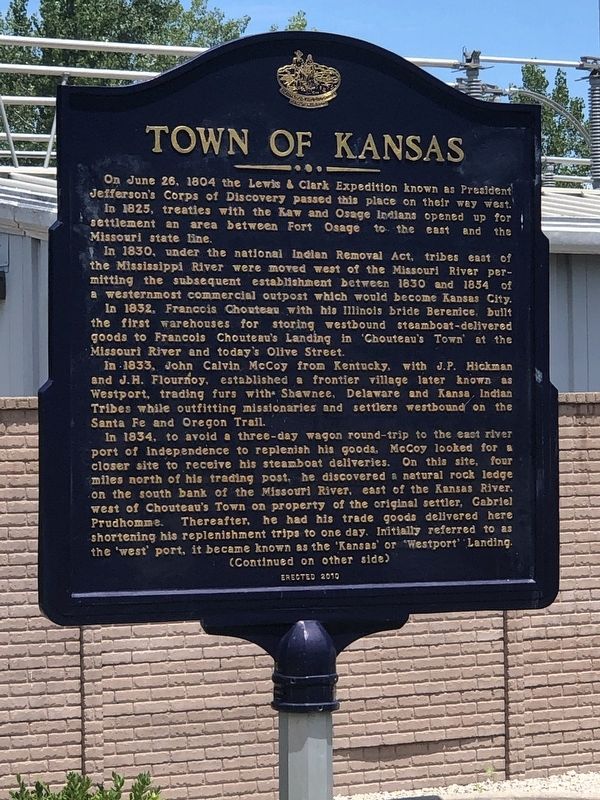
1. Town of Kansas Marker, Side One
On June 26, 1804 the Lewis & Clark Expedition known as President Jefferson's Corps of Discovery passed this place on their way west.
In 1825, treaties with the Kaw and Osage Indians opened up for settlement an area between Fort Osage to the east and the Missouri state line.
In 1830, under the national Indian Removal Act, tribes east of the Mississippi River were moved west of the Missouri River permitting the subsequent establishment between 1830 and 1854 of a westernmost commercial outpost which would become Kansas City.
In 1832, Francois Chouteau with his Illinois bride Berenice, built the first warehouses for storing westbound steamboat-delivered goods to Francois Chouteau's Landing in 'Chouteau's Town' at the Missouri River and today's Olive Street.
In 1833, John Calvin McCoy from Kentucky, with J.P. Hickman and J.H. Flournoy, established a frontier village later known as Westport, trading furs with Shawnee, Delaware and Kansa Indian Tribes while outfitting missionaries and settlers westbound on the Santa Fe and Oregon Trail.
In 1834, to avoid a three-day wagon round-trip to the east river port of Independence
this page online
After his death, Prudhomme's property of 257 acres including the landing, despite its several deep ravines, was sold by his family on November 14, 1838 for $4,220 at a court-ordered public sale to a fourteen-man town company including McCoy. They named it the town of ‘Kansas' after the nearby Kansa Indian Tribe. Both the river to the west and its state were named accordingly. In like fashion, both the Missouri River and this state took their names respectively from another nearby Indian Tribe, the 'Missouris'.
On June 3, 1850 after platting by McCoy, the town was chartered the town of 'Kansas' by the County Court of

Photographed by Duane and Tracy Marsteller, June 30, 2024
2. Town of Kansas Marker, Side Two
Notwithstanding its original importance as a trading center with protection from nearby Fort Leavenworth, for those easterners, European emigrants and a few slaves in search of a better life, Westport Landing became the trails gateway for those westbound on the Santa Fe, Oregon and California Trails.
Erected 2010 by The Native Sons and Daughters of Greater Kansas City.
Topics. This historical marker is listed in these topic lists: Industry & Commerce • Settlements & Settlers • Waterways & Vessels. A significant historical date for this entry is June 26, 1804.
Location. 39° 6.672′ N, 94° 35.024′ W. Marker is in Kansas City, Missouri, in Jackson County. It is in River Market. It is on Main Street north of East 2nd Street, on the right when traveling north. Marker is in the parking lot at the southern end of the Riverfront Heritage Trail. Touch for map. Marker is at or near this postal address: 108 Main St, Kansas

Photographed by Duane and Tracy Marsteller, June 30, 2024
3. Town of Kansas Marker

Regionally, this marker is in the American Midwest, in the Lewis & Clark Corridor, in the Corn Belt, and on the Santa Fe Trail Corridor. Globally, it is in North America, the Western Hemisphere, the Western World, and the Anglosphere. Historically, it finds itself in what was once the territory of the Mississippian Culture, the Louisiana Purchase, and the Antebellum South.
Other nearby markers. At least 8 other markers are within walking distance of this marker: From Steamboat Landing to City (about 500 feet away, measured in a direct line); Waterfront Town to Metropolis (about 500 feet away); City Market (about 600 feet away); Hannibal Bridge (about 600 feet away); Gilliss House Hotel (about 700 feet away); Building Through the Bluffs (about 700 feet away); W. H. Morgan & Company (about 800 feet away); J. P. Campbell & Company Building (about 800 feet away). Touch for a list and map of all markers in Kansas City.

via SqueezeBoxCity (Public Domain)
4. Kansas City in 1830
An artist's rendering of Westport Landing.
Credits. This page was last revised on July 13, 2025. It was originally submitted on July 23, 2024, by Duane and Tracy Marsteller of Murfreesboro, Tennessee. This page has been viewed 647 times since then and 88 times this year. Photos: 1, 2, 3, 4. submitted on July 23, 2024, by Duane and Tracy Marsteller of Murfreesboro, Tennessee.
