Stockport in Greater Manchester, England, United Kingdom — Northwestern Europe (the British Isles)
Channel Island Evacuees
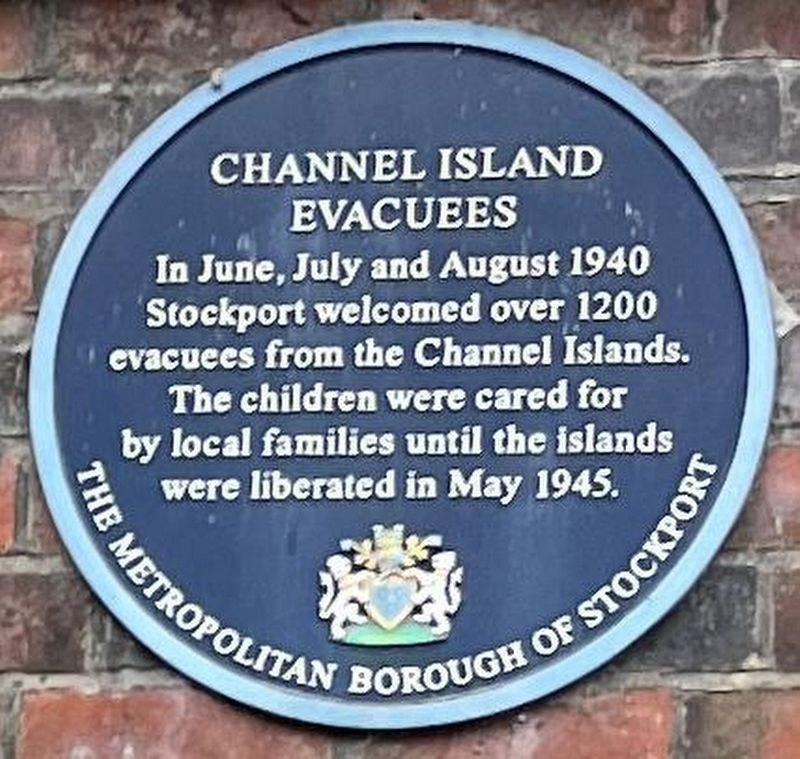
Photographed by Ray Gurganus, April 13, 2024
1. Channel Island Evacuees Marker
Erected by Metropolitan Borough of Stockport.
Topics. This historical marker is listed in these topic lists: Immigration • War, World II. A significant historical date for this entry is June 15, 1940.
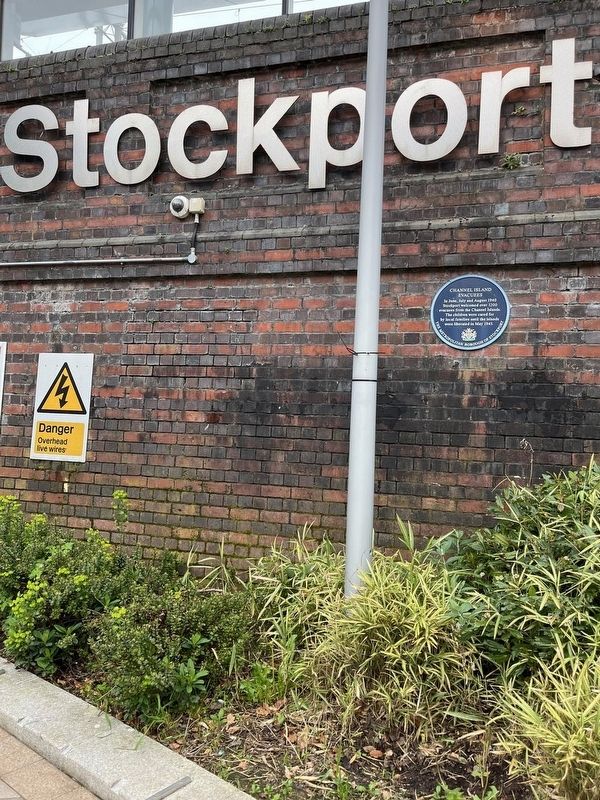
Location. 53° 24.356′ N, 2° 9.75′ W. Marker is in Stockport, England, in Greater Manchester. It is on Station Road. The marker is on exterior wall of the Stockport rail station. Touch for map. Marker is at or near this postal address: 1 Station Road, Stockport, England SK3 9HZ, United Kingdom. Touch for directions.

Regionally, this marker is in North West England. Globally, it is on the Atlantic Ocean, in the North Atlantic Region, in Europe, in Atlantic Europe, on one of the British Isles, in the Western World, and in the Anglosphere. Historically, it finds itself in what was once the Roman Empire.
Other nearby markers. At least 8 other markers are within 3 kilometers of this marker, measured as the crow flies: Heaton Norris, Viaduct
this page online
Also see . . . Evacuation of civilians from the Channel Islands in 1940 (Wikipedia).
Excerpt: The evacuation of civilians from the Channel Islands in 1940 was an organised, partial, nautical evacuation of Crown dependencies in the Channel Islands, primarily from Jersey, Guernsey, and Alderney to Great Britain during World War II. The evacuation occurred in phases, starting with school aged children, their teachers, and mother volunteers. The islands and the British military began the evacuation following the Allies' loss in the Battle of France, after which the British Army withdrew from the islands.(Submitted on July 23, 2024.)
… When it becameclear that the Battle of France was lost, time was limited for anyone to evacuate, even so 25,000 people went to Great Britain, roughly 17,000 from Guernsey, 6,000 from Jersey and 2,000 from Alderney in the ten days before the German troops landed at the end of June 1940. Most civilians who were evacuated went to England.Photographed by Ray Gurganus, April 13, 20242. Channel Island Evacuees Marker
Credits. This page was last revised on July 23, 2024. It was originally submitted on July 23, 2024, by Ray Gurganus of Washington, District of Columbia. This page has been viewed 153 times since then and 35 times this year. Photos: 1, 2. submitted on July 23, 2024, by Ray Gurganus of Washington, District of Columbia. • Andrew Ruppenstein was the editor who published this page.
