Parachute in Garfield County, Colorado — The American Mountains (Southwest)
Parachute
⎯⎯⎯
Battlement Mesa
Boundless Landscapes • Spirited People
| — | Northwest Colorado | — |

Photographed by Cosmos Mariner, July 14, 2024
1. Parachute / Battlement Mesa Marker
Community Legacy
Located at the crossroads between the rugged mountain ranges and the mesas and plateaus of Colorado's Western Slope, the region surrounding Battlement Mesa and Parachute was once the seasonal campground of the Ute Indians. Later the area appealed to the early settlers who, tired of cold winters in the high mountain terrain, sought a more moderate climate for ranching and farming. As a result, the valley is rich with both Native American history as well as that of early Colorado settlers. Starting in the mid-to-late 1800s the area transitioned from first farming and ranching to mineral extraction with links to both the east and west coast via the railroad and later by the automobile. Today in the 21st century, Parachute and Battlement Mesa are highly desirable communities for those seeking diverse recreational opportunities and a desire to enjoy the great Colorado outdoors.
1 • Battlement School / Thomas Glover Cabin
7235 County Road 300
Built in 1897, this one room schoolhouse features native stone, which was hauled by team and wagon two miles from a rock quarry. A 1907 addition gave the school its current
this page online
Photo: A Mesa Creek Valley rancher's daughter en route to school, ca. 1898
2 • McKay-Wasson House
259 Cardinal Way
This stately stone structure was designated a National Historic Site in 2012. Built in the late 1890s along Parachute Creek, it is now occupied by the Parachute/Battlement Mesa Park and Rec District. The home is open Mon-Fri 8am-5pm. Visitors are welcome.
3 • Parachute Town Hall
222 Grand Valley Way
Three Jack Roberts paintings of the Last Great Train Robbery, which took place near Parachute, hang in the Council Chambers of Parachute Town Hall. Town Hall is open Monday through Friday.
4 • Morrisania Community House
3188 301 County Road
Formerly a schoolhouse, this community center is the focal point of Morrisania — an area east of Battlement Mesa, now consisting of small ranches and fruit orchards. At one time the area grew some of the finest fruits and vegetables in the region.
5 • Battlement Mesa
When Tosco, Exxon and other petroleum companies

Photographed by Cosmos Mariner, July 14, 2024
2. Parachute / Battlement Mesa Marker
Looking southeast; Green Street is in the right background.
Exxon began construction of a "company" town planned for 25,000 residents. But in the boom and bust cycle of 1982, Exxon closed down their Colony Oil Shale project overnight and layed off thousands just as the infrastructure of the town of Battlement Mesa was nearing completion. After a few years of hard times, the Battlement Mesa community was transformed into a large homeowners association (HOA) development complete with an award-winning golf course and a 53,000 square foot recreation center. Today, Battlement Mesa, which is still an HOA rather than a city or town, is a planned and covenant protected community of approximately 5,000 residents.
Pioneers and Settlers
It is believed that the first recorded European visitors to the area in 1776 were Friars Escalante and Dominguez and their team. A century later, after Colorado became a State, several significant discoveries of gold and silver were made. The discovery led miners and potential settlers to agitate for the removal of native Ute
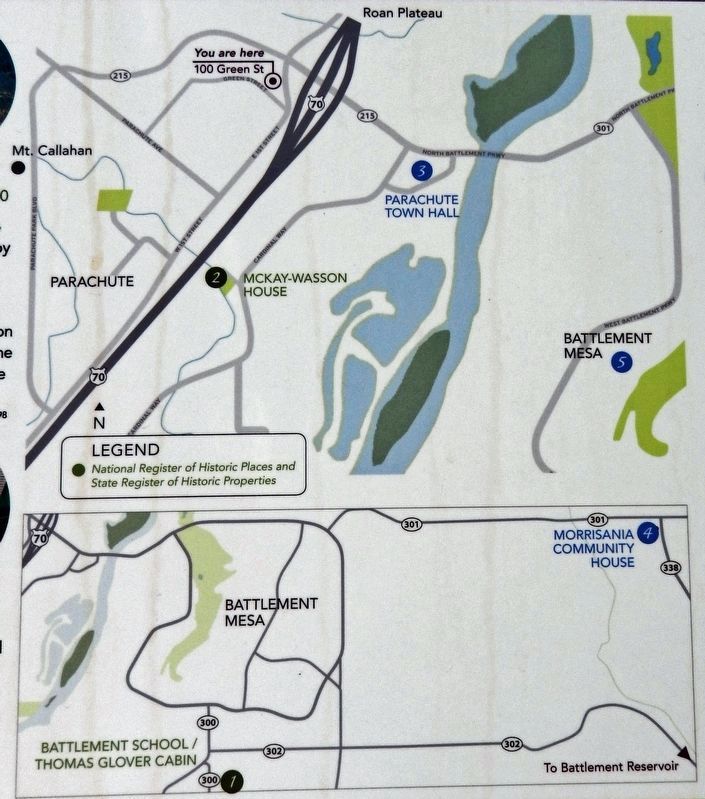
3. Marker detail: Historical Site Map
In the 1880s, sheepman J.B. Hurlburt and 2,000 sheep arrived from California in Meeker. There they met Luther Sage "Yellowstone" Kelly, a frontiersman, and former Army scout, who advised Hurlburt to drive the sheep south down to the Grand River (now the Colorado) because winters in the Grand Valley were less severe. Over time, sheep and cattle ranches as well as fruit orchards prospered at Battlement Mesa, Morrisania Mesa, and along Parachute Creek.
Cattle and sheep ranching continue in the region today. And, a new breed of settler (and visitor) comes to Battlement Mesa to play golf on an award-winning course with awe-inspiring views.
Mineral Wealth
Grand Valley where Battlement Mesa and Parachute are located is rich in mineral resources — including oil, oil shale, natural gas, soda ash, and uranium. Because these minerals are plentiful in the region and in high demand throughout the U.S. and the world, mineral extraction drives the local economy. But, because demand for these minerals is highly cyclical, the local economy is dramatically impacted by energy price and availability causing "boom and bust" cycles.
Today the area is known for natural gas production; however, for the past century oil shale has played a role in both the economy and the region's development. The Grand Valley is part of Colorado's Piceance Basin, an area described as the "richest known deposits" of oil shale beds. It is part of the Colorado, Utah, and Wyoming Green River Formation shale deposit which has been estimated to contain 800 billion barrels, or more than triple Saudi Arabia's proven reserves.
Mountains and Vistas
This region has long been known for its mountains and vistas. Battlement Mesa Forest Reserve, the third forest reserve created in the US, was established by Benjamin Harrison in 1892 with 858,240 acres. (The name was discontinued in 1908 when a portion of the acreage was transferred to other forests.) The remaining acreage is now known as Grand Mesa National Forest and is the third largest flattop mountain in the world. Area visitors will encounter majestic views of lush green mountains south of the Colorado River and contrasting vistas of colorful but dryer mountains north of the river.
Explore the Battlement reservoirs, at 10,300' elevation, south of Battlement Mesa; whether hiking or driving, the trip is a challenging experience. Less adventurous visitors may enjoy a drive through Morrisania Mesa or a drive up Hwy 215 north of Parachute in the area widely known for oil shale exploration and the early 1980s Colony Oil Shale project which led to the creation of the town of Battlement Mesa.
Outlaws
Outlaw Kid Curry and accomplices from the "Wild Bunch" held up the West bound Denver & Rio Grande train West of Parachute in 1904. Over estimating the dynamite needed to open the safe, they blew up the railcar. The robbers made their getaway, first by boat across the Colorado River, then over the Battlement Mesa on horseback. A posse caught up with them and killed one man. Local legend claims Kid Curry was that man.
Wildlife and Nature
Vast tracts of uninhabited public lands and high mountain creeks and streams flowing to the Colorado River provide diverse habitats for wildlife to thrive. Large herds of elk migrate between the Battlements and the Colorado River; deer, mountain lion, coyotes, beavers, hawks and even eagles are prevalent. High mountain lakes and the waters of the Colorado River are home to several species of fish coveted by anglers.
For directions and information: www.nwcoloradoheritagetravel.org
This project was funded in part by a grant from Garfield County and contributions from Battlement Mesa Company, Town of Parachute, Alpine Bank-Battlement Mesa, Parachute-Battlement Mesa Chamber of Commerce, WPX Energy and Grand Valley Historical Society and Battlement Mesa Service Association.
Topics. This historical marker is listed in these topic lists: Indigenous Peoples and Communities • Industry & Commerce • Railroads & Streetcars • Settlements & Settlers.
Location. 39° 27.339′ N, 108° 3.021′ W. Marker is in Parachute, Colorado, in Garfield County. It is at the intersection of East 2nd Street and Green Street, on the right when traveling north on East 2nd Street. The marker is located on the Parachute Visitor Center grounds. Touch for map. Marker is at or near this postal address: 400 East 2nd Street, Rifle CO 81650, United States of America. Touch for directions.

Regionally, this marker is in the Western Slope. It is also in the American Mountain West. Globally, it is in North America, the Rocky Mountains, the Western Hemisphere, the Western World, and the Anglosphere. Historically, it finds itself in what was once Mexico’s Alta California.
Other nearby markers. At least 2 other markers are within walking distance of this marker: The Robbery - The Getaway (a few steps from this marker); The Battlement Creek Fire of 1976 (within shouting distance of this marker).
Credits. This page was last revised on June 29, 2025. It was originally submitted on July 23, 2024, by Cosmos Mariner of Cape Canaveral, Florida. This page has been viewed 1,322 times since then and 165 times this year. Photos: 1, 2, 3. submitted on July 24, 2024, by Cosmos Mariner of Cape Canaveral, Florida.
