Bowling Green in Wood County, Ohio — The American Midwest (Great Lakes)
A Legacy of Public Service
Photographed by Craig Doda, July 21, 2024
1. A Legacy of Public Service Marker
City Building, Police Department, Fire Department
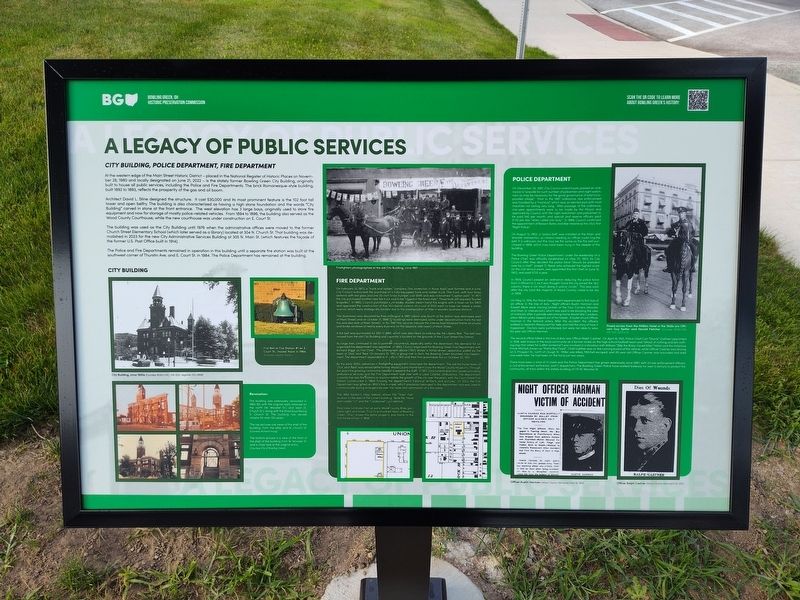
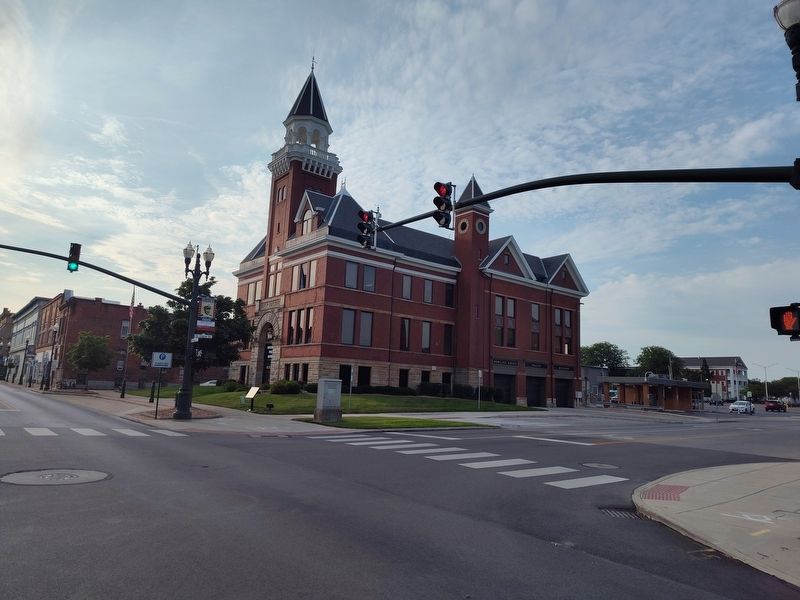
At the western edge of the Main Street Historic District - placed in the National Register of Historic Places on Novem- ber 28, 1980 and locally designated on June 21, 2022 is the stately former Bowling Green City Building, originally built to house all public services, including the Police and Fire Departments. The brick Romanesque-style building, built 1892 to 1893, reflects the prosperity of the gas and oil boom.
Architect David L. Stine designed the structure. It cost $30,000 and its most prominent feature is the 102 foot tall tower and open belfry. The building is also characterized as having a high stone foundation and the words "City Building" carved in stone at the front entrance. The west elevation has 3 large bays, originally used store fire equipment and now for storage of mostly police-related vehicles. From 1894 to 1896, the building also served as the Wood County Courthouse, while the new courthouse was under construction on E. Court St.
The building was used as the City Building until 1976 when the administrative offices were moved to the former Church
this page online
The Police and Fire Departments remained in operation in this building until a separate fire station was built at the southwest corner of Thurstin Ave. and E. Court St. in 1984. The Police Department has remained at the building.
City Building
Renovation:
The building was extensively renovated in 1984-85, with the original walls retained on the north (W. Wooster St.) and west (S. Church St.), along with the three bays facing S. Church St. The building has served citizens for over 130 years.
The top pictures are views of the shell of the building, from the aley and N. Church St.
The bottom is a view of the front of the shell of the building from W. Wooster St. and a close look at the original entry.
Fire Department
On February 15, 1873, a "hook and ladder company (fire protection in those days) was formed and in June, City Council authorized the purchase of a fully-equipped
Photographed by Craig Doda, July 21, 2024
2. A Legacy of Public Service Marker
The downtown was devasted by fires on August 4, 1887 (about one-fourth of the district was destroyed, east of Main Stree Street) and on October 31 31, 1888 (17 buildings were destroyed, some under reconstruction from the last fire and also east of Main Street). In the 1887 fire, records indicate the intense heat blistered frame structures and broke windows of nearly every business on the opposite side (west) of Main Street.
A fire bell was purchased for $90 in 1888, which was described as looking like the Liberty Bell. The bell was moved from the old City
Photographed by Craig Doda, July 21, 2024
3. Bowling Green City Building
As large fires continued to be a commen occurrence, especially within the downtown, the demand for an organized fire department was appareny In 1893, Council organized the Bowling Green Fire Department with Richard Biggs as Fire Chief. The photograph above (1901) shows a horse-drawn apparatus in apparatus tus pulled by the team of 'Dick' wing Green Volunteer Fire Depart Pick' and 'Ned: On January 10, 1910, a group 10 1910, a group met to form the Bowling ment. The department responded to 21 calls in 1910 and their first automobile fire on October 20, 1912.
By the early 1920s, advances in firefighting equipment motorized the department. The old fire horse team of 'Dick' and 'Nod" was retired lathe former Wood County Home farm (now the Wood County Museum). Through the years the growing community needed to expand the staff. In 1971, local funeral directors ceased providing ambulance services and the Fire Department took over with a used Codilac ambulance. The department currently has two fire Trations to accommodate the growth of the city over the years,
Photographed by Craig Doda, July 21, 2024
4. A Legacy of Public Service Marker
The 1884 Sanborn Map (below) shows the "Town Hall" location to the east of the current building. Note the "Hook and Ladder Co and the "Coloboose" (jail) behind.
Most may not know that an early Wood County Atlas (pic- tured right) and book, 'First One Hundred Years of Bowling Green, Ohio, shows this some property was home to the first frome school in 1856.
Police Department
On December 26, 1887, City Council unanimously passed an an ordi- nonce to "provide for such number of policemen and night watch- men as may be necessary for the good governance of said incor- porated village. Prior to the 1887 ordinance, law enforcement was handled by o "marshal", which w ch was an elected post with most marshals not lasting very long. After passage of the ordinance, one-year appointments were to be made by the Mayor and approved by Council, with the night watchmen and policemen to be paid $40 per month, and special and reserve officers paid $1.50 per day when called into duty. In 1888, Council confirmed the appointment of Reason Bates and Abe Ireland as the city's first "Night Police."
On August 12, 1902, a "police bell" was installed at the Main and Wooster intersection, so citizens needing an officer could ring the bell. It is unknown, but this may be the same as the fire bell pur- chased in 1888, which may have been hung in the steeple of this building.
The Bowling Green Police Department, under the leadership of a Police Chief, was officially established on May 25, 1903, by City Council after they decided the police force "should be presided over by a chief Joseph D. Reed, who achieved the highest score on the civil service exam, was appointed the first chief on June 15, 1903, and paid $720 a year.
In 1909, Council passed on ordinance reducing the police force from 3 officers to 2, as it was thought "since the city joined the 'dry' column, there is not much doing in police circles." This was soon after the city (and the majority of Wood County) voted to be dry in 1908.
On May 13, 1919, the Police Department experienced its first loss of on officer in the line of duty. Night officers Austin Harman and Everett Allure were moving lumber at the Four Corners (Wooster and Main St. intersection), which was said to be blocking the view of matonists after a parade welcoming home World War I soldiers, when Alkire's pistol slipped out of his holster. A bullet struck Officer Harmon in the femoral artery. After the accident, the officers walked to Ireland's Restaurant for help and told the story of how it happened. Doctors were summoned, but were not able to save 63-year old Officer Harman.
The second officer kiled in the line of duty was Officer Ralph Castner. On April 16, 1931, Police Chief Carl "Shorty" Galliher (appointed in 1928, well-known to the local community as a former tackle on the high school football team and "afraid of nothing and lets noth- ing stop him when he is after someone") was involved in a shootout with William "Billy the Baby-Faced Killer" Miller and the notorious Frank Mitchell, known as "Pretty Boy Floyd Chief Galliher was on the running board of the vehicle, while Officer Castner was driving on 5. Prospect St., north of Clough St. Miller was killed, Mitchell escaped, and 28-year old Officer Castner was wounded and died one week later. He had been on the force just two years.
There have been a total of 13 chiefs and the Police Department has grown extensively since 1887, with 43 law enforcment officers, a civil enforcement technician, and 11 dispatchers. The Bowling Green Police have worked tirelessly for over a century to protect the community, all from within the stately building of 175 W. Wooster St.
Erected 2024 by Bowling Green, OH Historic Preservation Commission.
Topics. This historical marker is listed in these topic lists: Charity & Public Work • Law Enforcement. A significant historical date for this entry is January 10, 1910.
Location. 41° 22.49′ N, 83° 39.113′ W. Marker is in Bowling Green, Ohio, in Wood County. It is at the intersection of West Wooster Street and South Church Street, on the right when traveling east on West Wooster Street. Touch for map. Marker is at or near this postal address: 160 W Wooster St, Bowling Green OH 43402, United States of America. Touch for directions.

Regionally, this marker is in the Black Swamp, in the Till Plains, and in the Toledo Metropolitan Area. It is also in the American Midwest and in the Corn Belt. Globally, it is in North America, on the Great Lakes, in the Western Hemisphere, in the Western World, and in the Anglosphere. Historically, it finds itself in what was once the Haudenosaunee (Iroquois) Confederacy, the territory of the Mississippian Culture, and the Northwest Territory.
Other nearby markers. At least 8 other markers are within walking distance of this marker: Wiley Post No. 46 (within shouting distance of this marker); Welcome To Wooster Green (within shouting distance of this marker); Ties That Bind (within shouting distance of this marker); Historic Churches (within shouting distance of this marker); Historic Schools (within shouting distance of this marker); Boom Town (about 300 feet away, measured in a direct line); The Four Corners (about 400 feet away); Exchange Bank (about 400 feet away). Touch for a list and map of all markers in Bowling Green.
Credits. This page was last revised on July 29, 2024. It was originally submitted on July 24, 2024, by Craig Doda of Napoleon, Ohio. This page has been viewed 291 times since then and 64 times this year. Photos: 1, 2, 3, 4. submitted on July 24, 2024, by Craig Doda of Napoleon, Ohio. • Devry Becker Jones was the editor who published this page.
