Lower Macungie Township in Wescosville in Lehigh County, Pennsylvania — The American Northeast (Mid-Atlantic)
Business & Industry
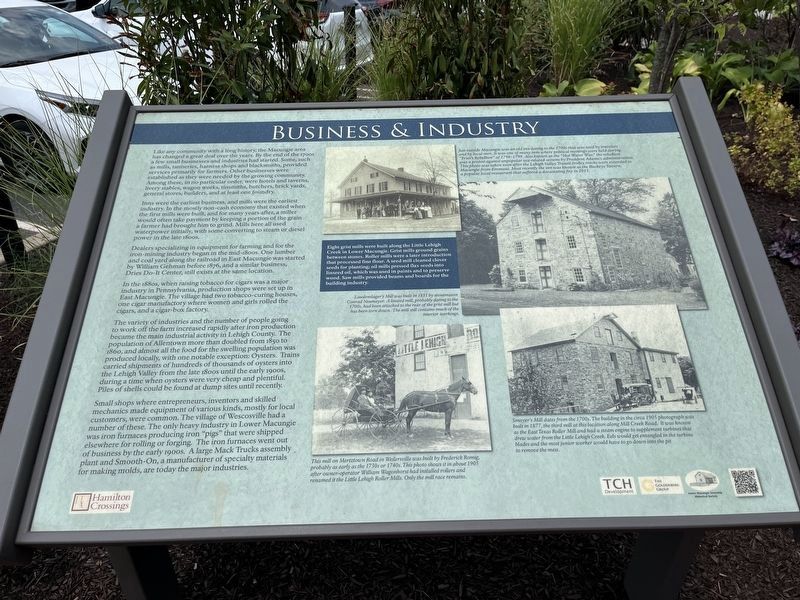
Like any community with a long history, the Macungie area has changed a great deal over the years. By the end of the 1700s a few small businesses and industries had started. Some, such as mills, tanneries, harness shops and blacksmiths, provided services primarily for farmers. Other businesses were established as they were needed by the growing community. Among these, in no particular order, were hotels and taverns, livery stables, wagon works, tinsmiths, butchers, brick yards, general stores, builders, and at least one foundry.
Inns were the earliest businesses, and mills were the earliest industry. In the mostly non-cash economy that existed when the first mills were built, and for many years after, a miller would often take payment by keeping a portion of the grain a farmer had brought him to grind. Mills here all used waterpower initially, with some converting to steam or diesel power in the late 1800s.
Dealers specializing in equipment for farming and for the iron-mining industry began in the mid-1800s. One lumber and coal yard along the railroad in East Macungie was started by William Gehman before 1876, and
this page online
In the 1880s, when raising tobacco for cigars was a major industry in Pennsylvania, production shops were set up in East Macungie. The village had two tobacco-curing houses, one cigar manufactory where women and girls rolled the cigars, and a cigar-box factory.
The variety of industries and the number of people going to work off the farm increased rapidly after iron production became the main industrial activity in Lehigh County. The population of Allentown more than doubled from 1850 to 1860, and almost all the food for the swelling population was produced locally, with one notable exception: Oysters. Trains carried shipments of hundreds of thousands of oysters into the Lehigh Valley from the late 1800s and until the early 1900s, during a time when oysters were very cheap and plentiful. Piles of shells could be found at dump sites until recently.
Small shops where entrepreneurs, inventors and skilled mechanics made equipment of various kinds, mostly for local customers, were common. The village of Wescosville had a number of these. The only heavy industry
[Sidebar:]
Eight grist mills were built along the Little Lehigh Creek in Lower Macungie. Grist mills ground grains between stones. Roller mills were a later introduction that processed fine flour. A seed mill cleaned clover seeds for planting; oil mills pressed flax seeds into linseed oil, which was used in paints and to preserve wood. Saw mills provided beams and boards for the building industry.
[Captions:]
Just outside Macungie was an old inn dating to the 1700s that was used by travelers and by local men. It was one of many inns where political meetings were held during "Fries's Rebellion" of 1798-1799. Also known as the "Hot Water War," the rebellion was a protest against unpopular tax-related actions by President Adams's administration. This photo was taken soon after the Lehigh Valley Transit trolley tracks were extended to Macungie from Emmaus. Most recently the inn was known as the Buckeye Tavern, a popular local restaurant that suffered a devastating fire in 2015.
Laudenslager's Mill was built in 1831 by stonemason Conrad Neumeyer. A linseed mill, probably dating to the 1700s, had been attached to the rear of the grist mill but has been torn down. The mill still contains much of the interior workings.
This mill on Mertztown Road in Weilersville was built by Frederick Romig, probably as early as the 1730s or 1740s. This photo shows it in about 1905 after owner-operator William Wagonhorst had installed rollers and renamed it the Little Lehigh Roller Mills. Only the mill race remains.
Smoyer's Mill dates from the 1700s. The building in the circa 1905 photograph was built in 1877, the third mill at this location along Mill Creek Road. It was known as the East Texas Roller Mill and had a steam engine to supplement turbines that drew water from the Little Lehigh Creek. Eels would get entangled in the turbine blades and the most junior worker would have to go down into the pit to remove the mess.
Erected by TCH Development; The Goldberg Group; Lower Macungie Township Historical Society. (Marker Number 8.)
Topics and series. This historical marker is listed in these topic lists: Agriculture • Animals • Industry & Commerce. In addition, it is included in the Pennsylvania, Lower Macungie Township Historic Walking Trail series list. A significant historical year for this entry is 1876.
Location. 40° 33.954′ N, 75° 33.752′ W. Marker is in Wescosville, Pennsylvania, in Lehigh County. It is in Lower Macungie Township. It is on North Krocks Road just south of Fred Jaindl Memorial Highway (U.S. 222), on the right when traveling north. Touch for map. Marker is in this post office area: Allentown PA 18106, United States of America. Touch for directions.

Regionally, this marker is in Southeast Pennsylvania and in Lehigh Valley. It is also in the American Northeast and in the Mid-Atlantic. Globally, it is in North America, the Western Hemisphere, the Western World, and the Anglosphere. Historically, it finds itself in what was once the Haudenosaunee (Iroquois) Confederacy and also one of the original Thirteen Colonies.
Other nearby markers. At least 8 other markers are within walking distance of this marker: The Mining Industry (within shouting distance of this marker); A Farming Community (about 300 feet away, measured in a direct line); Barns, Decorative Art & Music (about 300 feet away); Early Roads & Highways (about 700 feet away); Trains and Trolleys (about 700 feet away); Churches and Schools (about 800 feet away); Early Settlers (approx. 0.2 miles away); Villages (approx. ¼ mile away). Touch for a list and map of all markers in Wescosville.
Credits. This page was last revised on July 24, 2024. It was originally submitted on July 24, 2024, by Devry Becker Jones of Washington, District of Columbia. This page has been viewed 277 times since then and 51 times this year. Photos: 1, 2. submitted on July 24, 2024, by Devry Becker Jones of Washington, District of Columbia.
