New Franklin in Howard County, Missouri — The American Midwest (Upper Plains)
Franklin: Mother of the Santa Fe Trail
Artist: Harry Weber
—
Dedicated August 31, 2013
—
Photographed by Duane and Tracy Marsteller, July 1, 2024
1. Franklin: Mother of the Santa Fe Trail Marker
Inscription.
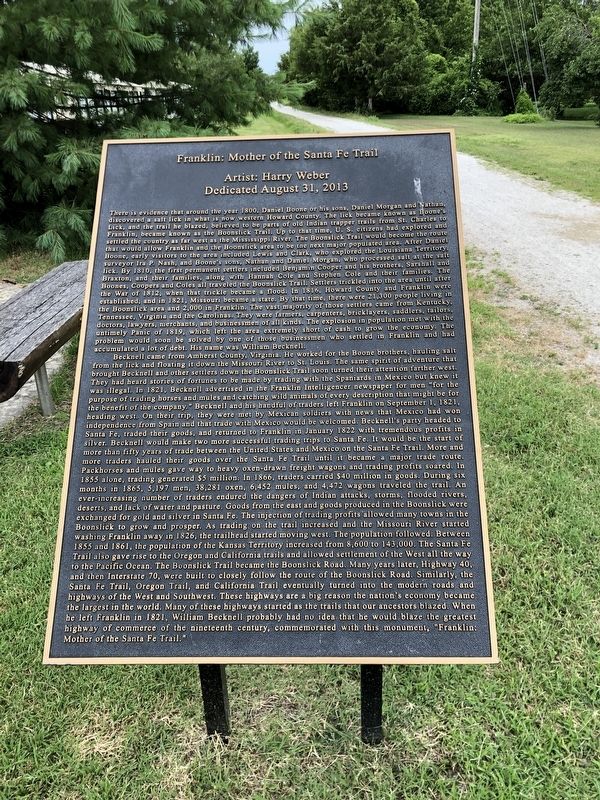
There is evidence that around the year 1800, Daniel Boone or his sons, Daniel Morgan and Nathan, discovered a salt lick in what is now western Howard County. The lick became known as Boone's Lick, and the trail he blazed, believed to be parts of old Indian trapper trails from St. Charles to Franklin, became known as the Boonslick Trail. Up to that time, U.S citizens had explored and settled the country as far west as the Mississippi River. The Boonslick Trail would become the route that would allow Franklin and the Boonslick area to be the next major populated area. After Daniel Boone, early visitors to the area included Lewis and Clark, who explored the Louisiana Territory; surveyor Ira P. Nash, and Boone's sons, Nathan and Daniel Morgan, who processed salt at the salt lick. By 1810, the first permanent settlers included Benjamin Cooper and his brothers, Sarshall and Braxton, and their families, along with Hannah Cole and Stephen Cole and their families. The Boones, Coopers and Coles all traveled the Boonslick Trail. Settlers trickled into the area until after the War of 1812, when that tickle became a flood. In 1816,
Click or scan to see this page online
Howard County and Franklin were established, and in 1821, Missouri became a state. By that time, there were 21,3100 people living in the Boonslick area and 2,000 in Franklin. The vast majority of those settlers came from Kentucky, Tennessee, Virginia and the Carolinas. They were farmers, carpenters, bricklayers, saddlers, tailors, doctors, lawyers, merchants, and businessmen of all kinds. The explosion in population met with the untimely Panic of 1819, which left the area extremely short of cash to grow the economy. The problem would soon be solved by one of those businessmen who settled in Franklin and had accumulated a lot of debt. His name was William Becknell.
Becknell came from Amherst County, Virginia. He worked for the Boone brothers, hauling salt from the lick and floating it down the Missouri River to St. Louis. The same spirit of adventure that brought Becknell and other settlers down the Boonslick Trail soon turned their attention farther west. They had heard stories of fortunes to be made by trading with the Spaniards in Mexico but knew it was illegal. In 1821, Becknell advertised in the Franklin Intelligencer newspaper
Photographed by Duane and Tracy Marsteller, July 1, 2024
2. Franklin: Mother of the Santa Fe Trail Marker
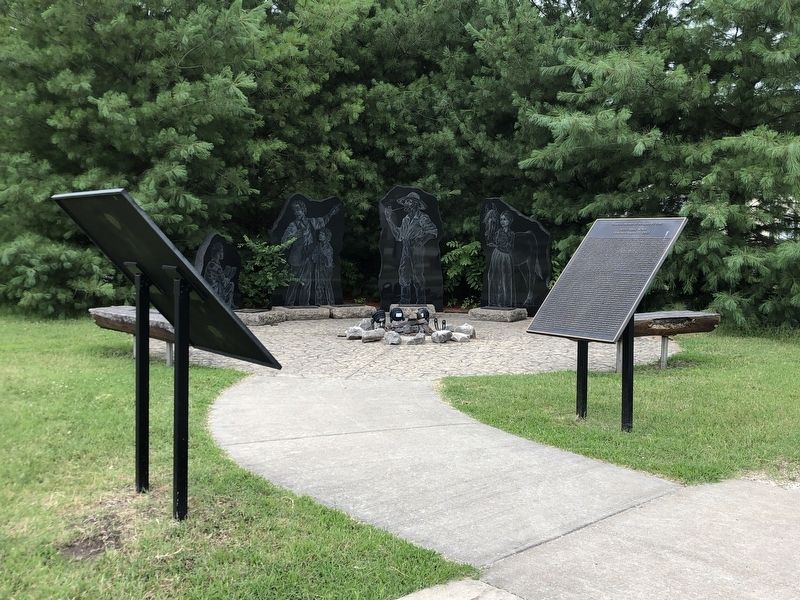
Featured marker is on the right.
for men “for the purpose of trading horses and mules and catching wild animals of every description that might be for the benefit of the company.” Becknell and his handful of traders left Franklin on September 1, 1821, heading west. On their trip, they were met by Mexican soldiers with news that Mexico had won independence from Spain and that trade with Mexico would be welcomed. Becknell's party headed to Santa Fe, traded their goods, and returned to Franklin in January 1822 with tremendous profits in silver. Becknell would make two more successful trading trips to Santa Fe. It would be the start of more than fifty years of trade between the United States and Mexico on the Santa Fe Trail. More and more traders hauled their goods over the Santa Fe Trail until it became a major trade route. Packhorses and mules gave way to heavy oxen-drawn freight wagons and trading profits soared. In 1855 alone, trading generated $5 million. In 1866, traders carried $40 million in goods. During six months in 1865, 5,197 men, 38,281 oxen, 6,452 mules, and 4,472 wagons traveled the trail. An ever-increasing number of traders endured the dangers of Indian
Photographed by Duane and Tracy Marsteller, July 1, 2024
3. Franklin: Mother of the Santa Fe Trail Monument
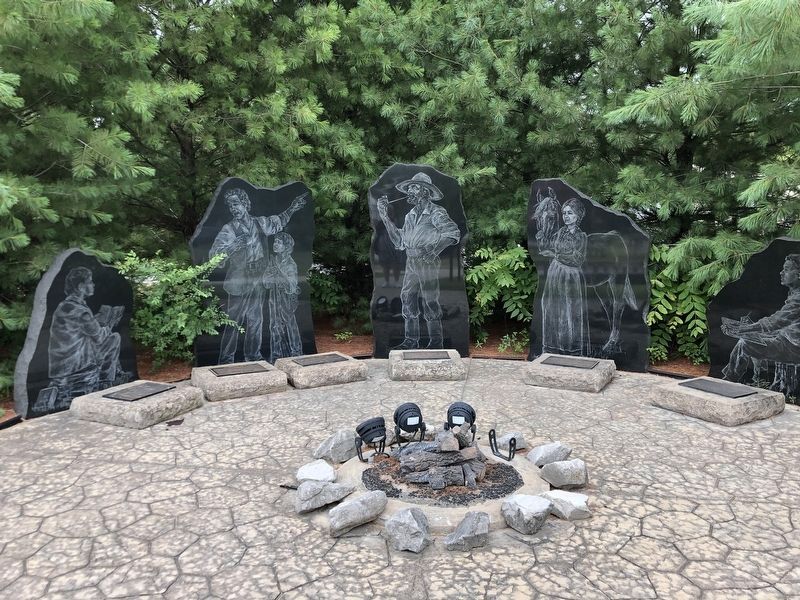
The monument features black granite etchings of and biographical plaques about six people who played key roles in the Santa Fe Trail and Boonslick region's development. They are William Becknell, George Caleb Bingham, Christopher "Kit" Carson, Millie Cooper, Josiah Gregg and Ezekial Williams.
attacks, storms, flooded rivers, deserts, and lack of water and pasture. Goods from the east and goods produced in the Boonslick were exchanged for gold and silver in Santa Fe. The injection of trading profits allowed many towns in the Boonslick to grow and prosper. As trading on the trail increased and the Missouri River started washing Franklin away in 1826, the trailhead started moving west. The population followed. Between 1855 and 1861, the population of the Kansas Territory increased from 8,600 to 143,000. The Santa Fe Trail also gave rise to the Oregon and California trails and allowed settlement of the West all the way to the Pacific Ocean. The Boonslick Trail became the Boonslick Road. Many years later, Highway 40, and then Interstate 70, were built to closely follow the route of the Boonslick Road. Similarly, the Santa Fe Trail, Oregon Trail, and California Trail eventually turned into the modern roads and highways of the West and Southwest. These highways are a big reason the nation's economy became the largest in the world. Many of these highways started as the trails that our ancestors blazed. When be left Franklin in 1821, William Becknell probably had no idea that he would blaze the greatest highway of commerce of the nineteenth century, commemorated with this monument, “Franklin:
Mother of the Santa Fe Trail.”
Location. 39° 0.748′ N, 92° 44.27′ W. Marker is in New Franklin, Missouri, in Howard County. It is at the intersection of Missouri Route 5 and Katy Trail, on the right when traveling south on Missouri Route 5. Touch for map. Marker is at or near this postal address: 312 S Missouri St, New Franklin MO 65274, United States of America. Touch for directions.
Regionally, this marker is in Little Dixie and in the Missouri River Corridor. It is also in the American Midwest, in the Lewis & Clark Corridor, in the Corn Belt, and on the Santa Fe Trail Corridor. Globally, it is in North America, the Western Hemisphere, the Western World, and the Anglosphere. Historically, it finds itself in what was once the territory of the Mississippian Culture, the Louisiana Purchase, and the Antebellum South.
Credits. This page was last revised on July 28, 2024. It was originally submitted on July 26, 2024, by Duane and Tracy Marsteller of Murfreesboro, Tennessee. This page has been viewed 516 times since then and 64 times this year. Photos:1, 2, 3. submitted on July 26, 2024, by Duane and Tracy Marsteller of Murfreesboro, Tennessee.