Stockade District in Kingston in Ulster County, New York — The American Northeast (Mid-Atlantic)
We The People

Photographed by Cosmos Mariner, May 15, 2024
1. We The People Marker
John Jay (1745-1829) was the principal author of the New York State Constitution written at the Courthouse in Kingston. Although he himself owned slaves, he advocated tirelessly for the abolition of slavery in the state, but his efforts failed among the many slave-owning lawmakers, one of his greatest disappointments. Jay was chief negotiator (with John Adams and Benjamin Franklin) of the Treaty of Paris that ended the Revolutionary War. He also wrote five of the 85 essays in the Federalist Papers, published with Alexander Hamilton and James Madison. Jay was appointed by President George Washington as the first Chief Justice of the U.S. Supreme Court in 1789, after having served in that role in New York State. He was elected second governor of New York from 1795 to 1801, during which time he signed the “Act for the Gradual Abolition of Slavery.”
Gouverneur Morris (1752-1816) played a prominent role in the passage of the State Constitution, but was an arrogant, irritable womanizer disliked by many contemporaries — perhaps the reason he is often overlooked as a Founding Father. Morris was snubbed by New York leaders to be
this page online
The Revolutionary War was in full swing when the British embarked on a plan to divide the colonists in New England from those in New York City and the mid-Atlantic states. British troops attacked Kingston, as the new state capital was considered a hotbed of rebels. Docking at Kingston Point overnight, 1,600 Redcoats armed with rifles and bayonets marched to the Stockade the morning of October 16, 1777 burning everything in sight. In just three hours, they destroyed more than 300 houses, barns, and structures in the defenseless town. No Kingstonians were

Photographed by Cosmos Mariner, May 15, 2024
2. We The People Marker
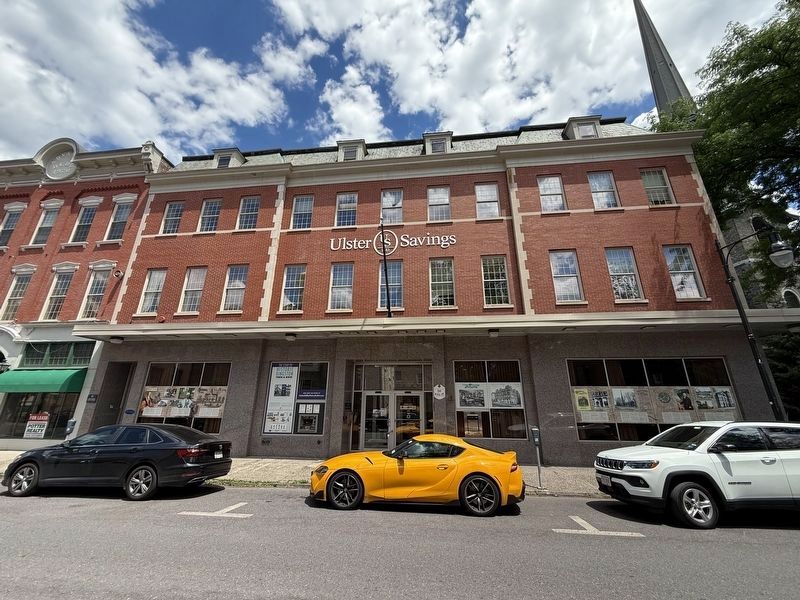
The marker is mounted across the front windows of the office building.
Pieter Cornelius Louw, a Dutch immigrant, is believed to have built this home circa 1676 using native limestone. He and his wife Elizabeth Blanshan had nine children in the house. One of the earliest surviving colonial buildings in North America, it was partially burned by the British in 1777. The Bogardus family owned the surrounding property from 1777 to 1830, although the house itself passed through several owners. The next known owner was William Dunneman and his family who resided there from 1892-1921, when various additions were made. According to historian Howard Chipp in 1915, the street was called Frog Alley due to the “good, loud-voiced frogs” in nearby Mill Pond. The name was changed to Converse Street in 1892. In 1975, Friends of Historic Kingston saved the house from destruction and reinstated the original street name.
Sojourner Truth was a famous abolitionist
After a religious conversion, Isabella changed her name to Sojourner Truth in 1843 and traveled the country speaking as an abolitionist and suffragette. A tall woman known for her powerful singing voice, she went on to meet President Abraham Lincoln, Frederick Douglass, and Susan B. Anthony, forging a lasting legacy far beyond the norm for an illiterate Black woman.

4. Marker detail: John Jay & Gouverneur Morris
Originally founded in 1661, the county courthouse operated out of the multipurpose community center in the early Stockade. A separate two-story wooden structure was built at the current location on Wall Street shortly after Ulster County was incorporated in 1683, and rebuilt in stone from 1732-37. It was this Courthouse that played a central role in the creation of New York State. When the British captured New York City in 1776, a core group of young citizens charged with drafting the State Constitution, including 31-year-old John Jay, 30-year-old Robert Livingston, and 25-year-old Gouverneur Morris, fled to White Plains and then Fishkill before taking up residence at the Courthouse in

5. Marker detail: Sojourner Truth

6. Marker detail: 1818 Ulster County Courthouse
Located directly across Wall Street from this marker.
Topics. This historical marker is listed in these topic lists: Abolition & Underground RR • African Americans • Patriots & Patriotism • War, US Revolutionary. A significant historical date for this entry is October 16, 1777.
Location. 41° 55.996′ N, 74° 1.166′ W. Marker is in Kingston, New York, in Ulster County. It is in the Stockade District. It is on Wall Street 0.1 miles north of Main Street, on the right when traveling north. The marker is mounted across the front windows of the office building at this address. Touch for map. Marker is at or near this postal address: 280 Wall Street, Kingston NY 12401, United States of America. Touch for directions.

Regionally, this marker is in Upstate New York and in the Hudson Valley. It is also in the American Northeast, in the Mid-Atlantic, and on the Eastern Seaboard. Globally, it is in the North Atlantic Region, North America, the Western Hemisphere, the Western World, and the Anglosphere. Historically, it finds itself in what was once New Netherland and also one of the original Thirteen Colonies.
Other nearby markers. At least 8 other markers are within walking distance of this marker: Ulster County Courthouse (a few steps from this marker); Sojourner Truth (a few steps from this marker); Beginning of the State of New York (a few steps from this marker); a different marker also named Sojourner Truth (a few steps from this marker); “The Reformed Protestant Dutch Church of the Town of Kingston in Ulster County” (within shouting distance of this marker); The Story of Historic Kingston (within shouting distance of this marker); The Stockade Historic District (within shouting distance of this marker); The Pike Plan (within shouting distance of this marker). Touch for a list and map of all markers in Kingston.
Also see . . .
1. John Jay (Wikipedia). Excerpt:
After the establishment of the new federal government, Jay was appointed by President George Washington the first Chief Justice of the United States, serving from 1789 to 1795. The Jay Court experienced a light workload, deciding just four cases over six years. In 1794, while serving as chief justice, Jay negotiated the highly controversial Jay Treaty with Britain. Jay received a handful of electoral votes in three of the first four presidential elections but never undertook a serious bid for the presidency.(Submitted on July 28, 2024, by Cosmos Mariner of Cape Canaveral, Florida.)
2. Gouverneur Morris (Wikipedia). Excerpt:
Gouverneur Morris was an American statesman, a Founding Father of the United States, and a signatory to the Articles of Confederation and the United States Constitution. He wrote the Preamble to the United States Constitution and has been called the "Penman of the Constitution". While most Americans still thought of themselves as citizens of their respective states, Morris advanced the idea of being a citizen of a single union of states. He was also one of the most outspoken opponents of slavery among those who were present at the Constitutional Congress.(Submitted on July 28, 2024, by Cosmos Mariner of Cape Canaveral, Florida.)
3. Sojourner Truth (Wikipedia). Excerpt:
Sojourner Truth, born Isabella Baumfree, was an American abolitionist and activist for African-American civil rights, women's rights, and alcohol temperance. Her best-known speech was delivered extemporaneously, in 1851, at the Ohio Women's Rights Convention in Akron, Ohio. The speech became widely known during the Civil War by the title "Ain't I a Woman?" During the Civil War, Truth helped recruit black troops for the Union Army; after the war, she tried unsuccessfully to secure land grants from the federal government for formerly enslaved people (summarized as the promise of "forty acres and a mule"). She continued to fight on behalf of women and African Americans until her death.(Submitted on July 28, 2024, by Cosmos Mariner of Cape Canaveral, Florida.)
Credits. This page was last revised on June 22, 2026. It was originally submitted on July 27, 2024, by Cosmos Mariner of Cape Canaveral, Florida. This page has been viewed 292 times since then and 40 times this year. Photos: 1. submitted on July 27, 2024, by Cosmos Mariner of Cape Canaveral, Florida. 2. submitted on July 28, 2024, by Cosmos Mariner of Cape Canaveral, Florida. 3. submitted on June 22, 2026, by Devry Becker Jones of Washington, District of Columbia. 4, 5, 6. submitted on July 28, 2024, by Cosmos Mariner of Cape Canaveral, Florida.
