North End East in Hamilton, Ontario — Central Canada (North America)
HMCS Haida and the Tribal-Class Destroyers
⎯⎯⎯
Le NCSM Haida et les destroyers de classe Tribal

Photographed by Tim Boyd, July 17, 2024
1. HMCS Haida and the Tribal-Class Destroyers Marker

Four Canadian Tribal-class destroyers served in the Second World War. These ships, listed with their commissioning dates, included:
HMCS Iroquois, November 30, 1942
HMCS Athabaskan, February 3, 1943
HMCS Huron, July 28, 1943
HMCS Haida, August 30, 1943
Historically, these ships were spoken of as "sister ships", denoting a design-based relationship between the vessels. Previously, ships were often associated with feminine pronouns. While this terminology is still used by people today, the Royal Canadian Navy has shifted away from this practice.
HMCS Haida's keel was laid down on September 29, 1941, in Newcastle-upon-Tyne, England by Vickers-Armstrong. The ship was commissioned on August 30, 1943. At the time, the Tribal-class destroyers were among the fastest and most heavily armed ships of the Allied Forces. The Canadian ships were known from the outset as Improved Tribal-class destroyers, as the design of the Canadian Tribal-class took advantage of the early lessons from the war and were built to withstand Arctic conditions.
The other Canadian ships - HMCS Micmac, HMCS Nootka, HMCS Cayuga, and HMCS Athabaskan II - were built in Halifax, Nova Scotia, and commissioned after the war.
All of the Tribal-class destroyers were named for Indigenous peoples around the world. HMCS Haida was named after the Haida people of Haida Gwaii on Canada's West Coast.
What is a "commissioning date"?
In naval terms, commissioning refers to the act of putting a ship into service. It marks when a ship
this page online
What does HMCS stand for?
HMCS is short for His/Her Majesty's Canadian Ship; the pronoun changes depending on the current reigning British monarch.
Quatre destroyers canadiens de classe Tribal ont servi pendant la Seconde Guerre mondiale. Ces navires, énumérés avec leur date de mise en service, sont les suivants:
NCSM Iroquois, 30 novembre 1942
NCSM Athabaskan, 3 février 1943
NCSM Huron, 28 juillet 1943
NCSM Haida, 30 aout 1943
Historiquement, ces navires étaient appelés «navires jumeaux», ce qui montre une relation fondée sur la conception entre

Photographed by Tim Boyd, July 17, 2024
2. HMCS Haida and the Tribal-Class Destroyers / Le NCSM Haida et les destroyers de classe Tribal Marker
La quille du NCSM Haida a été posée le 29 septembre 1941 à Newcastle-upon-lyne, en Angleterre, par Vickers-Armstrong. Le navire a été mis en service le 30 août 1943. A l'époque, les destrovers de classe Tribal étaient parmi les navires les plus rapides et les plus ourdement armés des forces alliées. Les navires canadiens étaient connus dès le départ sous le nom de destroyers de classe Tribal améliorés, car leur conception tirait parti des premières leçons de la guerre et leur permettait de résister aux conditions arctiques.
Les autres navires canadiens, les NCSM Micmac, Nootka, Cayuga et Athabaskan Il ont été construits à Halifax, en Nouvelle-Écosse, et mis en service après la guerre.
Tous les destroyers de classe Tribal ont été nommés en l'honneur de peuples autochtones du monde entier. Le NCSM Haida a été nommé en l'honneur du peuple haïda de Haida Gwaii, sur la côte ouest du Canada.
Qu'est-ce qu'une «date de mise en service»?
En termes maritimes, la mise en service désigne l'action d'admettre un navire au service actif. Elle marque le moment ou un navire est entierement construit, lancé et équipé en tant que navire de combat et prêt à rejoindre la flotte. Une cérémonie où l'on observe diverses traditions a généralement lieu, comprenant notamment des discours, le hissage des drapeaux du navire, et des observations religieuses.
Que signifie NCSM?
«NCSM» est l'abréviation de « navire canadien de Sa Majesté »; en anglais, le pronom change en fonction du monarque britannique regnant actuel.
Topics. This historical marker is listed in these topic lists: War, World II • Waterways & Vessels. A significant historical year for this entry is 1943.
Location. 43° 16.522′ N,

Photographed by Tim Boyd, July 17, 2024
3. HMCS Haida and the Tribal-Class Destroyers / Le NCSM Haida et les destroyers de classe Tribal Marker

Regionally, this marker is on the Golden Horseshoe, in the Hamilton-Halton-Brant Area, and specifically in the Toronto Metropolitan Area. It is also in Central Canada. Globally, it is in North America, on the Great Lakes, in the Western Hemisphere, in the Western World, and in the Anglosphere. Historically, it finds itself in what was once a British colony, the Viceroyalty of New France, the Haudenosaunee (Iroquois) Confederacy, and Rupert’s Land.
Other nearby markers. At least 8 other markers are within walking distance of this marker: HMCS Haida - NCSM Haida (here, next to this marker); Ellen Ambrose and the Duet Club of Hamilton
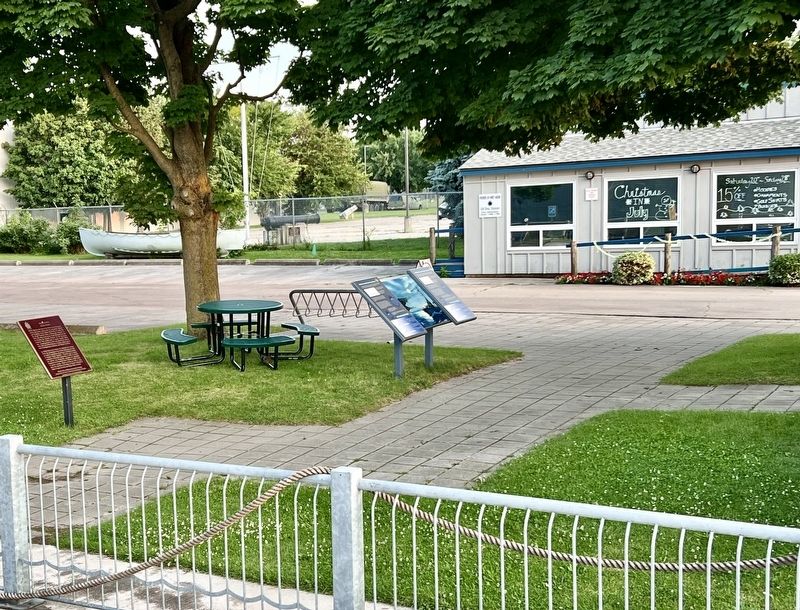
Photographed by Tim Boyd, July 26, 2024
4. HMCS Haida and the Tribal-Class Destroyers / Le NCSM Haida et les destroyers de classe Tribal Marker
Also see . . . Parks Canada - HMCS Haida NHS - History. <blockquote>HMCS Haida was a fighting ship, and it didn't matter what came the ship's way: destroyers, armed trawlers, submarines, even trains. HMCS Haida and the ship's crews distinguished themselves in every theatre of war and peace in which they played a part. The goal was always the same – to defend or exemplify Canada. And HMCS Haida was a happy ship, a lucky ship. In twenty years of service, the ship only lost two men when a gun exploded during combat. (Submitted on July 29, 2024, by Tim Boyd of Hamilton, Ontario.)

Photographed by Tim Boyd, September 9, 2023
5. HMCS Haida
Credits. This page was last revised on July 29, 2024. It was originally submitted on July 29, 2024, by Tim Boyd of Hamilton, Ontario. This page has been viewed 256 times since then and 42 times this year. Photos: 1, 2, 3, 4, 5. submitted on July 29, 2024, by Tim Boyd of Hamilton, Ontario. • Andrew Ruppenstein was the editor who published this page.
