Camden in Kershaw County, South Carolina — The American South (South Atlantic)
The Ye Iswa During the Revolution
Photographed by Mark Parker, April 7, 2024
1. The Ye Iswa During the Revolution Marker
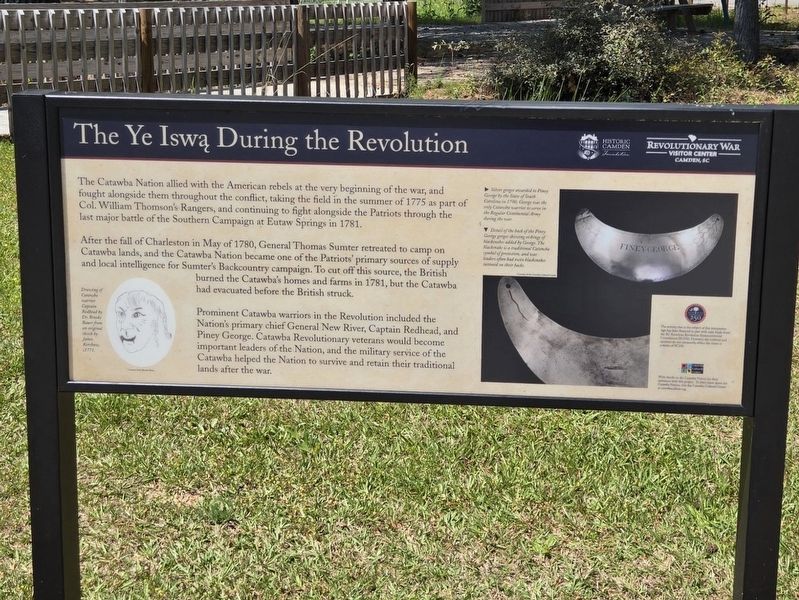
After the fall of Charleston in May of 1780, General Thomas Sumter retreated to camp on Catawba lands, and the Catawba Nation became one of the Patriots' primary sources of supply and local intelligence for Sumter's Backcountry campaign. To cut off this source, the British burned the Catawba's homes and farms in 1781, but the Catawba had evacuated before the British struck.
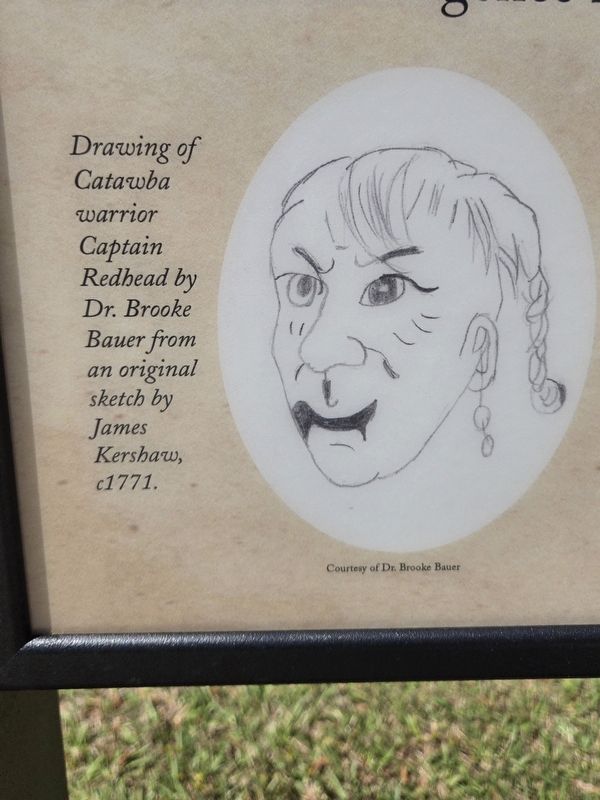
Prominent Catawba warriors in the Revolution included the Nation's primary chief General New River, Captain Redhead, and Piney George. Catawba Revolutionary veterans would become important leaders of the Nation, and the military service of the Catawba helped the Nation to survive and retain their traditional lands after the war.
Erected by Historic Camden Foundation / Revolutionary War Visitor Center.
this page online
Topics. This historical marker is listed in these topic lists: Indigenous Peoples and Communities • War, US Revolutionary. A significant historical year for this entry is 1775.
Location. 34° 13.963′ N, 80° 36.279′ W. Marker is in Camden, South Carolina, in Kershaw County. It can be reached from Broad Street (U.S. 521) 0.1 miles north of Ehreneclou Drive, on the right when traveling north. Located in the parking lot of the Revolutionary War Visitor Center. Touch for map. Marker is at or near this postal address: 212 Broad St, Camden SC 29020, United States of America. Touch for directions.

Regionally, this marker is in the Midlands and in the Olde English District. It is also in the American South and specifically in the Deep South. Globally, it is in North America, the Western Hemisphere, the Western World, and the Anglosphere. Historically, it finds itself in what was once the territory of the Mississippian Culture, one of the original Thirteen Colonies, one of the Confederate States of America, and the Antebellum South.
Other nearby markers. At least 8 other markers are within walking distance of this marker: Wateree Street
Photographed by Mark Parker, April 7, 2024
2. Closeup of Captain Redhead drawing
Drawing of Catawba warrior Captain Redhead by Dr. Brooke Bauer from an original sketch by James Kershaw, c1771.
Courtesy of Dr. Brooke Bauer
Courtesy of Dr. Brooke Bauer
Also see . . .
1. Revolutionary War Visitor Center at Camden. (Submitted on July 31, 2024.)
2. Historic Camden Foundation. (Submitted on July 31, 2024.)
Photographed by Mark Parker, April 7, 2024
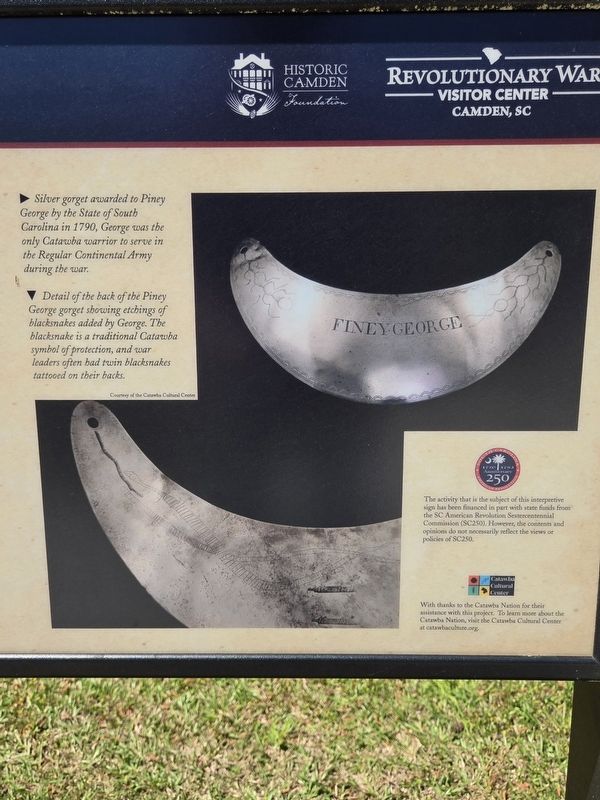
3. Closeup of silver gorget on the right side of the marker
(captions)
Silver gorget awarded to Piney George by the State of South Carolina in 1790, George was the only Catawba warrior to serve in the Regular Continental Army during the war.
Detail of the back of the Piney George gorget showing etchings of blacksnakes added by George. The blacksnake is a traditional Catawba symbol of protection, and war leaders often had twin blacksnakes tattooed on their backs.
Silver gorget awarded to Piney George by the State of South Carolina in 1790, George was the only Catawba warrior to serve in the Regular Continental Army during the war.
Detail of the back of the Piney George gorget showing etchings of blacksnakes added by George. The blacksnake is a traditional Catawba symbol of protection, and war leaders often had twin blacksnakes tattooed on their backs.
Photographed by Mark Parker, April 7, 2024
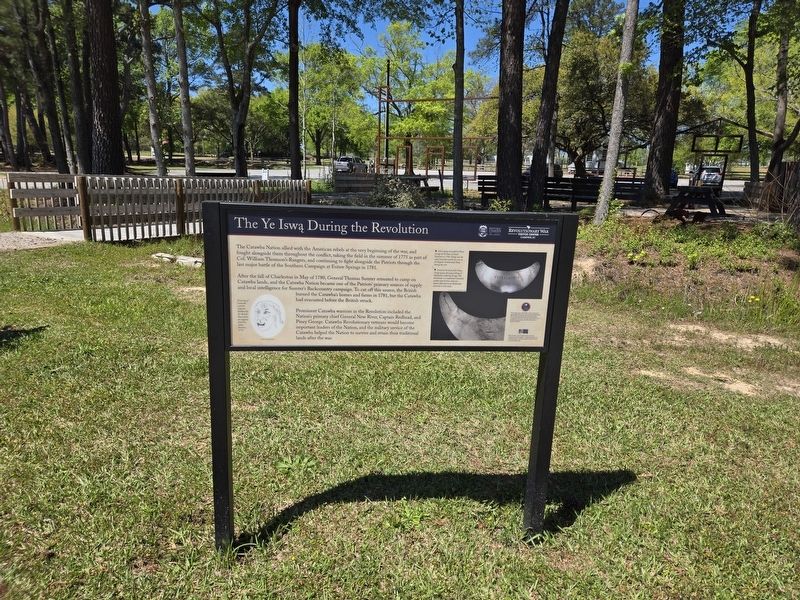
4. Wide view of The Ye Iswa During the Revolution Marker
Along the path between the two parking areas. Looking towards the parking lot to the north just off Historical Lane
Credits. This page was last revised on July 31, 2024. It was originally submitted on July 31, 2024, by Mark Parker of Hickory, North Carolina. This page has been viewed 470 times since then and 91 times this year. Photos: 1, 2, 3, 4. submitted on July 31, 2024, by Mark Parker of Hickory, North Carolina. • Bernard Fisher was the editor who published this page.
