Camden in Kershaw County, South Carolina — The American South (South Atlantic)
The Horse Is Our Great Safe Guard
Photographed by Mark Parker, April 7, 2024
1. The Horse Is Our Great Safeguard Marker
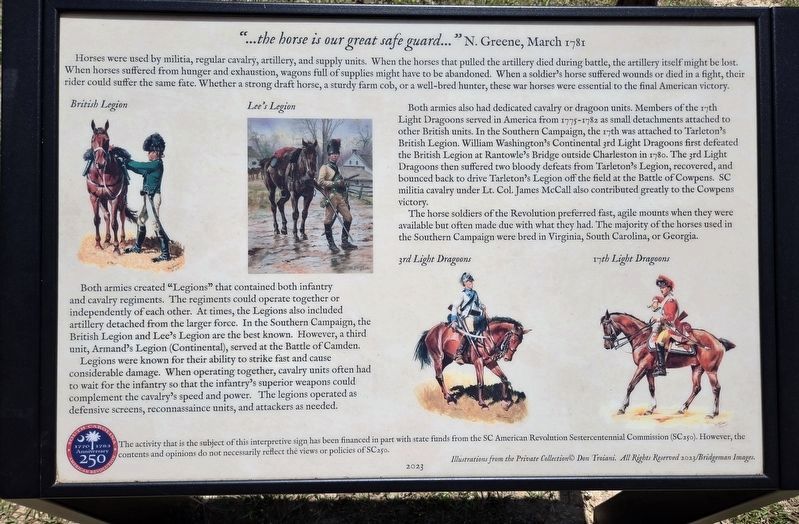
"…the horse is our great safe guard…" N. Greene March 1781
Horses were used by militia, regular cavalry, artillery, and supply units. When the horses that pulled the artillery died during battle, the artillery itself might be lost. When horses suffered from hunger and exhaustion, wagons full of supplies might have to be abandoned. When a soldier's horse suffered wounds or died in a fight, their rider could suffer the same fate. Whether a strong draft horse, a sturdy farm cob, or a well-bred hunter, these war horses were essential to the final American victory.
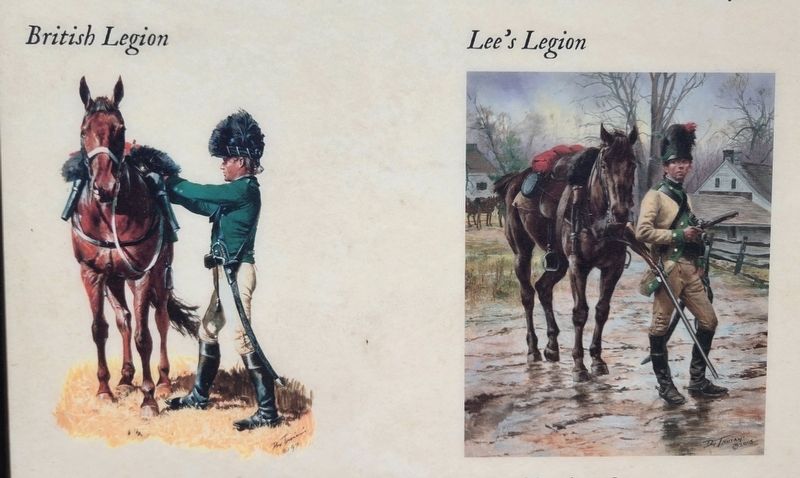
Both armies created "Legions" that contained both infantry and cavalry regiments. The regiments could operate together or independently of each other. At times, the Legions also included artillery detached from the larger force. In the Southern Campaign, the British Legion and Lee's Legion are the best known. However, a third unit, Armand's Legion (Continental), served at the Battle of Camden.
Legions were known for their ability to strike fast and cause considerable damage. When operating together, cavalry units often had to wait for the infantry so that
this page online
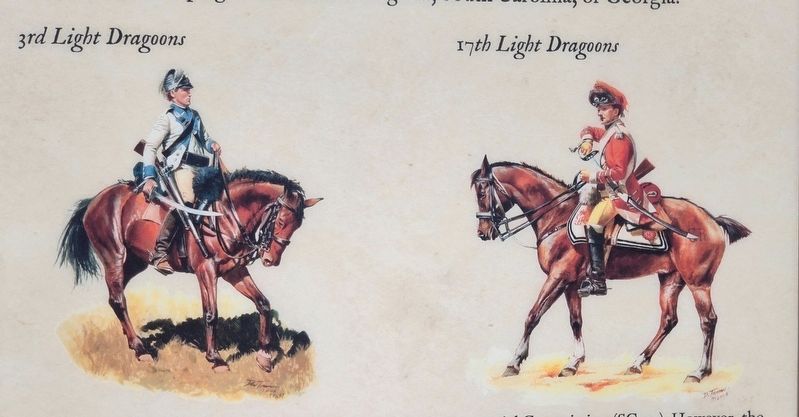
Both armies also had dedicated cavalry or dragoon units. Members of the 17th Light Dragoons served in America from 1775-1782 as small detachments attached to other British units. In the Southern Campaign, the 17th was attached to Tarleton's British Legion. William Washington's Continental 3rd Light Dragoons first defeated the British Legion at Rantowle's Bridge outside Charleston in 1780. The 3rd Light Dragoons then suffered two bloody defeats from Tarleton's Legion, recovered, and bounced back to drive Tarleton's Legion off the field at the Battle of Cowpens. SC. Militia cavalry under Lt. Col. James McCall also contributed greatly to the Cowpens victory.
The horse soldiers of the Revolution preferred fast, agile mounts when they were available but often made due with what they had. The majority of the horses used in the Southern Campaign were bred in Virginia, South Carolina, or Georgia.
Erected 2023 by SC American Revolution Sestercentennial Commission.
Photographed by Mark Parker, April 7, 2024
2. British Legion and Lee's Legion, Upper left of the marker
Iltustrations from the Private Collection Don Troiani. All Rights Reserved 2023/Bridgeman Images.
Topics. This historical marker is listed in these topic lists: Animals • Colonial Era • War, US Revolutionary. A significant historical year for this entry is 1780.
Location. 34° 13.931′ N, 80° 36.315′ W. Marker is in Camden, South Carolina, in Kershaw County. It can be reached from Broad Street (U.S. 521) near Ehrenclou Drive (Bypass U.S. 521), on the right when traveling north. Located on the south side of the Revolutionary War Visitors Center at Camden. Touch for map. Marker is at or near this postal address: 212 Broad St, Camden SC 29020, United States of America. Touch for directions.

Regionally, this marker is in the Midlands and in the Olde English District. It is also in the American South and specifically in the Deep South. Globally, it is in North America, the Western Hemisphere, the Western World, and the Anglosphere. Historically, it finds itself in what was once the territory of the Mississippian Culture, one of the original Thirteen Colonies, one of the Confederate States of America, and the Antebellum South.
Other nearby markers. At least 8 other markers are within walking distance of this marker:
Photographed by Mark Parker, April 7, 2024
3. Closeup of 3rd Light Dragoons and 17th Light Dragoons, far right of the marker
Ilustrations from the Private Collection Don Troiani. All Rights Reserved 2023/Bridgeman Images.
Also see . . . Revolutionary War Visitor Center at Camden. (Submitted on August 1, 2024.)
Photographed by Mark Parker, April 7, 2024
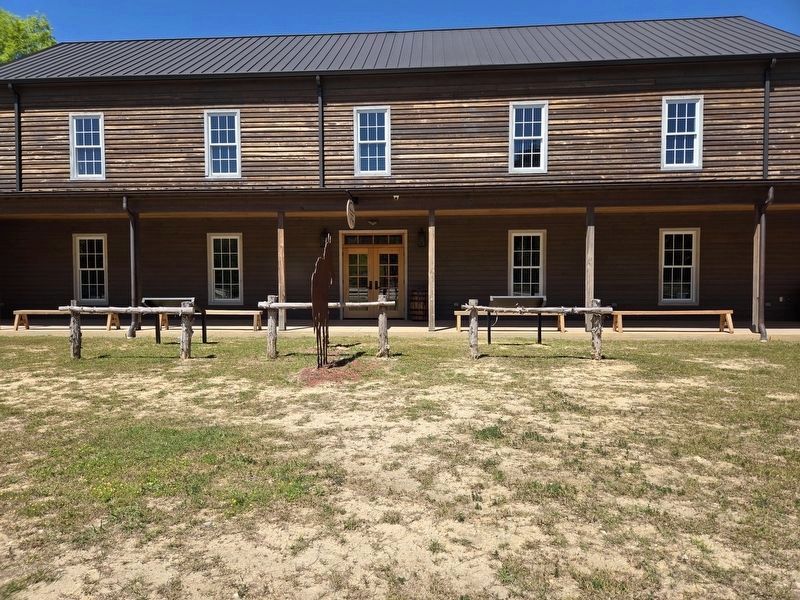
4. Entrance to Exhibit Hall at the visitor center. Subject marker is on the left.
Credits. This page was last revised on August 1, 2024. It was originally submitted on August 1, 2024, by Mark Parker of Hickory, North Carolina. This page has been viewed 154 times since then and 20 times this year. Photos: 1, 2, 3, 4. submitted on August 1, 2024, by Mark Parker of Hickory, North Carolina. • Bernard Fisher was the editor who published this page.
