Bowling Green in Wood County, Ohio — The American Midwest (Great Lakes)
Historic Main Street
Photographed by Craig Doda, July 21, 2024
1. Historic Main Street Marker
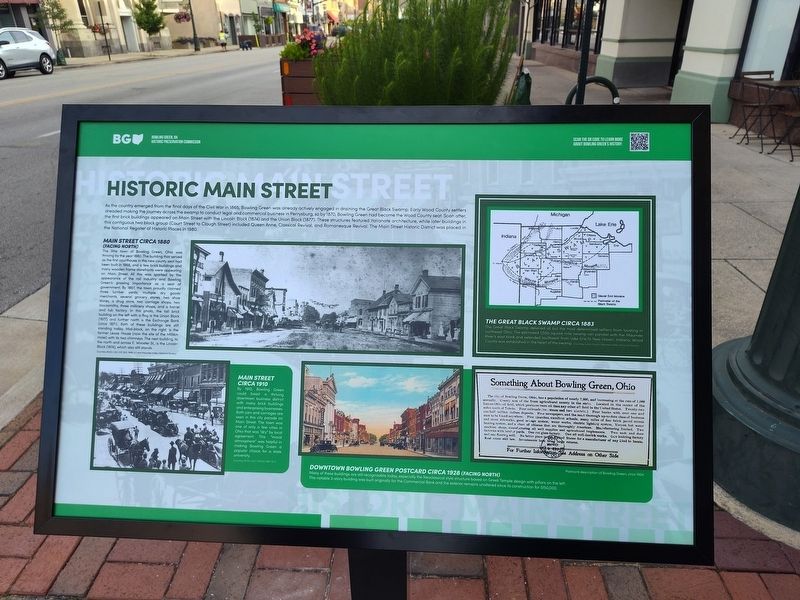
As the country emerged from the final days of the Civil War in 1865, Bowling Green was already actively engaged in draining the Great Black Swamp. Early Wood County settlers dreaded making the journey across the swamp to conduct legal and commercial business in Perrysburg, so by 1870, Bowling Green had become the Wood County seat. Soon after, the first brick buildings appeared on Main Street with the Lincoln Block (1874) and the Union Block (1877). These structures featured Italianate architecture, while later buildings in this contiguous two block group (Court Street to Clough Street) included Queen Anne, Classical Revival, and Romanesque Revival. The Main Street Historic District was placed in the National Register of Historic Places in 1980.
Main Street Circa 1880 (Facing North)
The little town of Bowling Green, Ohio was thriving by the year 1880. The building that served as the first courthouse in the new county seat had been built in 1868, and a few brick buildings and many wooden frame storefronts were appearing on Main Street. All this was sparked by the appearance of the rail industry and Bowling Green's growing
this page online
Main Street Circa 1910
By 1910, Bowling Green could boast a thriving downtown business district with many brick buildings and enterprising businesses. Both cars and carriages are seen in this city parade on Main Street. The town was one of only a few cities in Ohio that was "dry" by local agreement. This "moral atmosphere was helpful in making Bowling Green a popular choice for a state university.
The Great Black Swamp Circa 1883
The Great Black Swamp deterred
Photographed by Craig Doda, July 21, 2024
2. Historic Main Street Marker
Downtown Bowling Green Postcard Circa 1928 (Facing North)
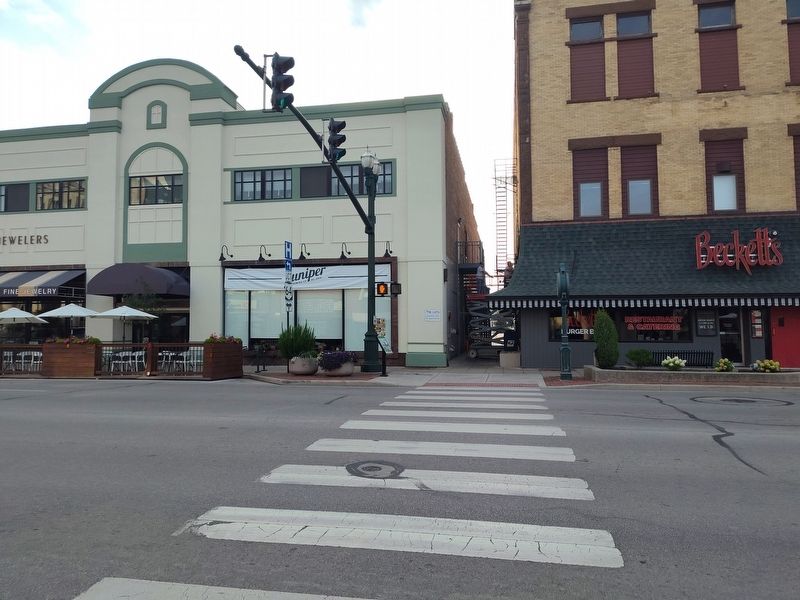
Many of these buildings are still recognizable today, especially the Neoclassical style structure based on Greek Temple design with pillars on the left. This notable 3-story building was built originally for the Commercial Bank and the exterior remains unaltered since its construction for $150,000.
Topics. This historical marker is listed in these topic lists: Industry & Commerce • Roads & Vehicles. A significant historical year for this entry is 1865.
Location. 41° 22.438′ N, 83° 39.032′ W. Marker is in Bowling Green, Ohio, in Wood County. It is on South Main Street 0.1 miles south of West Wooster Street, on the right when traveling south. Touch for map. Marker is at or near this postal address: 145 S Main St, Bowling Green OH 43402, United States of America. Touch for directions.

Regionally, this marker is in the Black Swamp, in the Till Plains, and in the Toledo Metropolitan Area. It is also in the American Midwest and in the Corn Belt. Globally, it is in North America, on the Great Lakes, in the Western Hemisphere, in the Western World, and in the Anglosphere. Historically, it finds itself in what was once the Haudenosaunee (Iroquois) Confederacy, the territory of the Mississippian Culture, and the Northwest Territory.
Other nearby markers. At least 8 other markers are within walking distance of this marker: The Main Street Historic District (here, next to this marker); The Changing Face of South Main (a few steps from this marker); The Great Black Swamp (within shouting distance of this marker); Commerce & Finance In Old Bowling Green (within shouting distance of this marker); The Four Corners (about 300 feet away, measured in a direct line); Bowling Green's Interurban & Rail Line (about 300 feet away); Exchange Bank (about 400 feet away); Wiley Post No. 46 (about 400 feet away). Touch for a list and map of all markers in Bowling Green.
Credits. This page was last revised on August 1, 2024. It was originally submitted on August 1, 2024, by Craig Doda of Napoleon, Ohio. This page has been viewed 237 times since then and 36 times this year. Photos: 1, 2. submitted on August 1, 2024, by Craig Doda of Napoleon, Ohio. • Devry Becker Jones was the editor who published this page.
