Camden in Kershaw County, South Carolina — The American South (South Atlantic)
"…the protection of the Country greatly depends upon… a superiour Cavalry"
N. Greene, February 1781
Photographed by Mark Parker, April 7, 2024
1. "…the protection of the Country greatly depends upon… a superiour Cavalry" Marker
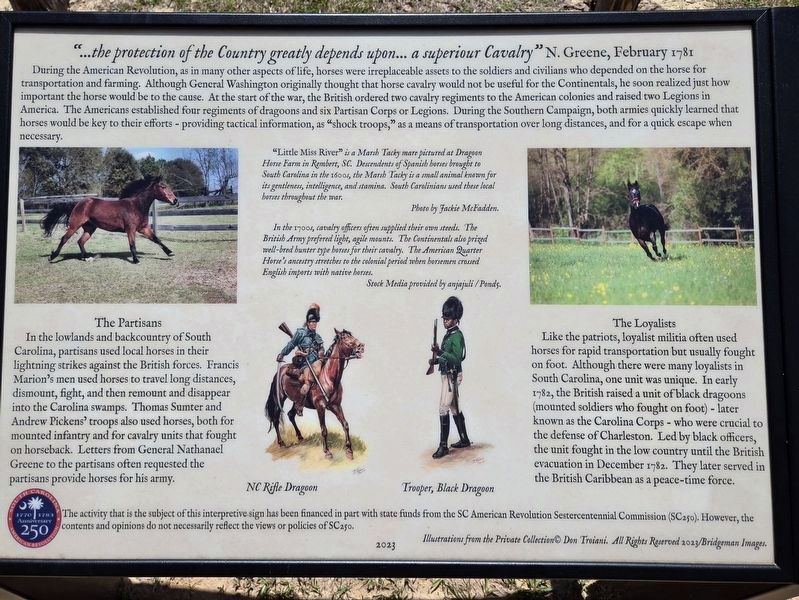
During the American Revolution, as in many other aspects of life, horses were irreplaceable assets to the soldiers and civilians who depended on the horse for transportation and farming. Although General Washington originally thought that horse cavalry would not be useful for the Continentals, he soon realized just how important the horse would be to the cause. At the start of the war, the British ordered two cavalry regiments to the American colonies and raised two Legions in America. The Americans established four regiments of dragoons and six Partisan Corps or Legions. During the Southern Campaign, both armies quickly learned that horses would be key to their efforts - providing tactical information, as "shock troops," as a means of transportation over long distances, and for a quick escape when necessary.
The Partisans
In the lowlands and backcountry of South Carolina, partisans used local horses in their lightning strikes against the British forces. Francis Marion's men used horses to travel long distances, dismount, fight, and then remount and disappear into the Carolina swamps. Thomas Sumter and Andrew Pickens'
this page online
The Loyalists
Like the patriots, loyalist militia often used horses for rapid transportation but usually fought on foot. Although there were many loyalists in South Carolina, one unit was unique. In early 1782, the British raised a unit of black dragoons (mounted soldiers who fought on foot) - later known as the Carolina Corps - who were crucial to the defense of Charleston. Led by black officers, the unit fought in the low country until the British evacuation in December 1782. They later served in the British Caribbean as a peace-time force.
(captions)
"Little Miss River" is a Marsh Tacky mare pictured at Dragoon Horse Farm in Rembert, SC. Descendants of Spanish horses brought to South Carolina in the 1600s. The Marsh Tacky is a small animal known for its gentleness, intelligence, and stamina. South Carolinians used these local horses throughout the war. Photo by Jackie McFadden.
In the 1700s, cavalry officers often supplied their own steeds. The British Army preferred light, agile mounts. The Continentals also prized well-bred hunter type horses for their cavalry. The American Quarter Horse's ancestry stretches to the colonial period when horsemen crossed English imports with native horses. Stock Media provided by anjajuli/Ponds.
Erected 2023
Photographed by Devry Becker Jones (CC0), January 15, 2026
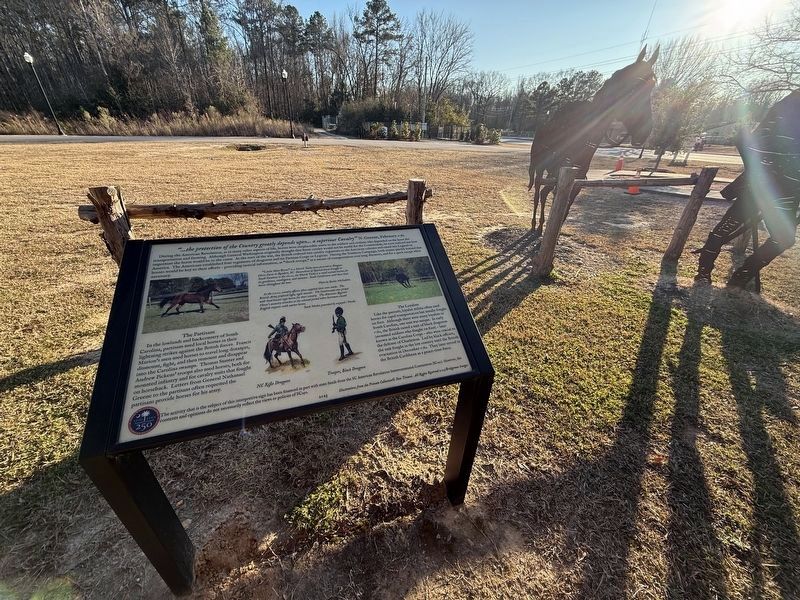
2. "…the protection of the Country greatly depends upon… a superiour Cavalry" Marker
Topics. This historical marker is listed in these topic lists: Animals • Colonial Era • War, US Revolutionary. A significant historical month for this entry is December 1782.
Location. 34° 13.932′ N, 80° 36.312′ W. Marker is in Camden, South Carolina, in Kershaw County. It can be reached from Broad Street (U.S. 521) 0.1 miles Ehrenclou Drive (Bypass U.S. 521), on the right when traveling north. Located on the south side of the Revolutionary War Visitors Center at Camden. Touch for map. Marker is at or near this postal address: 212 Broad St, Camden SC 29020, United States of America. Touch for directions.

Regionally, this marker is in the Midlands and in the Olde English District. It is also in the American South and specifically in the Deep South. Globally, it is in North America, the Western Hemisphere, the Western World, and the Anglosphere. Historically, it finds itself in what was once the territory of the Mississippian Culture, one of the original Thirteen Colonies, one of the Confederate States of America, and the Antebellum South.
Other nearby markers. At least
Photographed by Mark Parker, April 7, 2024
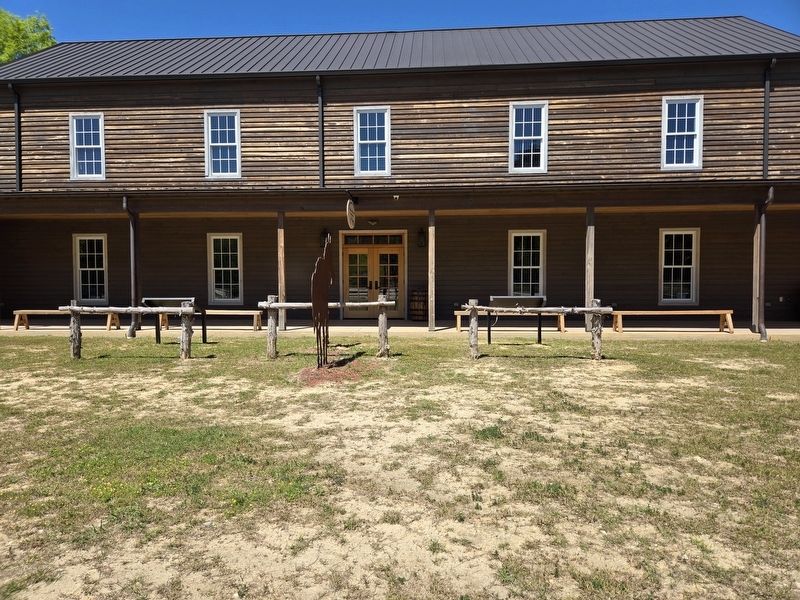
3. Entrance to Exhibit Hall at the visitor center. Subject marker is on the right.
Also see . . . Revolutionary War Visitor Center at Camden. (Submitted on August 2, 2024.)
Credits. This page was last revised on January 19, 2026. It was originally submitted on August 1, 2024, by Mark Parker of Hickory, North Carolina. This page has been viewed 171 times since then and 45 times this year. Photos: 1. submitted on August 1, 2024, by Mark Parker of Hickory, North Carolina. 2. submitted on January 19, 2026, by Devry Becker Jones of Washington, District of Columbia. 3. submitted on August 1, 2024, by Mark Parker of Hickory, North Carolina. • Bernard Fisher was the editor who published this page.
