Roundup in Musselshell County, Montana — The American West (Mountains)
Teddy Blue Abbott Crossing the Musselshell

Photographed by Cosmos Mariner, July 2, 2024
1. Teddy Blue Abbott Crossing the Musselshell Marker
Erected 2022 by Main Street Sculpture
this page online
Topics. This historical marker is listed in these topic lists: Agriculture • Arts, Letters, Music • Industry & Commerce • Settlements & Settlers. A significant historical year for this entry is 1883.
Location. 46° 26.761′ N, 108° 32.505′ W. Marker is in Roundup, Montana, in Musselshell County. It is on Main Street (U.S. 12/87) just north of 5th Avenue East, on the right when traveling north. The marker and sculpture are located at the southwest corner of the Musselshell County Courthouse grounds. Touch for map. Marker is at or near this postal address: 506 Main Street, Roundup MT 59072, United States of America. Touch for directions.

Regionally, this marker is in the American Mountain West, in the Lewis & Clark Corridor, on the Great Plains, and specifically on the Northern Plains. Globally, it is in North America, the Western Hemisphere, the Western World, and the Anglosphere. Historically, it finds itself in what was once Rupert’s Land and also the Louisiana Purchase.
Other nearby markers. At least 3 other markers are within 2 miles of this marker, measured as the crow flies: The Great Montana Cattle Drive
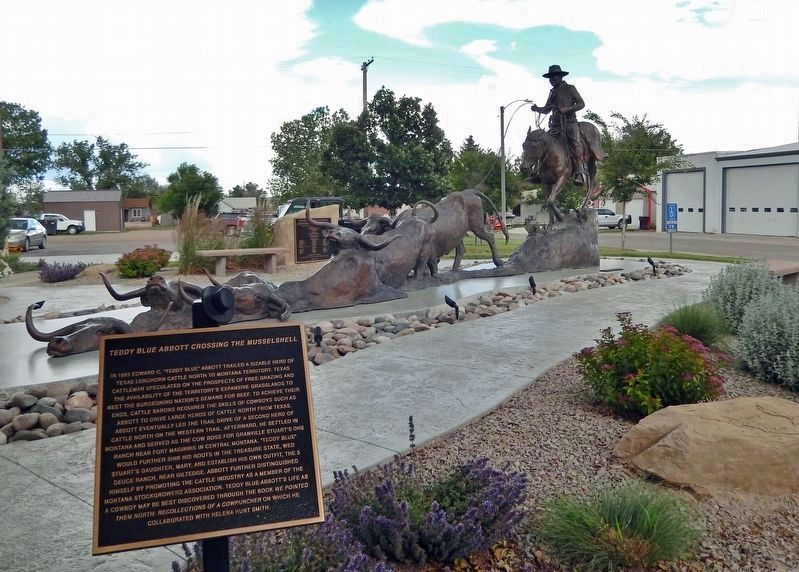
Photographed by Cosmos Mariner, July 2, 2024
2. Teddy Blue Abbott Crossing the Musselshell Marker
Looking southeast from Main Street; the life-sized bronze sculpture is in the background.
Also see . . .
1. New statue in Roundup brings the old west to Main Street. Billings Gazette website entry (Submitted on May 24, 2026, by Larry Gertner of New York, New York.)
2. Edward Charles “Teddy Blue” Abbott (Find A Grave). Excerpt:
(Fort Maginnis Cemetery, Giltedge, Fergus County, Montana, USA) Edward Charles "Teddy Blue" Abbott was born December 17, 1860, in Cranwich Hall, Norfolk County, England. In 1871, he came to the United States with his father, J.B. Abbott. They went to Texas, eventually purchased a cattle herd, and drove it north to Nebraska. Teddy Blue settled with his family at the end of the Texas cattle trail near Lincoln, Nebraska. In 1883, he entered Montana with a herd of longhorns, and two years later, signed on with the DHS Ranch at Fort Maginnis. He became engaged to Mary Stuart, daughter of one of his employers, Granville Stuart. The couple married on September 29, 1889, and settled on the 3 Deuce Ranch at Giltedge. They had ten children.(Submitted on August 2, 2024, by Cosmos Mariner of Cape Canaveral, Florida.)Teddy Blue Abbott was a longtime member of the Montana Stockgrowers Association, he served six years on the Montana Stock Commission for Fergus County, thirty years as a member of the Democratic Central Committee, and sixteen years as a school trustee, and, in 1924, he was an unsuccessful candidate for the state legislature. In 1938, Abbott collaborated with Helena Huntington Smith on his autobiography "We Pointed Them North," the story of his years as a cowpuncher on the Texas cattle drives and his experiences on Montana's open range in the 1880s. Teddy Blue Abbott died of pneumonia April 7, 1939, days after the book was published.Photographed by Cosmos Mariner, July 2, 20243. Teddy Blue Abbott Crossing the Musselshell MonumentA gift to the past and present residents of the Musselshell Valley and our beloved state of Montana from artist Greg Eiselein, his family, and the generous donors to this monument.
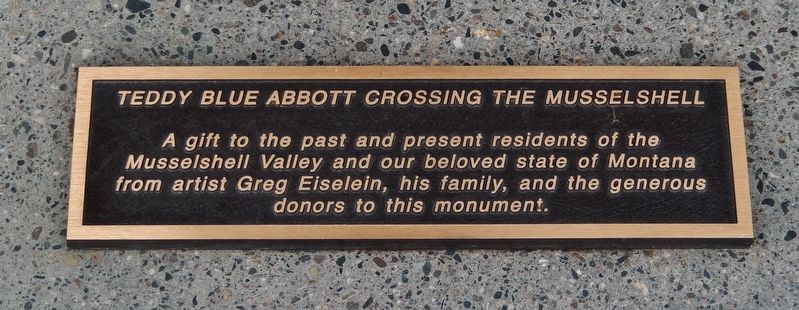
3. E.C. "Teddy Blue" Abbott (1860-1939) (Montana Cowboy Hall of Fame). Excerpt:
By the time Teddy Blue came on the scene, the Texas trail had been in existence nearly four years with a steady stream of cattle herds moving northward. Lincoln, Nebraska was at that time the northern end of the trail, as there were no ranches beyond that point. Cattle were abundant in Texas after the Civil War. They had increased in numbers(Submitted on August 2, 2024, by Cosmos Mariner of Cape Canaveral, Florida.)significantly and ran wild while men were away from their homes fighting for the Confederacy, especially along the Nueces River and the Rio Grande area. Cattle were down to $4 a head - if one could find a buyer. Longhorn cattle were overrunning Texas while the rest of the country was hungry for beef and for this reason cowboys began trailing them across hundreds of miles of wild country. Teddy Blue and his father went by train to New Orleans, then by boat to Texas, to partake in the cattle drives. Teddy Blue made his first trip up the trail at 11 years of age. The cattle were received near Red River and Teddy Blue fell in love with the cowboy way of life.Photographed by Cosmos Mariner, July 2, 20244. Teddy Blue Abbott Crossing the Musselshell MonumentLooking northeast; the Musselshell County Courthouse is in the background.

4. Teddy Blue Abbott Crossing the Musselshell. Excerpt:
In 1833 Edward hired on as a drover trailing longhorns to Montana. The cattle drive ended in Miles City. It was in this eastern Montana town that he was nicknamed Teddy Blue after consuming alcohol in large quantities. In his pursuit of a young lady backstage of a vaudeville theater the curtain suddenly lifted. Lacking sobriety he grabbed(Submitted on August 2, 2024, by Cosmos Mariner of Cape Canaveral, Florida.)a chair and "rode" it across the stage calling, "Whoa Blue!" A gray horse is often called blue. His friends thereafter addressed him as Teddy Blue. Abbott made numerous cattle drives from Texas headed North. Finding northern markets young cowpunchers rounded these cattle up and trailed them north where there was a need in the gold fields to feed the miners and to supply the Army and Indians on the reservations with meat.Photographed by Cosmos Mariner, July 2, 20245. Teddy Blue Abbott Crossing the Musselshell MonumentLooking southwest from the Musselshell County Courthouse.

5. Local Artist Dedicates Life Size Monument in Roundup on July 3rd, 2022. Excerpt:
A dedication of the life size monument “Teddy Blue Abbott-Crossing the Musselshell” will take place July 3rd at 3 p.m. on site in front of the Musselshell County courthouse in Roundup, MT. The sculpture, a work in progress for the past 2 years, is a gift to the community by local artist Greg Eiselein. The ceremony will reference the inspiration behind the project, the historical importance of Teddy Blue to local history and will acknowledge and thank financial donors and in-kind work that has helped make possible the completion of various stages of this project.(Submitted on August 2, 2024, by Cosmos Mariner of Cape Canaveral, Florida.)
Credits. This page was last revised on May 24, 2026. It was originally submitted on August 1, 2024, by Cosmos Mariner of Cape Canaveral, Florida. This page has been viewed 1,090 times since then and 159 times this year. Photos: 1, 2, 3, 4, 5. submitted on August 2, 2024, by Cosmos Mariner of Cape Canaveral, Florida.
