Sumter in Sumter County, South Carolina — The American South (South Atlantic)
Potter's Raid
April 8-21, 1865
Photographed by Mark Parker, April 6, 2024
1. Potter's Raid Marker
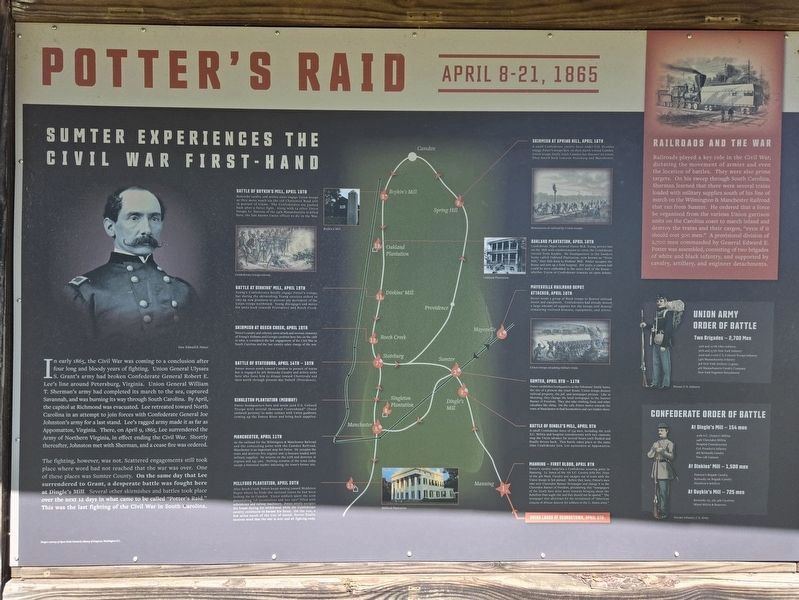
In early 1865, the Civil War was coming to a conclusion after four long and bloody years of fighting. Union General Ulysses S. Grant's army had broken Confederate General Robert E. Lee's line around Petersburg, Virginia. Union General William T. Sherman's army had completed its march to the sea, captured Savannah, and was burning its way through South. By April, the capitol at Richmond was evacuated. Lee retreated toward North Carolina in an attempt to join forces with Confederate General Joe Johnston's army for a last stand. Lee's ragged army made it as far as Appomattox, Virginia. There, on April 9, 1865, Lee surrendered the Army of Northern Virginia, in effect ending the Civil War. Shortly thereafter, Johnston met with Sherman, and a cease fire was ordered.
The fighting, however, was not. Scattered engagements took place where word had not reached that the war was over. One of these places was Sumter County. On the same day that Lee surrendered to Grant, a desperate battle was fought here at Dingle's Mill. Several other skirmishes and battles took place over the next
this page online
Battle of Boykin's Mill, April 18th
Kentucky cavalry and militia units engage Union troops as they move south via the old Charleston Road still in pursuit of trains. The Confederates are pushed back after a fierce fight. Along with 14 other Union troops, Lt. Stevens of the 54th Massachusetts is killed here, the last known Union officer to die in the War.
Battle at Dinkins' Mill, April 19th
Young's Confederates briefly engage Potter's troops, but during the skirmishing Young receives orders to take up new positions to prevent any movement of the Union troops northward. Young disengages and moves his units back towards Providence and Beech Creek.
Skirmish at Beech Creek, April 19th
Potter's cavalry and infantry units attack and overrun elements of Young's Alabama and Georgia cavalries here late on the 19th in what is considered the last engagement of the Civil War in South Carolina and the last cavalry saber charge of the war.
Battle of Stateburg, April 14th-15th
Potter moves north toward Camden in pursuit of trains but is engaged by 9th Kentucky Cavalry and militia units here who force him to detour toward Cherryvale and then north through present-day Dalzell (Providence).
Singleton Plantation (Midway)
Potter headquarters here and sends 32nd U.S. Colored Troops with several thousand "contraband" (freed enslaved persons) to make contact with Union gunboats coming up the Santee River and bring back supplies.
Manchester, April 11th
As the railhead for the Wilmington & Manchester Railroad and the connecting point with the Camden Railroad, Manchester is an important stop for Potter, He occupies the town and destroys five engines and 13 boxcars loaded with military supplies. He returns on the 20th and destroys 16 engines and 245 cars. Nothing remains of the town today except a historical marker indicating the town's former site.
Milford Plantation, April 20th
After Beech Creek, Potter keeps moving toward Middleton Depot where he finds the railroad trains he had been looking for in Camden. Union soldiers spent the 20th demolishing "18 locomotives and 200 cars" filled with subsistence and railway machinery. Potter briefly occupies the house during his withdrawal while the Confederate cavalry continues to harass his force. On the 21st, a few miles south of the line of march, Potter finally receives word that the war is over and all fighting ends.
Skirmish at Spring Hill, April 16th
A small Confederate cavalry force under Col. Pressley engage Potter's troops here on their march toward Camden. Union troops finally reach Camden but discover no trains. They march back towards Stateburg and Manchester.
Oakland Plantation, April 18th
Confederate Major General Pierce M.B. Young arrives late on the 18th with reinforcements to cover the Confederate retreat from Boykin. He headquarters in the Sanders home called Oakland Plantation, now known as "Dixie Hall", then falls back to Dinkins' Mill. Potter occupies the house and sets up a field hospital. For years, a cannon ball could be seen embedded in the outer wall of the house - whether Union or Confederate remains an open debate.
Marysville Railroad Depot Attacked, April 10th
Potter sends a group of Black troops to destroy railroad stores and equipment. Confederates had already moved a large amount of supplies but the troops still destroy remaining railroad boxcars, equipment, and stores.
Sumter April 9th-11th
Potter establishes headquarters in the Solomons' family home, the site of a present-day court house. Union troops destroy railroad property, the jail, and newspaper presses. Like in Manning, they change the local newspaper to the Sumter Banner of Freedom. They also take clothing, food, and other valuables like china. On the 11th, Potter moves towards the town of Manchester to find locomotives and cars hidden there.
Battle of Dingle's Mill, April 9th
A small Confederate force of 154 men, including the 20th S.C. Militia and hospital convalescents with two cannons, stop the Union advance for several hours until flanked and finally driven back. This battle takes place at the same time Confederate Gen. Lee surrenders at Appomattox.
Manning-First Blood, April 8th
Potter's cavalry surprises a Confederate scouting party in Manning. Lt. Jones of the 7th S.C. Cavalry kills Pvt. Pratt of the 4th Mass. Cavalry and escapes out of town with the Union troops in hot pursuit. Before they leave, Potter's men take over Clarendon Banner Newspaper and change it to the Clarendon Banner of Freedom, proclaiming that "newspapers of the South have done more towards bringing about the Rebellion than aught else and they should not be spared." The newspaper also advertises for the recruitment of "American citizens of African descent for soldiers in the U. States army.
Union Lands at Georgetown, April 5th
(sidebar)
Railroads and the War
Railroads played a key role in the Civil War, dictating the movement of armies and even the location of battles. They were also prime targets. On his sweep through South Carolina, Sherman learned that there were several trains loaded with military supplies south of his line of march on the Wilmington & Manchester Railroad that ran from Sumter. He ordered that a force be organized from the various Union garrison units on the Carolina coast to march inland and destroy the trains and their cargos, "even if it should cost 500 men." A provisional division of 2,700 men commanded by General Edward E. Potter was assembled, consisting of two brigades of white and black infantry, and supported by cavalry, artillery, and engineer detachments.
Union Army Order of Battle
Two Brigades - 2,700 Men
25th and 107th Ohio Infantry
56th and 157th New York Infantry
32nd and 102nd U.S.Colored Troops Infantry
54th Massachusetts Infantry
3rd New York Artillery (2 guns)
4th Massachusetts Cavalry Company
New York Engineer Detachment
Confederate Order of Battle
At Dingle's Mill- 154 men
20th S.C. (Sumter) Militia
44th Clarendon Militia
Hospital Convalescents
Col. Pressley's Infantry
9th Nentucky Cavalry
Two 12 lb. Cannon
At Dinkins' Mill- 1,500 men
Hannon's Brigade Cavalry
Kentucky 1st Brigade Cavalry
Hamilton's Artillery
At Boykin's Mill-725 men
Kentucky 1st, 5th, 9th Cavalries
Mixed Militia & Reserves
(captions)
General Edward E. Potter
Confederate troops retreat
Boykin's Mill
Millford Plantation
Oakland Plantation
Destruction of railroad by Union troops
Union troops attacking military train
Private U.S. Infantry
Private Infantry, C.S. Army
Images courtesy of Open Parks Network: Library of Congress, Washington, D.C.
Topics. This historical marker is listed in this topic list: War, US Civil. A significant historical date for this entry is April 9, 1865.
Location. 33° 52.579′ N, 80° 20.161′ W. Marker is in Sumter, South Carolina, in Sumter County. It can be reached from the intersection of Manning Road (U.S. 521) and South Guinard Parkway (U.S. 521), on the right when traveling south. Located at the Battle of Dingle's Mill Battleground, Historic Civil War Site. Touch for map. Marker is at or near this postal address: 1400 Manning Rd, Sumter SC 29150, United States of America. Touch for directions.

Regionally, this marker is in South Carolina’s Pee Dee. It is also in the American South and specifically in the Deep South. Globally, it is in North America, the Western Hemisphere, the Western World, and the Anglosphere. Historically, it finds itself in what was once the territory of the Mississippian Culture, one of the original Thirteen Colonies, one of the Confederate States of America, and the Antebellum South.
Other nearby markers. At least 8 other markers are within 3 miles of this marker, measured as the crow flies: Battle of Dingle's Mill (here, next to this marker); a different marker also named Battle of Dingle's Mill (within shouting distance of this marker); a different marker also named Battle of Dingles Mill (within shouting distance of this marker); Site of The Battle of Dingle's Mill (within shouting distance of this marker); Henry J. Maxwell Farm (approx. 1.2 miles away); Jehovah Baptist Church (approx. 2.1 miles away); Kendall Institute (approx. 2½ miles away); First Baptist Church (approx. 2.7 miles away). Touch for a list and map of all markers in Sumter.
Credits. This page was last revised on November 2, 2024. It was originally submitted on August 1, 2024, by Mark Parker of Hickory, North Carolina. This page has been viewed 1,212 times since then and 172 times this year. Photo 1. submitted on August 1, 2024, by Mark Parker of Hickory, North Carolina. • Bernard Fisher was the editor who published this page.
