Port Stanley in Elgin County, Ontario — Central Canada (North America)
Bridges
Photographed by Tim Boyd, July 27, 2024
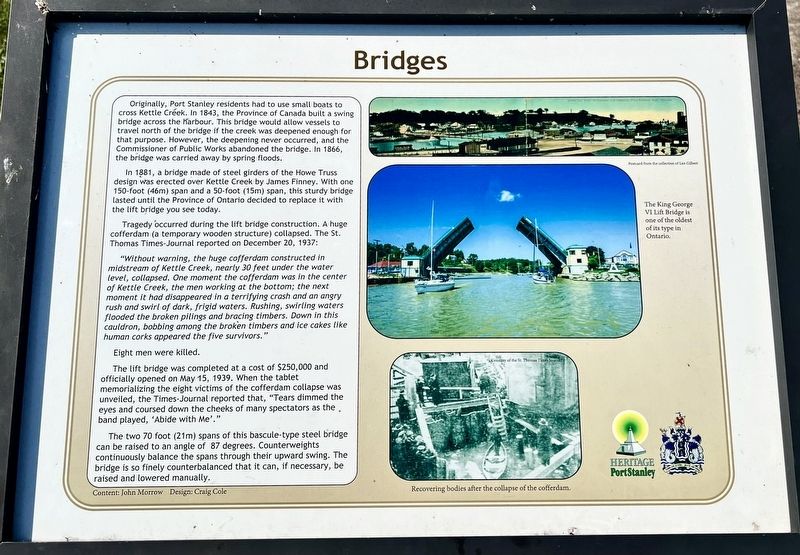
1. Bridges Marker
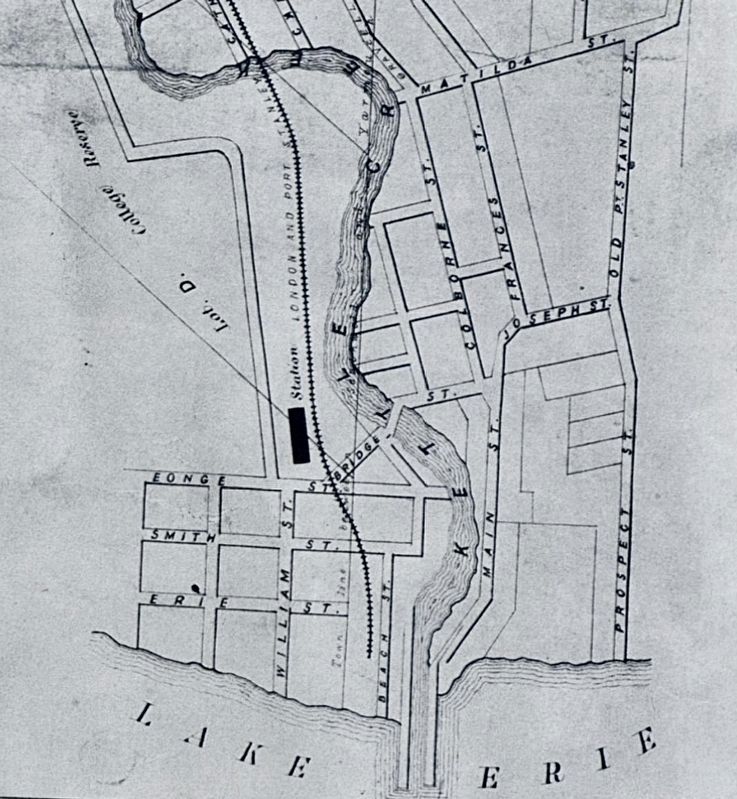
Originally, Port Stanley residents had to use small boats to cross Kettle Creek. In 1843, the Province of Canada built a swing bridge across the Harbour. This bridge would allow vessels to travel north of the bridge if the creek was deepened enough for that purpose. However, the deepening never occurred, and the Commissioner of Public Works abandoned the bridge. In 1866, the bridge was carried away by spring floods.
In 1881, a bridge made of steel girders of the Howe Truss design was erected over Kettle Creek by James Finney. With one 150-foot (46m) span and a 50-foot (15m) span, this sturdy bridge lasted until the Province of Ontario decided to replace it with the lift bridge you see today.
Tragedy occurred during the lift bridge construction. A huge cofferdam (a temporary wooden structure) collapsed. The St. Thomas Times-Journal reported on December 20, 1937:
"Without warning, the huge cofferdam constructed in midstream of Kettle Creek, nearly 30 feet under the water level, collapsed. One moment the cofferdam was in the center of Kettle Creek, the men working at the bottom; the next moment it had disappeared in a terrifying crash and an angry rush and swirl of dark, frigid waters. Rushing, swirling waters flooded the broken pilings and bracing timbers. Down in this cauldron, bobbing among the broken timbers and ice cakes like human corks appeared the five survivors."
Eight
this page online
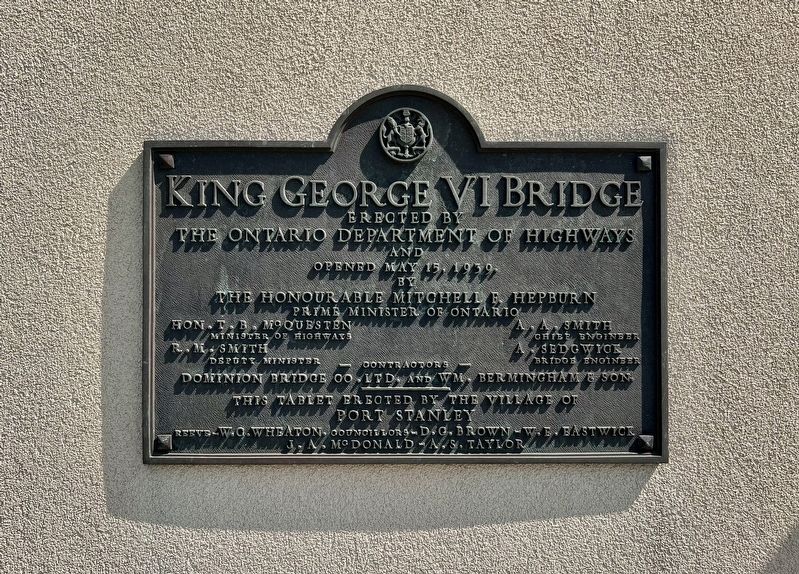
The lift bridge was completed at a cost of $250,000 and officially opened on May 15, 1939. When the tablet memorializing the eight victims of the cofferdam collapse was unveiled, the Times-Journal reported that, "Tears dimmed the eyes and coursed down the cheeks of many spectators as the band played, 'Abide with Me'."
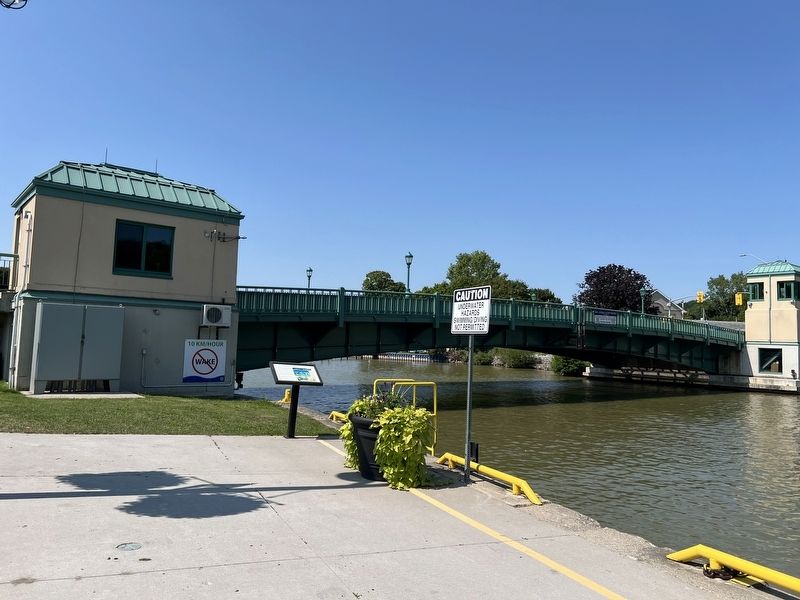
The two 70 foot (21m) spans of this bascule-type steel bridge can be raised to an angle of 87 degrees. Counterweights continuously balance the spans through their upward swing. The bridge is so finely counterbalanced that it can, if necessary, be raised and lowered manually.
Topics. This historical marker is listed in these topic lists: Bridges & Viaducts • Disasters • Waterways & Vessels. A significant historical year for this entry is 1843.
Location. 42° 39.894′ N, 81° 12.843′ W. Marker is in Port Stanley, Ontario, in Elgin County. It is at the intersection of Bridge Street (County Road 4) and Carlow Road, on the right when traveling east on Bridge Street (County Road 4). Touch for map. Marker is at or near this postal address: 308 County Rd 4, Port Stanley ON N5L N5L, Canada. Touch for directions.

Regionally,
Photographed by Tim Boyd, July 27, 2024
2. Bridges Marker
Other nearby markers. At least 8 other markers are within 11 kilometers of this marker, measured as the crow flies: The London and Port Stanley Railroad / Le Chemin de Fer London and Port Stanley (within shouting distance of this marker); Commemoration of Port Stanley Harbour (within shouting distance of this marker); The Telegraph Office and the Traction Line (within shouting distance of this marker); Port Stanley (about 210 meters away, measured in a direct line); Lieut.-Col. John Bostwick (approx. 0.6 kilometers away); Col. John Bostwick (approx. 0.6 kilometers away); RCAF Technical Training School / L’École de Formation de L’Aviation Royale du Canada (approx. 8.4 kilometers away); RCAF No. 4 Bombing and Gunnery School (approx. 10.1 kilometers
Photographed by Tim Boyd, July 27, 2024
3. The King George VI Bridge dedication plaque
1864
4. Port Stanley, 1864, showing the first bridge over Kettle Creek
Credits. This page was last revised on August 4, 2024. It was originally submitted on August 2, 2024, by Tim Boyd of Hamilton, Ontario. This page has been viewed 365 times since then and 81 times this year. Photos: 1, 2, 3, 4. submitted on August 2, 2024, by Tim Boyd of Hamilton, Ontario. • Andrew Ruppenstein was the editor who published this page.
