White Sands in Doña Ana County, New Mexico — The American Mountains (Southwest)
Nike Ajax
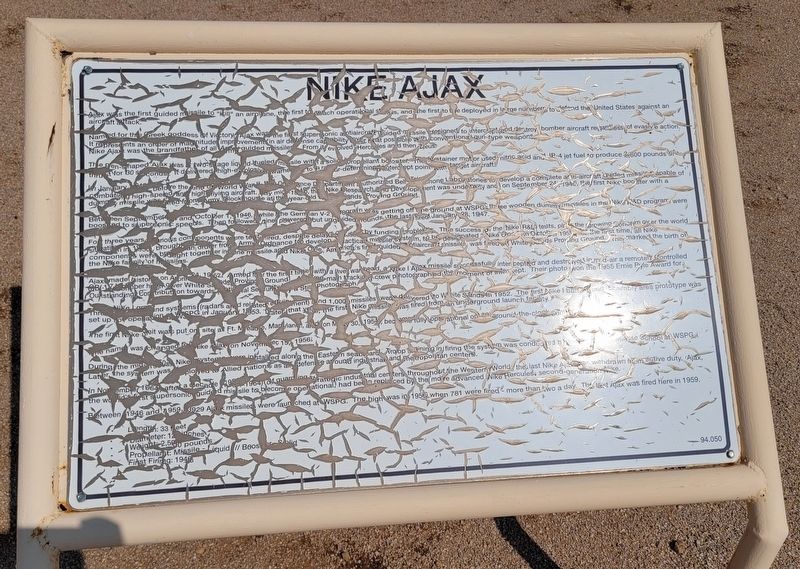
Photographed by James Hulse, July 23, 2024
1. Nike Ajax Marker
Named for the Greek goddess of Victory, Ajax was the first supersonic antiaircraft guided missile designed to intercept and destroy bomber aircraft regardless of evasive action. It represents an order of magnitude improvement in air defense capability over that possible with conventional gun-type weapons. Nike Ajax was the grandfather of all Army guided missiles. From it evolved Hercules and then Zeus.
The pen-shaped Ajax was a two-stage liquid-fueled missile with a solid-propellant booster. The sustainer motor used nitric acid and JP-4 jet fuel to produce 2,600 pounds of thrust for 30 seconds. It delivered high-explosive warheads to a radar-determined intercept point with target aircraft.
In January 1945, before the end of World War II, the Ordnance Department authorized Bell Telephone Laboratories to develop a complete anti-aircraft guided missile capable of combating high-speed and high-flying aircraft. By mid-1945,
this page online
Between September 24 and October 1, 1946, while the German V-2 program was getting off the ground at WSPG, three wooden dummy missiles in the Nike R&D program were boosted to supersonic speeds. Then followed nine powered but unguided rounds, the last fired January 28, 1947.
For three years, various components were test-fired, despite delays caused by funding problems. The success of the Nike R&D tests, plus the growing concern over the world situation in 1950, brought an order from Army Ordnance to develop a tactical missile system, to be designated "Nike One." In October 1951, for the first time, all Nike components were brought together in one missile and Nike One, America's first guided antiaircraft missile, was fired at White Sands Proving Ground. This marked the birth of the Nike family of missiles.
Ajax made history on April 24, 1952. Armed for the first time with a live warhead, a Nike | Ajax missile successfully intercepted and
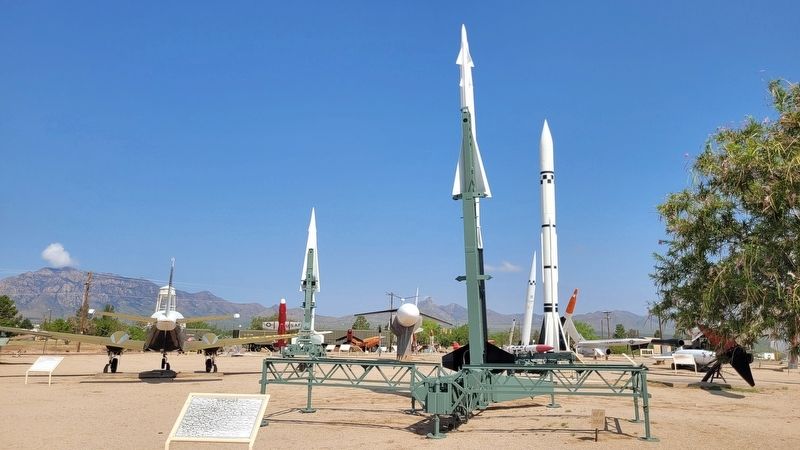
Photographed by James Hulse, July 23, 2024
2. The Nike Ajax and Marker
Three Nike I ground systems (radars and related equipment) and 1,000 missiles were delivered to White Sands in 1952. The first Nike I battery and assembly area prototype was set up for operation at WSPG in January 1953. Later that year, the first Nike missile was fired from an underground launch facility. The first Nike unit was put on site at Ft. Meade, Maryland, and on May 30, 1954, became fully operational on an around-the-clock combat-ready status.
The name was changed to Nike Ajax on November 15, 1956.
During the mid-1950s, Nike systems were installed along the Eastern seaboard. Troop training in firing the system was conducted by the Army Air Defense School at WSPG. Later, the system was deployed to Allied nations as air defense around industrial and metropolitan centers.
In November 1964, after a decade (1954-1964) of guarding strategic industrial
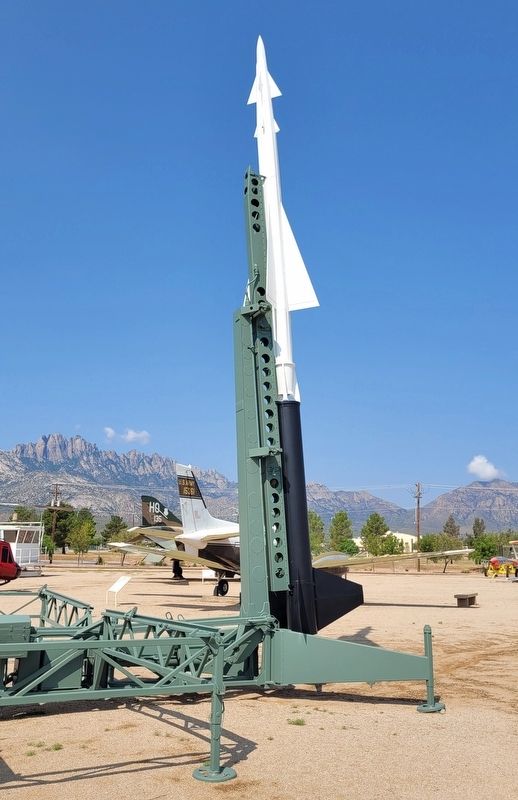
Photographed by James Hulse, July 23, 2024
3. Nike Ajax
Between 1946 and 1959, 3929 Ajax missiles were launched at WSPG. The high was in 1956 when 781 were fired - more than two a day. The last Ajax was fired here in 1959.
Length: 33 feet
Diameter: 12 inches
Weight: 2,500 pounds
Propellant: Missile-Liquid // Booster-Solid
First Firing: 1946
Erected by White Sands Missile Range Museum. (Marker Number 94.050.)
Topics. This historical marker is listed in these topic lists: Air & Space • War, Cold. A significant historical month for this entry is January 1945.
Location. 32° 23.142′ N, 106° 28.702′ W. Marker is in White Sands, New Mexico, in Doña Ana County. It is on Wsmr P Rt 1 (New Mexico Route 213) 4 miles south of U.S. 70. The marker and various missiles are located on the grounds of the White Sands Missile Range Museum. Touch for map. Marker is in this post office area: White Sands Missile Range NM 88002, United States of America. Touch for directions.

Regionally, this marker is in the Rio Grande Valley. It is also in the American Borderlands and in the Southwest. Globally, it is in North America, the Western Hemisphere, the Western World, and the Anglosphere. Historically, it finds itself in what was once New Spain, the Gadsden Purchase, and the Republic of Texas.
Other nearby markers. At least 8 other markers are within walking distance of this marker: Lark (a few steps from this marker); VC-6A Plane (a few steps from this marker); MGM-3 Little John (a few steps from this marker); Honest John (within shouting distance of this marker); IGOR (within shouting distance of this marker); Huey Helicopter UH-1M (within shouting
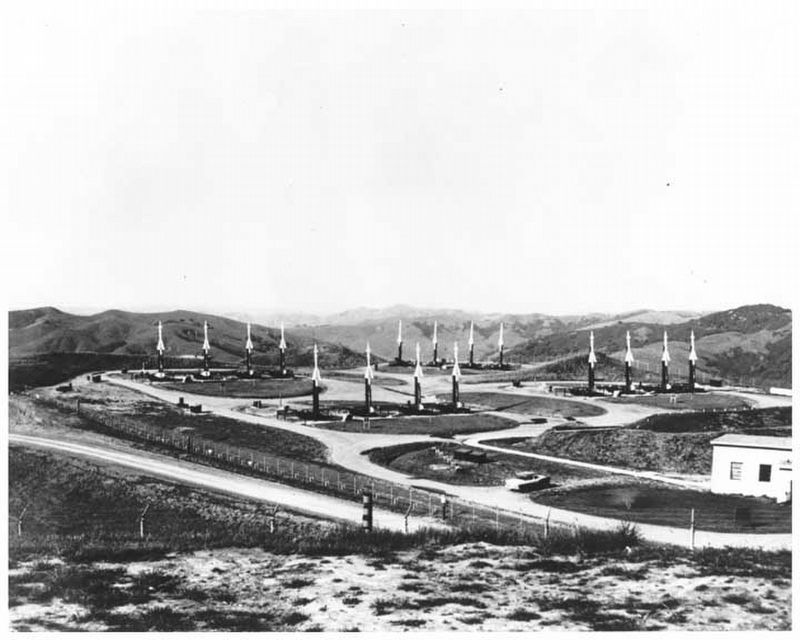
Public Domain - US Army Redstone Arsenal
4. Nike Ajax base on alert
This Nike Ajax site is on full alert, with missiles ready for launch on all sixteen launch sites. This image appears to be taken from the control area (IFC) which was separated from the launch area to allow its radars to see the missiles as they launched.
More about this marker. The marker and museum are located on the White Sands Missile Range, an active U.S. military installation. The museum is open to the public, but appropriate identification is required for access.
Also see . . .
1. Welcome to the White Sands Missile Range Museum. White Sands Missile Range Museum (Submitted on August 2, 2024, by James Hulse of Medina, Texas.)
2. MIM-3 Nike Ajax. Wikipedia
The Nike Ajax was an American guided surface-to-air missile (SAM) developed by Bell Labs for the United States Army. The world's first operational guided surface-to-air missile, the Nike Ajax was designed to attack conventional bomber aircraft flying at high subsonic speeds and altitudes above 50,000 feet (15 km). Nike entered service in 1954 and was initially deployed within the United States to defend against potential Soviet bomber attacks, though it was later deployed overseas to protect US military bases, and was also sold to various allied militaries. Some examples remained in use until the 1970s.(Submitted on August 3, 2024, by James Hulse of Medina, Texas.)
Credits. This page was last revised on December 22, 2024. It was originally submitted on August 2, 2024, by James Hulse of Medina, Texas. This page has been viewed 443 times since then and 154 times this year. Photos: 1, 2, 3, 4. submitted on August 3, 2024, by James Hulse of Medina, Texas.
