Sumter in Sumter County, South Carolina — The American South (South Atlantic)
Battle of Dingle's Mill
April 9, 1865
Photographed by Mark Parker, April 6, 2024
1. Battle of Dingle's Mill Marker
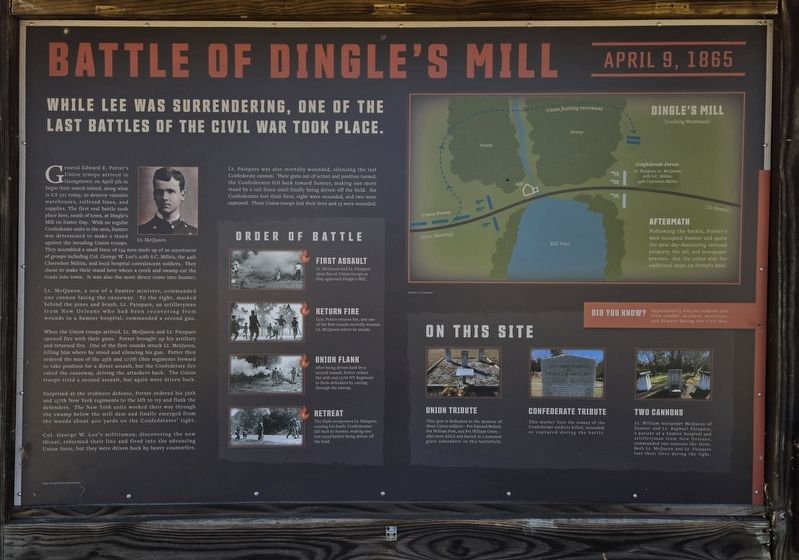
General Edward E. Potter's Union troops arrived in Georgetown on April Sth to begin their march inland, along what is US 521 today, to destroy valuable warehouses, railroad lines, and supplies. The first real battle took place here, south of town, at Dingle's Mill on Easter Day. With no regular Confederate units in the area, Sumter was determined to make a stand against the invading Union troops. They assembled a small force 154 men made up of an assortment of groups including Col. George W. Lee's 20th S.C. Militia, the 44th Clarendon Militia, and local hospital convalescent soldiers. They chose to make their stand here where a creek and swamp cut the roads into town. It was also the most direct route into Sumter.
Lt. McOueen, a son of a Sumter minister, commanded one cannon facing the causeway. To the right, masked behind the pines and brush, Lt. Painpare, an artilleryman from New Orleans who had been recovering from wounds in Sumter hospital, commanded second gun.
When the Union troops arrived, Lt. McQueen and Lt. Painpare opened
this page online
Surprised at the stubborn defense, Potter ordered his 56th and 157th New York regiments to the left to try and flank the defenders. The New York units worked their way through the swamp below the mill dam and finally emerged from the woods about 400 vards on the Confederates' right.
Col. George W. Lee's militiamen, discovering the new threat, reformed their line and fired into the advancing Union force, but they were driven back by heavy counterfire.
Lt. Painpare was also mortally wounded, silencing the last Confederate cannon. Their guns out of action and position turned, the Confederates fell back toward Sumter, making one more stand by a rail fence until finally being driven off the field. Six Confederates lost
Photographed by Mark Parker, April 6, 2024
2. Union Tribute at Dingle's Mill
Order of Battle
1. First Assault Lt. McQueen and Lt. Painpare open fire on Union troops as they approach Dingle's Mill.
2. Return Fire
Gen. Potter returns fire,and one of the first rounds mortally wounds Lt. McQueen where he stands.
3. Union Flank
After being driven back by a second assault, Potter orders the 56th and 157th NY Regiment to flank defenders by cutting through the swamp.
4. Retreat
The flank overpowers Lt. Painpare, causing his death. Confederates fall back to Sumter, making one last stand before being driven off the field.
Aftermath
Following the battle Potter's men occupied Sumter and spent the next day destroying railroad property, the jail, and newspaper presses See the other side for additional stops on Potter's Raid.
Did You Know?
Approximately 620,000 soldiers died from combat, accidents, starvation and disease during the Civil War.
On This Site
Union Tribute
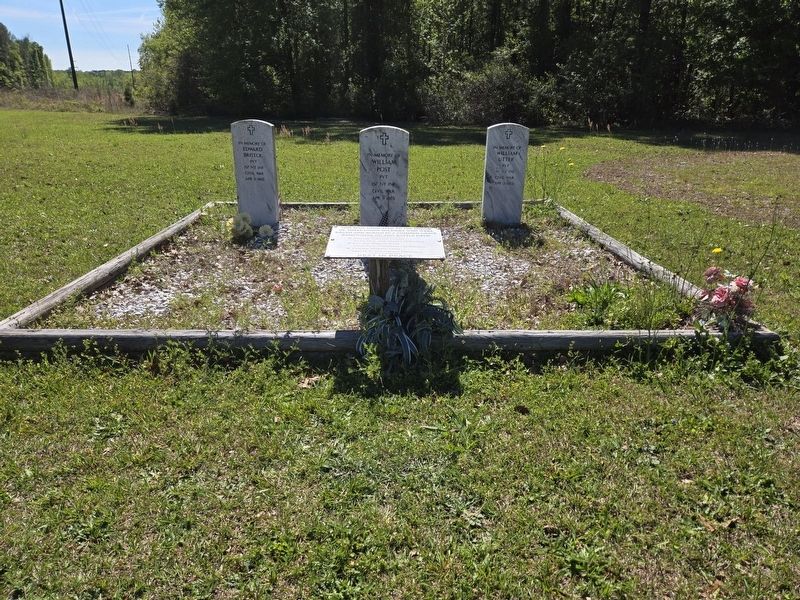
This spot is dedicated to the memory of three Union soldiers - Pvt Edward Bristol, Pvt William Post, and Pyt William Utter, - who were killed and buried in a common grave somewhere on this battlefield.
Confederate Tribute
This marker lists the names of the Confederate soldiers killed, wounded, captured during the battle.
Two Cannons
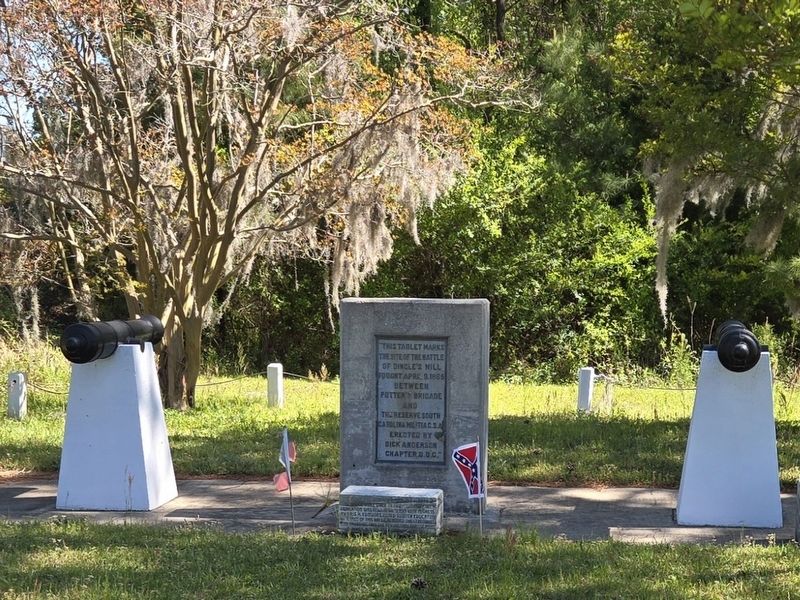
Lt. William Alexander McQueen of Sumter and Lt. Raphael Painpare, a patient of Sumter hospital and artilleryman from New Orleans, commanded two cannons like these. Both Lt. McQueen and Lt. Painpare lost their lives during the fight.
Topics.
Photographed by Mark Parker, April 6, 2024
3. Union Tribute at Dingle's Mill
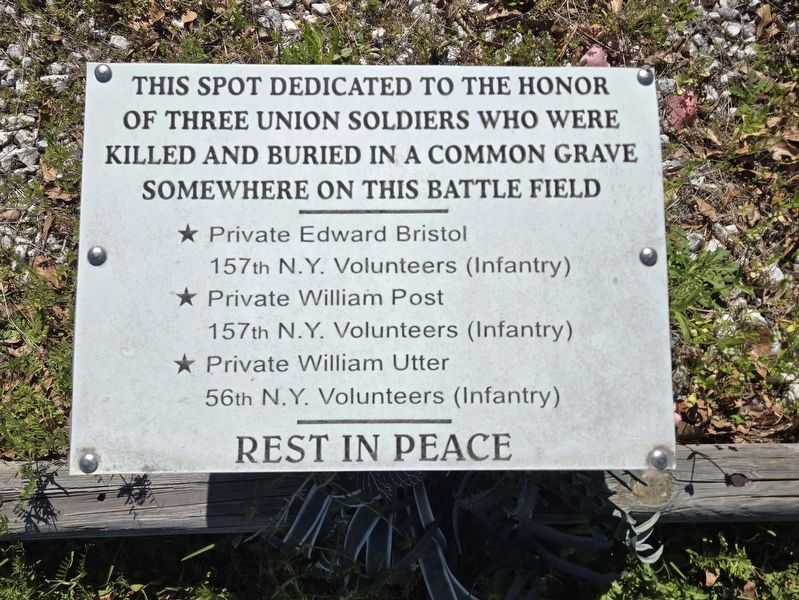
This spot dedicated to the honor of three Union soldiers who were killed and buried in a common grave somewhere on this battlefield.
Private Edward Bristol 157th N.Y. Volunteers (Infantry) • Private William Post 157th N.Y. Volunteers (Infantry) • Private William Utter 56th N.Y. Volunteers (Infantry)
Rest in Peace
Private Edward Bristol 157th N.Y. Volunteers (Infantry) • Private William Post 157th N.Y. Volunteers (Infantry) • Private William Utter 56th N.Y. Volunteers (Infantry)
Rest in Peace
Location. 33° 52.579′ N, 80° 20.162′ W. Marker is in Sumter, South Carolina, in Sumter County. It can be reached from Manning Road (U.S. 521) south of South Guinard Parkway (U.S. 521), on the right when traveling south. Located at the Battle of Dingle's Mill Battleground, Historic Civil War Site. Touch for map. Marker is at or near this postal address: 1400 Manning Rd, Sumter SC 29150, United States of America. Touch for directions.

Regionally, this marker is in the Pee Dee. It is also in the American South and specifically in the Deep South. Globally, it is in North America, the Western Hemisphere, the Western World, and the Anglosphere. Historically, it finds itself in what was once the territory of the Mississippian Culture, one of the original Thirteen Colonies, one of the Confederate States of America, and the Antebellum South.
Other nearby markers. At least 8 other markers are within 3 miles of this marker, measured as the crow flies: Potter's Raid (here, next to this marker); a different marker also

Photographed by Mark Parker, April 6, 2024
4. Confederate Tribute at Dingle's Mill Marker
Killed
Lt. Alex McQueen - Gardens Battery - Palmetto Artillery • Lt. Rafael Painpere S.C. Siege Train • Sgt. Joseph H. Long 20th S.C. Militia • Dr. John Thompson 20th S.C. Militia • Pvt. C.N. Harbin 2nd S.C. Reserves • Pvt. William Reeder Co. A.S.C. Siege Train
Wounded
Pvt. William Wingate 2Oth S.C. Militia • Pvt. Wade Newman Unit Unknown • Pvt. Potts Davis 2Oth S.C. Militia • Pvt. William Baker Co. D 1st S.C. Infantry • Pvt Charles McCoy 2Oth S.C. Militia.• Pvt. Fahm Georgia Regiment • Pvt. G. C. Fabib 22nd Georgia Regiment • Pvt. William Harral 2Oth S.C. Militia
Captured
Pvt. H.D. Lincoln 2Oth S.C. Militia • Pvt. William Wooten 2Oth S.C. Militia
Photographed by Mark Parker, April 6, 2024
5. Representative cannons used by Lt. Alex McQueen and Lt. Rafael Painpere at Battle of Dingle's Mill
Cannons surrounding markers related to the Battle of Dingle's Mill

Photographed by Mark Parker, April 6, 2024
6. Dingle's Mill Battlefield
Confederate Tribute on the left; Union Tribute on the right
Credits. This page was last revised on August 3, 2024. It was originally submitted on August 2, 2024, by Mark Parker of Hickory, North Carolina. This page has been viewed 271 times since then and 33 times this year. Photos: 1, 2, 3, 4, 5, 6. submitted on August 2, 2024, by Mark Parker of Hickory, North Carolina. • Bernard Fisher was the editor who published this page.
