Near San Antonio in Socorro County, New Mexico — The American Mountains (Southwest)
Prehistoric Peoples
Photographed by James Hulse, July 23, 2024
1. Prehistoric Peoples Marker
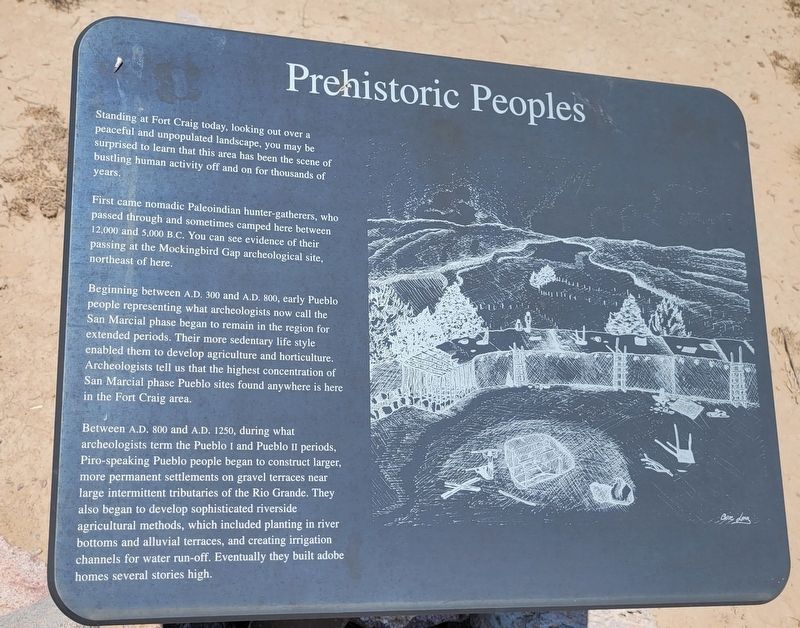
First came nomadic Paleoindian hunter-gatherers, who passed through and sometimes camped here between 12,000 and 5,000 B.C. You can see evidence of their passing at the Mockingbird Gap archeological site, northeast of here.
Beginning between A.D. 300 and A.D. 800, early Pueblo people representing what archeologists now call the San Marcial phase began to remain in the region for extended periods. Their more sedentary life style enabled them to develop agriculture and horticulture. Archeologists tell us that the highest concentration of San Marcial phase Pueblo sites found anywhere is here in the Fort Craig area.
Between A.D. 800 and A.D. 1250, during what archeologists term the Pueblo I and Pueblo II periods, Piro-speaking Pueblo people began to construct larger, more permanent settlements on gravel terraces near large intermittent tributaries of the Rio Grande. They also began to develop sophisticated riverside
this page online
Topics. This historical marker is listed in these topic lists: Forts and Castles • Indigenous Peoples and Communities. A significant historical year for this entry is 1250.
Location. 33° 38.108′ N, 107° 0.905′ W. Marker is near San Antonio, New Mexico, in Socorro County. It is on Fort Craig Road 4½ miles south of Old US Hwy 85 (New Mexico Highway 1). The marker is located at the Fort Craig Historic Site along the visitor trail. Touch for map. Marker is at or near this postal address: 457 Ft Craig Rd, San Antonio NM 87832, United States of America. Touch for directions.

Regionally, this marker is in Southwest New Mexico and in the Rio Grande Valley. It is also in the American Southwest. Globally, it is in North America, the Western Hemisphere, the Western World, and the Anglosphere. Historically, it finds itself in what was once New Spain and also the Republic of Texas.
Other nearby markers. At least 8 other markers are within walking

Photographed by James Hulse, July 23, 2024
2. Prehistoric Peoples Marker
More about this marker. At Fort Craig Historic Site, an ADA accessible, self-guided interpretive trail is open seven days a week, from 8:00 a.m. to one-hour before sunset. The visitor’s center is open Thursday through Monday from 8:00 a.m. to 5:00 p.m.
Also see . . . Fort Craig Historic Site. blm.gov
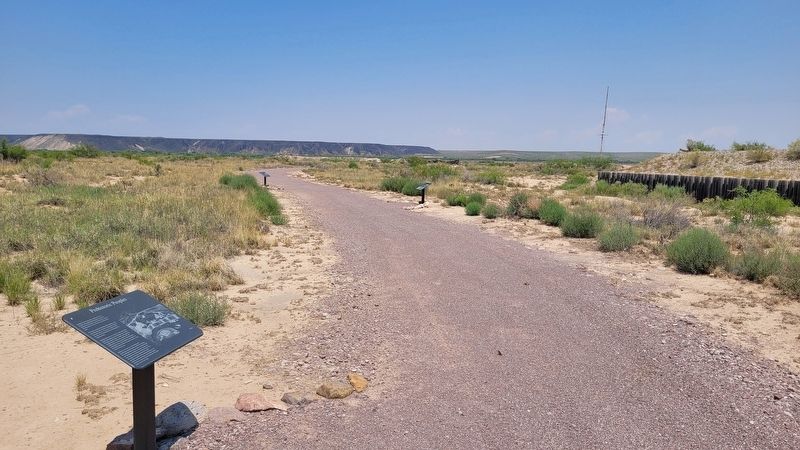
Fort Craig, established in 1854, was one of the largest and most important frontier forts in the West. Set in the rugged beauty of Socorro County, N.M., it was one of the eight forts situated along the primary north-south road in the Rio Grande(Submitted on August 5, 2024, by James Hulse of Medina, Texas.)Valley. Fort Craig played a crucial role in Indian campaigns and the Civil War.Photographed by James Hulse, July 23, 20243. The view of the Prehistoric Peoples Marker along the trail
Credits. This page was last revised on August 6, 2024. It was originally submitted on August 4, 2024, by James Hulse of Medina, Texas. This page has been viewed 177 times since then and 15 times this year. Photos: 1, 2, 3. submitted on August 5, 2024, by James Hulse of Medina, Texas.
