Near San Antonio in Socorro County, New Mexico — The American Mountains (Southwest)
Defensive Bastions
Photographed by James Hulse, July 23, 2024
1. Defensive Bastions Marker
Inscription.
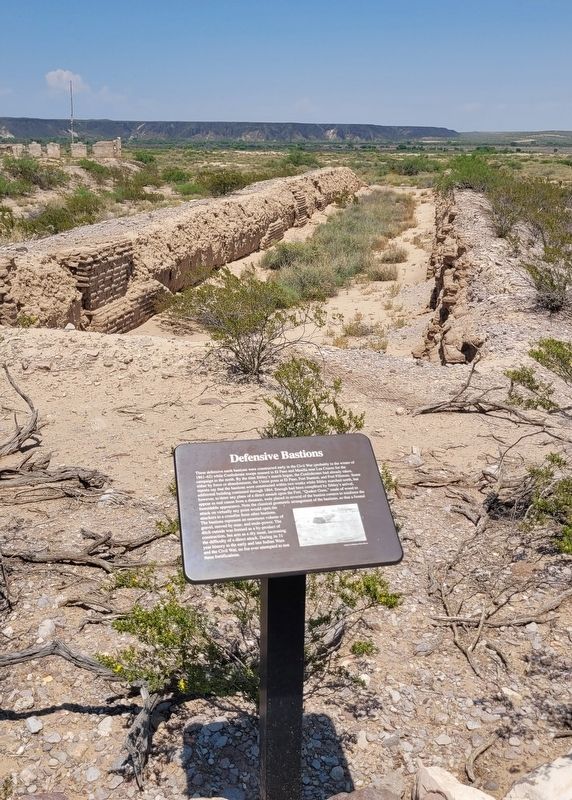
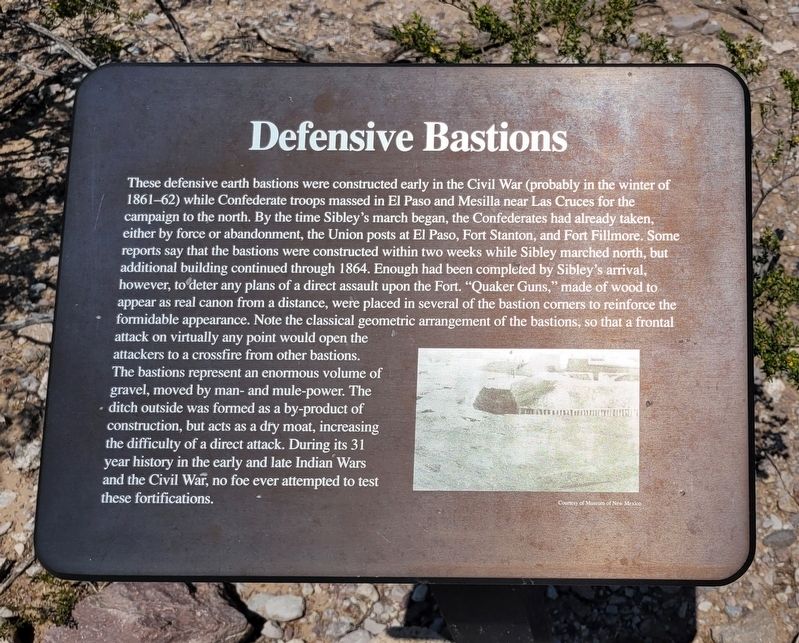
Defensive Bastions. . These defensive earth bastions were constructed early in the Civil War (probably in the winter of 1861-62) while Confederate troops massed in El Paso and Mesilla near Las Cruces for the campaign to the north. By the time Sibley's march began, the Confederates had already taken, either by force or abandonment, the Union posts at El Paso, Fort Stanton, and Fort Fillmore. Some reports say that the bastions were constructed within two weeks while Sibley marched north, but additional building continued through 1864. Enough had been completed by Sibley's arrival, however, to deter any plans of a direct assault upon the Fort. Quaker Guns, made of wood to appear as real canon from a distance, were placed in several of the bastion corners to reinforce the formidable appearance. Note the classical geometric arrangement of the bastions, so that a frontal attack on virtually any point would open the attackers to a crossfire from other bastions. The bastions represent an enormous volume of gravel, moved by man- and mule-power. The ditch outside was formed as a by-product of construction, but acts as a dry moat, increasing the difficulty of a direct attack. During its 31 year history in the early and late Indian Wars and the Civil War, no foe ever attempted to test these fortifications., Captions , Courtesy of Museum of New Mexico
These defensive earth bastions were constructed early in the Civil War (probably in the winter of 1861-62) while Confederate troops massed in El Paso and Mesilla near Las Cruces for the campaign to the north. By the time Sibley's march began, the Confederates had already taken, either by force or abandonment, the Union posts at El Paso, Fort Stanton, and Fort Fillmore. Some reports say that the bastions were constructed within two weeks while Sibley marched north, but additional building continued through 1864. Enough had been completed by Sibley's arrival, however, to deter any plans of a direct assault upon the Fort. Quaker Guns, made of wood to appear as real canon from a distance, were placed in several of the bastion corners to reinforce the formidable appearance. Note the classical geometric arrangement of the bastions, so that a frontal attack on virtually any point would open the attackers to a crossfire from other bastions. The bastions represent an enormous volume of gravel, moved by man- and mule-power. The ditch outside was formed as a by-product of construction, but acts as a dry moat, increasing the difficulty of a direct attack. During its 31 year history in the early and late Indian Wars and the Civil War, no foe ever attempted to test these fortifications.
Captions
Courtesy of Museum of
Click or scan to see this page online
New Mexico
Topics. This historical marker is listed in these topic lists: Forts and Castles • War, US Civil. A significant historical year for this entry is 1862.
Location. 33° 38.027′ N, 107° 0.898′ W. Marker is near San Antonio, New Mexico, in Socorro County. It is on Fort Craig Road 4½ miles south of Old US Hwy 85 (Scenic New Mexico Highway 1). The marker is located at the Fort Craig Historic Site along the visitor trail. Touch for map. Marker is at or near this postal address: 457 Ft Craig Rd, Socorro NM 87801, United States of America. Touch for directions.

Regionally, this marker is in Southwest New Mexico and in the Rio Grande Valley. It is also in the American Southwest. Globally, it is in North America, the Western Hemisphere, the Western World, and the Anglosphere. Historically, it finds itself in what was once New Spain and also the Republic of Texas.
More about this marker. At Fort Craig Historic Site, an ADA accessible, self-guided interpretive trail is open seven days a week, from 8:00 a.m. to one-hour before sunset. The visitors center is open Thursday through Monday from 8:00 a.m. to 5:00 p.m.
Fort Craig, established in 1854, was one of the largest and most important frontier forts in the West. Set in the rugged beauty of Socorro County, N.M., it was one of the eight forts situated along the primary north-south road in the Rio Grande Valley. Fort Craig played a crucial role in Indian campaigns and the Civil War.
(Submitted on August 5, 2024, by James Hulse of Medina, Texas.)
Photographed by James Hulse, July 23, 2024
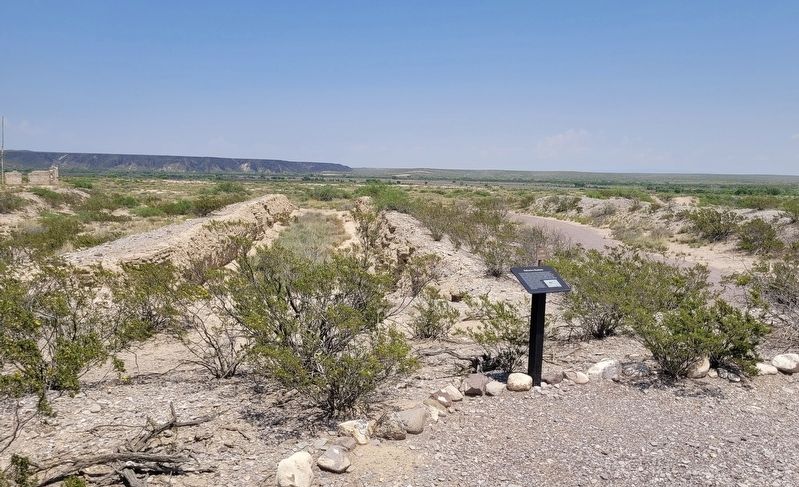
3. The view of the Defensive Bastions Marker along the trail
Credits. This page was last revised on August 6, 2024. It was originally submitted on August 4, 2024, by James Hulse of Medina, Texas. This page has been viewed 132 times since then and 15 times this year. Photos:1, 2, 3. submitted on August 6, 2024, by James Hulse of Medina, Texas.