Near San Antonio in Socorro County, New Mexico — The American Mountains (Southwest)
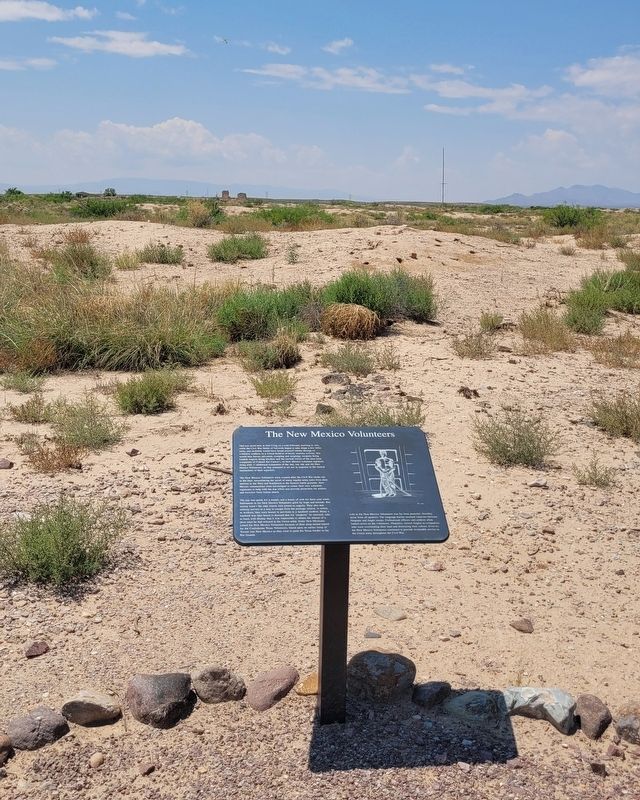
The New Mexico Volunteers

Photographed by James Hulse, July 23, 2024
1. The New Mexico Volunteers Marker
The New Mexico Volunteers were created after the Civil War broke out in the East, necessitating the recall of many regular army units from their stations in the West and Southwest to the Eastern battle grounds. New Mexico communities were encouraged to create their own volunteer regiments to help with the war effort and provide protection for settlers and travelers from Indian attack.
The pay was good, $13 a month, and a bonus of $100 for three-year stints. Enlistment in the
this page online
Life in the New Mexico Volunteers was far from peaceful. Hostility arose from all quarters. The language barrier strained relations between Hispanic and Anglo troops. Professional officers and soldiers often looked down on the volunteers. Hispanics viewed Anglos as conquerors who were overrunning their land and destroying their culture. Even so, the New Mexico Volunteers continued to provide invaluable service to the Union army throughout the Civil War.
Topics.
Photographed by James Hulse, July 23, 2024
2. The New Mexico Volunteers Marker
Location. 33° 38.025′ N, 107° 0.7′ W. Marker is near San Antonio, New Mexico, in Socorro County. It is on Fort Craig Road 4½ miles south of Old US Hwy 85 (New Mexico Highway 1). The marker is located at the Fort Craig Historic Site along the visitor trail. Touch for map. Marker is at or near this postal address: 457 Ft Craig Rd, San Antonio NM 87832, United States of America. Touch for directions.

Regionally, this marker is in Southwest New Mexico and in the Rio Grande Valley. It is also in the American Southwest. Globally, it is in North America, the Western Hemisphere, the Western World, and the Anglosphere. Historically, it finds itself in what was once New Spain and also the Republic of Texas.
Other nearby markers. At least 8 other markers are within walking distance of this marker: Civilian Life (within shouting distance of this marker); Corrals and Stables (within shouting distance of this marker); Sutler's Row (about 300 feet away, measured in a direct line); Hospital Row (about
Photographed by James Hulse, July 23, 2024
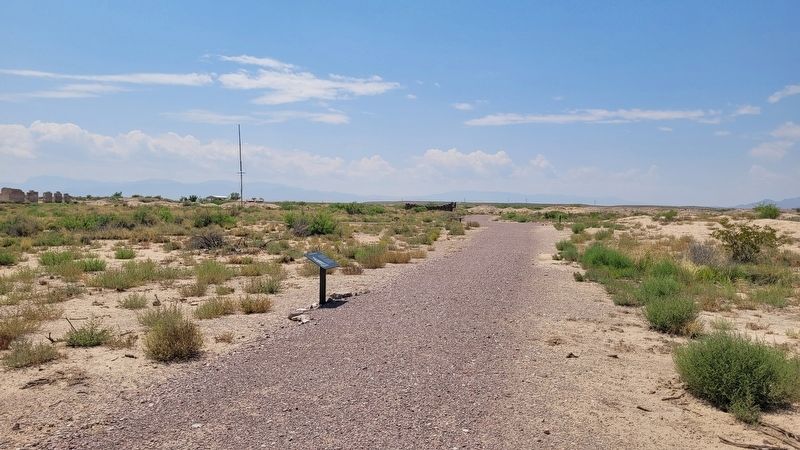
3. The view of the New Mexico Volunteers Marker along the trail
More about this marker. At Fort Craig Historic Site, an ADA accessible, self-guided interpretive trail is open seven days a week, from 8:00 a.m. to one-hour before sunset. The visitor’s center is open Thursday through Monday from 8:00 a.m. to 5:00 p.m.
Also see . . . Fort Craig Historic Site. blm.gov
Fort Craig, established in 1854, was one of the largest and most important frontier forts in the West. Set in the rugged beauty of Socorro County, N.M., it was one of the eight forts situated along the primary north-south road in the Rio Grande Valley. Fort Craig played a crucial role in Indian campaigns and the Civil War.(Submitted on August 5, 2024, by James Hulse of Medina, Texas.)
Credits. This page was last revised on August 6, 2024. It was originally submitted on August 4, 2024, by James Hulse of Medina, Texas. This page has been viewed 184 times since then and 20 times this year. Photos: 1, 2, 3. submitted on August 6, 2024, by James Hulse of Medina, Texas.
