
Woodbine Township near Elizabeth in Jo Daviess County, Illinois — The American Midwest (Great Lakes)
Voices of the Past
Photographed by Duane and Tracy Marsteller, July 7, 2024
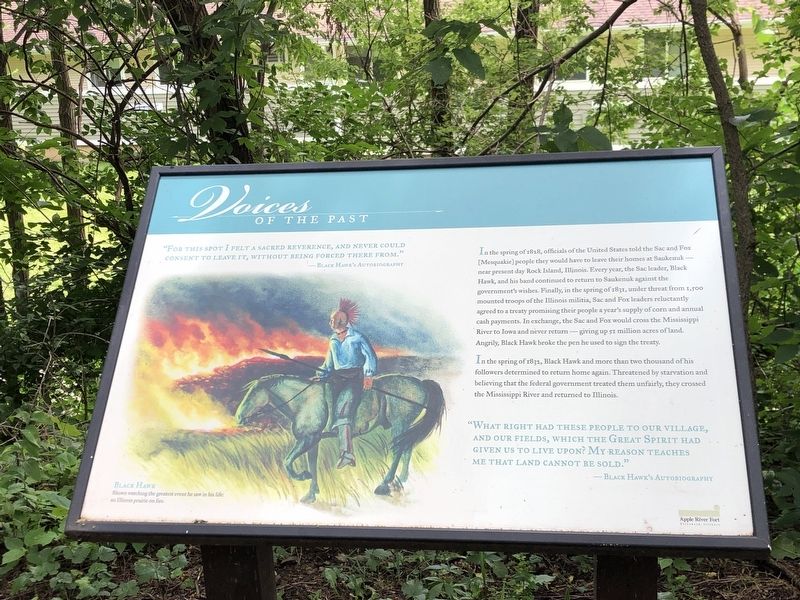
1. Voices of the Past Marker
“From this spot I felt a sacred reverence, and never could consent to leave it, without being forced there from.” – Black Hawk's autobiography
In the spring of 1818, officials of the United States told the Sac and Fox [Mesquakie] people they would have to leave their homes at Saukenuk – near present day Rock Island, Illinois. Every year, the Sac leader, Black Hawk, and his band continued to return to Saukenuk against the government's wishes. Finally, in the spring of 1831, under threat from 1,100 mounted troops of the Illinois militia, Sac and Fox leaders reluctantly agreed to a treaty promising their people a year's supply of corn and annual cash payments. In exchange, the Sac and Fox would cross the Mississippi River to Iowa and never return – giving up 51 million acres of land. Angrily, Black Hawk broke the pen he used to sign the treaty.
In the spring of 1832, Black Hawk and more than two thousand of his followers determined to return home again. Threatened by starvation and believing that the federal government treated them unfairly, they crossed the Mississippi River and returned to Illinois.
“"What righthad these people to our village, and our fields, which the Great Spirit had given us to live upon? My reason teaches me that land cannot be sold.” – Black Hawk's autobiography
Click or scan to see
this page online
Topics and series. This historical marker is listed in these topic lists: Government & Politics • Indigenous Peoples and Communities. In addition, it is included in the Black Hawk War series list. A significant historical year for this entry is 1832.
Location. 42° 19.113′ N, 90° 13.091′ W. Marker is near Elizabeth, Illinois, in Jo Daviess County. It is in Woodbine Township. It is on Old Fort Road east of Illinois Street, on the right when traveling east. Marker is on the entrance road to Apple River Fort State Historic Site. Touch for map. Marker is in this post office area: Elizabeth IL 61028, United States of America. Touch for directions.

Regionally, this marker is in the American Midwest, in the Corn Belt, in the Driftless Area — Bluff Country, and in the Great River Road Region. Globally, it is in North America, the Western Hemisphere, the Western World, and the Anglosphere. Historically, it finds itself in what was once the territory of the
Photographed by Duane and Tracy Marsteller, July 7, 2024
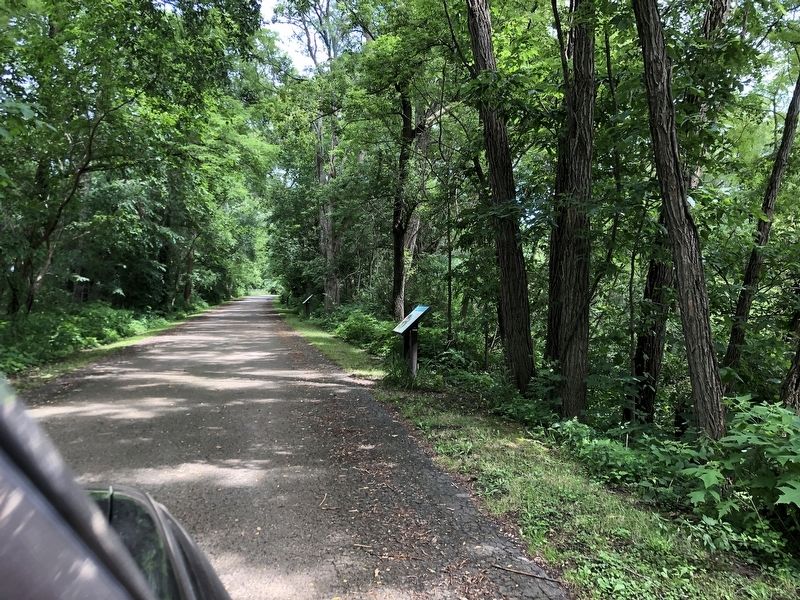
2. Voices of the Past Marker
Other nearby markers. At least 8 other markers are within walking distance of this marker: A different marker also named Voices of the Past (a few steps from this marker); a different marker also named Voices of the Past (within shouting distance of this marker); a different marker also named Voices of the Past (within shouting distance of this marker); a different marker also named Voices of the Past (within shouting distance of this marker); a different marker also named Voices of the Past (within shouting distance of this marker); Building the Apple River Fort (about 700 feet away, measured in a direct line); Attack! On Apple River Fort (about 700 feet away); Chicago Great Western Railroad Depot (approx. ¼ mile away). Touch for a list and map of all markers in Elizabeth.
Also see . . . The Black Hawk War: Introduction. On April 5, 1832, a band of roughly one thousand Sauk, Fox, and Kickapoo men, women, and children crossed the Mississippi River into Illinois near the mouth of the Iowa River. They moved north along the eastern bank of the river and then turned to the northeast along the Rock River. At the mouth of the Rock, they passed the remains of Saukenuk. For roughly one hundred years, Saukenuk had been the principal village of the Sauks; now, it lay in ruins. (James E. Lewis, Jr., Kalamazoo College; in The Black Hawk War of 1832 series, Northern Illinois University) (Submitted on August 4, 2024, by Duane and Tracy Marsteller of Murfreesboro, Tennessee.)
Credits. This page was last revised on August 4, 2024. It was originally submitted on August 4, 2024, by Duane and Tracy Marsteller of Murfreesboro, Tennessee. This page has been viewed 175 times since then and 14 times this year. Photos: 1, 2. submitted on August 4, 2024, by Duane and Tracy Marsteller of Murfreesboro, Tennessee.
