Hanover in Washington County, Kansas — The American Midwest (Upper Plains)
Camping Along the Trail
Photographed by Jeremy Snow, July 19, 2024
1. Camping Along the Trail Marker
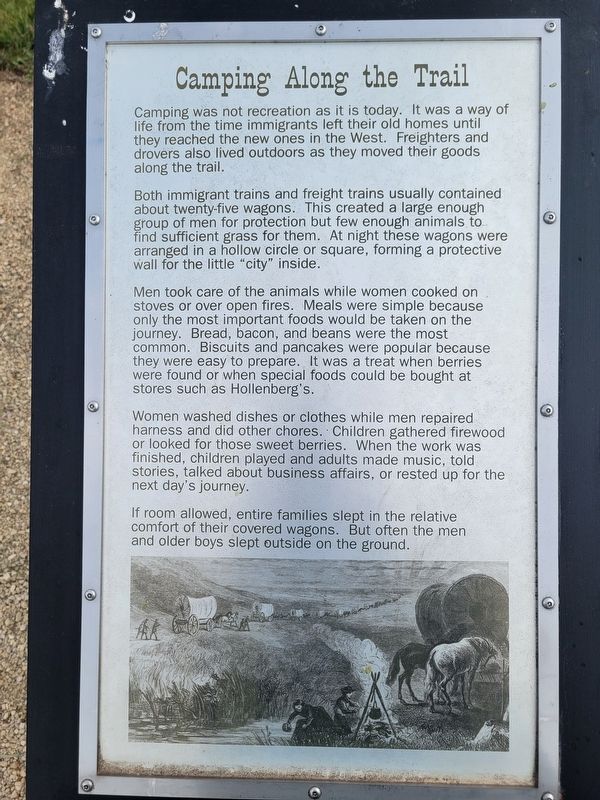
Camping was not recreation as it is today. It was a way of life from the time immigrants left their old homes until they reached the new ones in the West. Freighters and drovers also lived outdoors as they moved their goods along the trail.
Both immigrant trains and freight trains usually contained about twenty-five wagons. This created a large enough group of men for protection but few enough animals to find sufficient grass for them. At night these wagons were arranged in a hollow circle or square, forming a protective wall for the little "city" inside.
Men took care of the animals while women cooked on stoves or over open fires. Meals were simple because only the most important foods would be taken on the journey. Bread, bacon, and beans were the most common. Biscuits and pancakes were popular because they were easy to prepare. It was a treat when berries were found or when special foods could be bought at stores such as Hollenberg's.
Women washed dishes or clothes while men repaired harness and did other chores. Children gathered firewood or looked for those sweet berries. When the work was finished, children
this page online
If room allowed, entire families slept in the relative comfort of their covered wagons. But often the men and older boys slept outside on the ground.
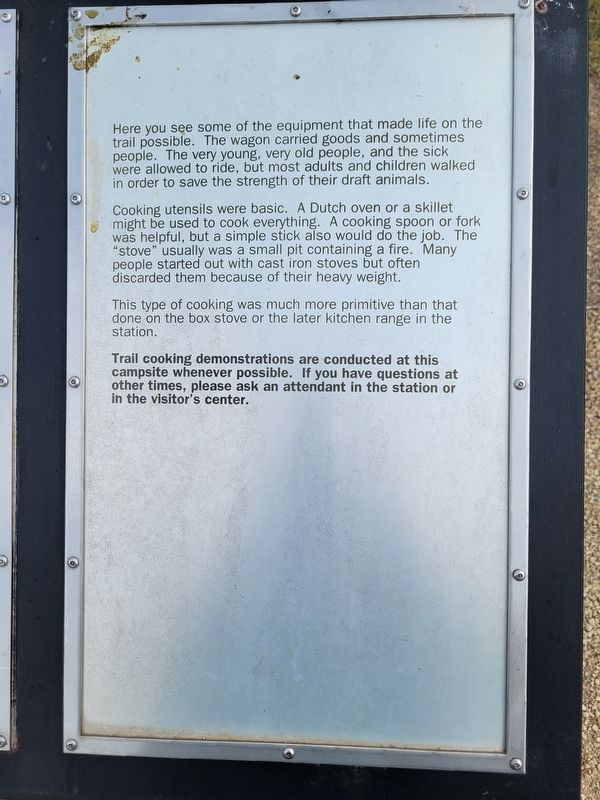
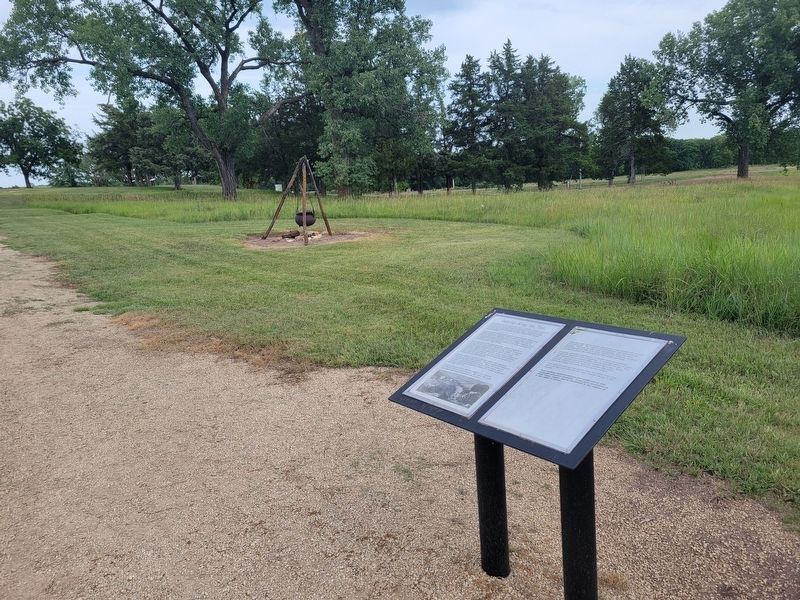
Here you see some of the equipment that made life on the trail possible. The wagon carried goods and sometimes people. The very young, very old people, and the sick were allowed to ride, but most adults and children walked in order to save the strength of their draft animals.
Cooking utensils were basic. A Dutch oven or a skillet might be used to cook everything. A cooking spoon or fork was helpful, but a simple stick also would do the job. The "stove” usually was a small pit containing a fire. Many people started out with cast iron stoves but often discarded them because of their heavy weight.
This type of cooking was much more primitive than that done on the box stove or the later kitchen range in the station.
Trail cooking demonstrations are conducted at this campsite whenever possible. If you have questions at other times, please ask an attendant in the
Photographed by Jeremy Snow, July 19, 2024
2. Camping Along the Trail Marker
Topics. This historical marker is listed in these topic lists: Roads & Vehicles • Settlements & Settlers.
Location. 39° 54.069′ N, 96° 50.697′ W. Marker is in Hanover, Kansas, in Washington County. It can be reached from Big Bear Road. Touch for map. Marker is at or near this postal address: 2307 Big Bear Rd, Hanover KS 66945, United States of America. Touch for directions.

Regionally, this marker is in Eastern Kansas. It is also in the American Midwest, in the Corn Belt, on the prairies, and on the Southern Plains. Globally, it is in North America, the Western Hemisphere, the Western World, and the Anglosphere. Historically, it finds itself in what was once the Louisiana Purchase.
Other nearby markers. At least 8 other markers are within 5 miles of this marker, measured as the crow flies: Points of Interest (about 300 feet away, measured in a direct line); Hollenberg Station and Transportation (about 300 feet away); Transportation (about 300 feet away); Hollenberg Ranch Pony Express Station (about 400 feet away); Hollenberg Pony Express Station
Photographed by Jeremy Snow, July 19, 2024
3. Camping Along the Trail Marker
Credits. This page was last revised on August 5, 2024. It was originally submitted on August 4, 2024, by Jeremy Snow of Cedar City, Utah. This page has been viewed 152 times since then and 28 times this year. Photos: 1, 2, 3. submitted on August 4, 2024, by Jeremy Snow of Cedar City, Utah. • J. Makali Bruton was the editor who published this page.
