Near San Antonio in Socorro County, New Mexico — The American Mountains (Southwest)
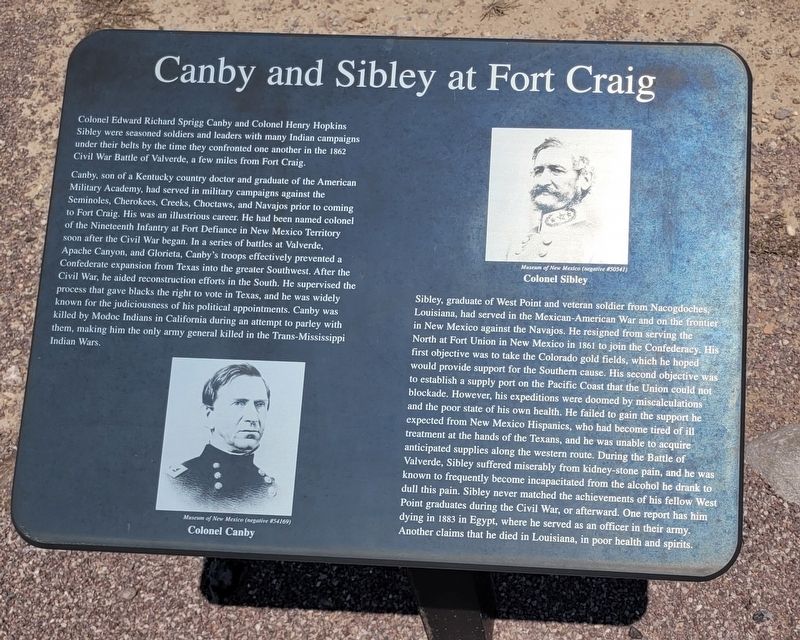
Canby and Sibley at Fort Craig
Photographed by James Hulse, July 23, 2024
1. Canby and Sibley at Fort Craig Marker
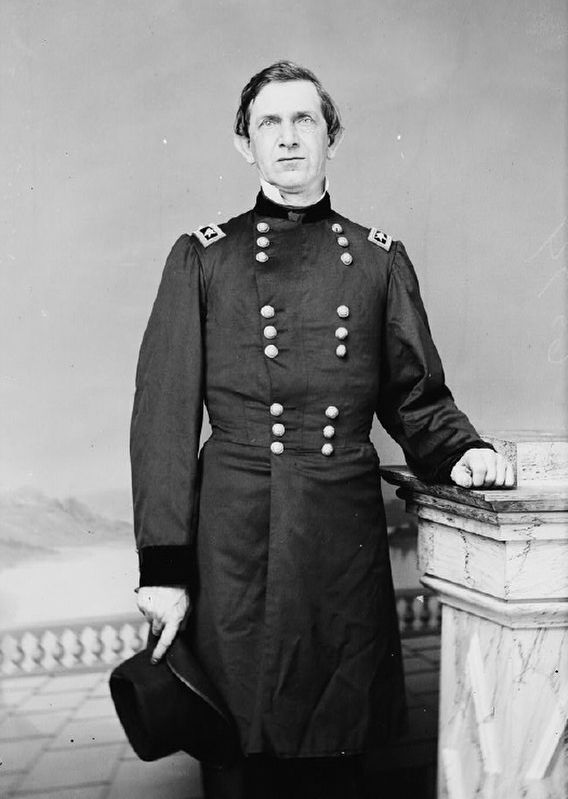
Canby, son of a Kentucky country doctor and graduate of the American Military Academy, had served in military campaigns against the Seminoles, Cherokees, Creeks, Choctaws, and Navajos prior to coming to Fort Craig. His was an illustrious career. He had been named colonel of the Nineteenth Infantry at Fort Defiance in New Mexico Territory soon after the Civil War began. In a series of battles at Valverde, Apache Canyon, and Glorieta, Canby's troops effectively prevented a Confederate expansion from Texas into the greater Southwest. After the Civil War, he aided reconstruction efforts in the South. He supervised the process that gave blacks the right to vote in Texas, and he was widely known for the judiciousness of his political appointments. Canby was killed by Modoc Indians in California during an attempt to parley with them, making him the only army general killed
this page online
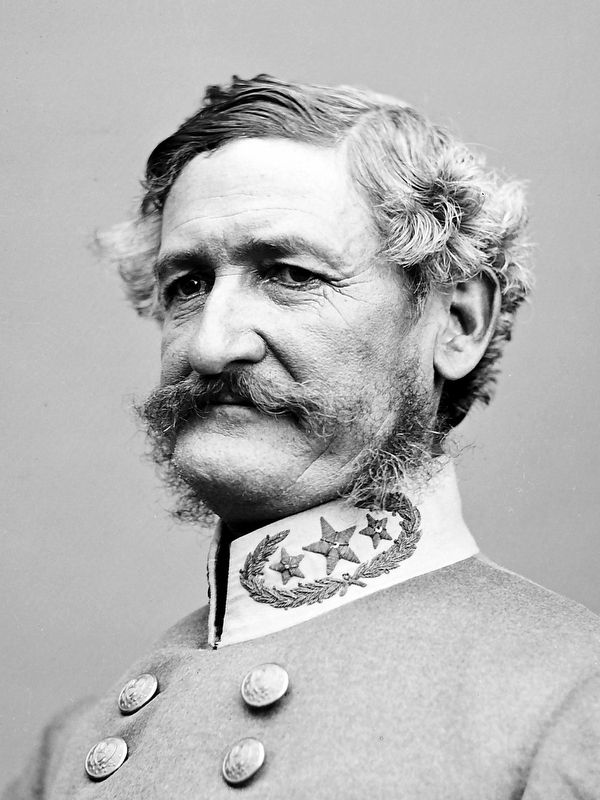
Sibley, graduate of West Point and veteran soldier from Nacogdoches, Louisiana, had served in the Mexican-American War and on the frontier in New Mexico against the Navajos. He resigned from serving the North at Fort Union in New Mexico in 1861 to join the Confederacy. His first objective was to take the Colorado gold fields, which he hoped would provide support for the Southern cause. His second objective was to establish a supply port on the Pacific Coast that the Union could not blockade. However, his expeditions were doomed by miscalculations and the poor state of his own health. He failed to gain the support he expected from New Mexico Hispanics, who had become tired of ill treatment at the hands of the Texans, and he was unable to acquire anticipated supplies along the western route. During the Battle of Valverde, Sibley suffered miserably from kidney-stone pain, and he was known to frequently become incapacitated from the alcohol he drank to dull this pain. Sibley never matched the achievements of his fellow West Point graduates during the Civil War, or afterward. One report has him dying
Photographed by James Hulse, July 23, 2024
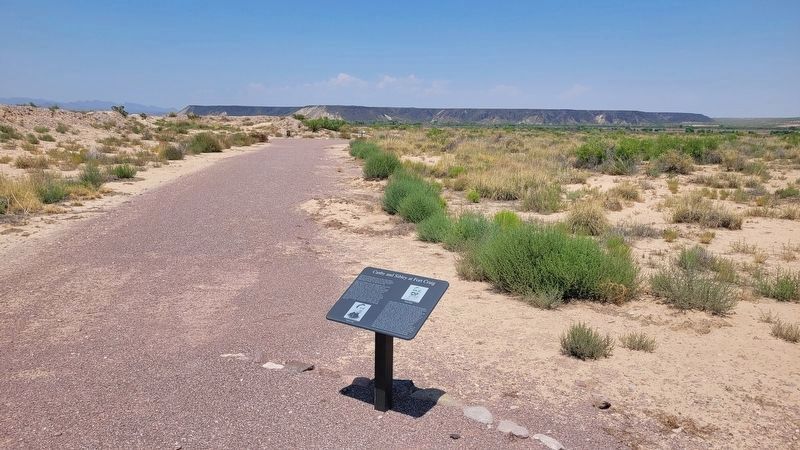
2. The view of the Canby and Sibley at Fort Craig Marker along the trail
Captions
Colonel Canby (left)
Museum of New Mexico (negative #54169)
Colonel Sibley (right)
Museum of New Mexico (negative #50541)
Topics. This historical marker is listed in these topic lists: Forts and Castles • War, US Civil. A significant historical year for this entry is 1862.
Location. 33° 38.168′ N, 107° 0.785′ W. Marker is near San Antonio, New Mexico, in Socorro County. It is on Fort Craig Road 4½ miles south of Old US Hwy 85 (New Mexico Highway 1). The marker is located at the Fort Craig Historic Site along the visitor trail. Touch for map. Marker is at or near this postal address: 457 Fort Craig Road, San Antonio NM 87832, United States of America. Touch for directions.

Regionally, this marker is in Southwest New Mexico and in the Rio Grande Valley. It is also in the American Southwest. Globally, it is in North America, the Western Hemisphere, the Western World, and the Anglosphere. Historically, it finds itself in what was once New Spain and also the Republic of Texas.
Public Domain - Lilienthal, Theo. (Theodore) - Library of Congress, circa 1860s
3. General Edward Canby
Other nearby markers. At least 8 other markers are within walking distance of this marker: The Battle of Valverde (here, next to this marker); Officers' Quarters (within shouting distance of this marker); Guard House and Sally Port (about 300 feet away, measured in a direct line); Parade Grounds and Enlisted Quarters About 1867 (about 300 feet away); The Buffalo Soldiers (about 400 feet away); Company Quarters (about 500 feet away); Commanding Officer's Quarters (about 500 feet away); The Establishment of Fort Craig (about 600 feet away). Touch for a list and map of all markers in San Antonio.
More about this marker. At Fort Craig Historic Site, an ADA accessible, self-guided interpretive trail is open seven days a week, from 8:00 a.m. to one-hour before sunset. The visitor’s center is open Thursday through Monday from 8:00 a.m. to 5:00 p.m.
Also see . . .
1. Fort Craig Historic Site. blm.gov
Fort Craig, established in 1854, was one of the largest and most important frontier forts in the West. Set in the rugged beauty of Socorro County, N.M., it was one of the eight forts situated along the primary north-south road(Submitted on August 5, 2024, by James Hulse of Medina, Texas.)in the Rio Grande Valley. Fort Craig played a crucial role in Indian campaigns and the Civil War.Photographed by James Hulse, circa 1860s4. Henry Hopkins Sibley
2. Edward Canby. Wikipedia
Edward Richard Sprigg Canby (November 9, 1817 – April 11, 1873) was a career United States Army officer and a Union general in the American Civil War. He served as a military governor after the war.(Submitted on August 7, 2024, by James Hulse of Medina, Texas.)
3. Henry Hopkins Sibley. Wikipedia
Henry Hopkins Sibley (May 25, 1816 – August 23, 1886) was a career officer in the United States Army, who commanded a Confederate cavalry brigade in the Civil War.(Submitted on August 7, 2024, by James Hulse of Medina, Texas.)
Credits. This page was last revised on August 20, 2026. It was originally submitted on August 4, 2024, by James Hulse of Medina, Texas. This page has been viewed 283 times since then and 47 times this year. Photos: 1, 2, 3, 4. submitted on August 7, 2024, by James Hulse of Medina, Texas.
