Near La Plume in Lackawanna County, Pennsylvania — The American Northeast (Mid-Atlantic)
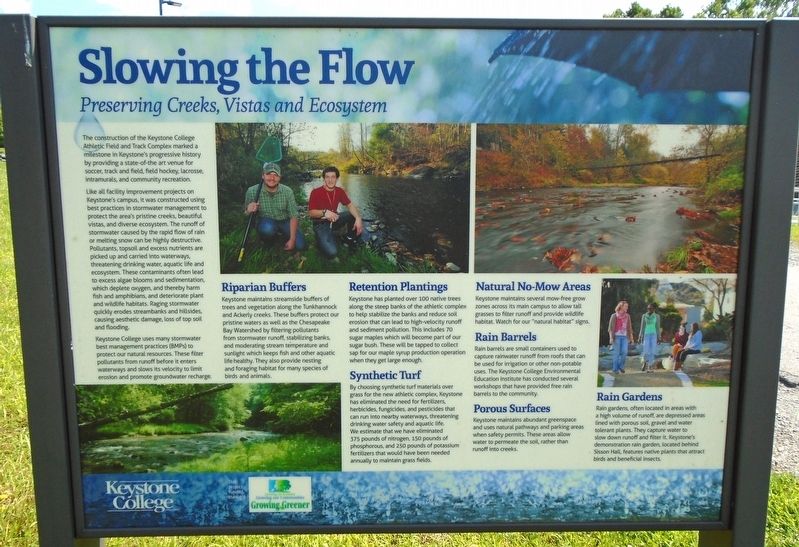
Slowing the Flow
Preserving Creeks, Vistas and Ecosystem
Photographed by William Fischer, Jr., July 26, 2024
1. Slowing the Flow Marker
The construction of the Keystone College Athletic Field and Track Complex marked a milestone in Keystone's progressive history by providing a state-of-the art venue for soccer, track and field, field hockey, lacrosse, intramurals, and community recreation.
Like all facility improvement projects on Keystone's campus, it was constructed using best practices in stormwater management to protect the area's pristine creeks, beautiful vistas, and diverse ecosystem. The runoff of stormwater caused by the rapid flow of rain or melting snow can be highly destructive. Pollutants, topsoil and excess nutrients are picked up and carried into waterways, threatening drinking water, aquatic life and ecosystem. These contaminants often lead to excess algae blooms and sedimentation, which deplete oxygen, and thereby harm fish and amphibians, and deteriorate plant and wildlife habitats. Raging stormwater quickly erodes streambanks and hillsides, causing aesthetic damage, loss of top soil and flooding.
Keystone College uses many stormwater best management practices (BMPs) to protect our natural resources. These filter pollutants
this page online
Riparian Buffers
Keystone maintains streamside buffers of trees and vegetation along the Tunkhannock and Ackerly creeks. These buffers protect our pristine waters as well as the Chesapeake Bay Watershed by filtering pollutants from stormwater runoff, stabilizing banks, and moderating stream temperature and sunlight which keeps fish and other aquatic life healthy. They also provide nesting and foraging habitat for many species of birds and animals.
Retention Plantings
Keystone has planted over 100 native trees along the steep banks of the athletic complex to help stabilize the banks and reduce soil erosion that can lead to high-velocity runoff and sediment pollution. This includes 70 sugar maples which will become part of our sugar bush. These will be tapped to collect sap for our maple syrup production operation when they get large enough.
Synthetic Turf
By choosing synthetic turf materials over grass for the new athletic complex, Keystone has eliminated the need for fertilizers, herbicides, fungicides,
Photographed by William Fischer, Jr., July 26, 2024
2. Slowing the Flow Marker
Natural No-Mow Areas
Keystone maintains several mow-free grow zones across its main campus to allow tall grasses to filter runoff and provide wildlife habitat. Watch for our "natural habitat” signs.
Rain Barrels
Rain barrels are small containers used to capture rainwater runoff from roofs that can be used for irrigation or other non-potable uses. The Keystone College Environmental Education Institute has conducted several workshops that have provided free rain barrels to the community.
Porous Surfaces
Keystone maintains abundant greenspace and uses natural pathways and parking areas when safety permits. These areas allow water to permeate the soil, rather than runoff into creeks.
Rain Gardens
Rain gardens, often located in areas with a high volume of runoff, are depressed areas lined with porous soil, gravel and water tolerant plants. They capture water to slow down runoff and filter it. Keystone's demonstration rain garden, located behind Sisson Hall, features native plants that attract birds and beneficial insects.
Erected by Keystone College.
Topics. This historical marker is listed in this topic list: Environment.
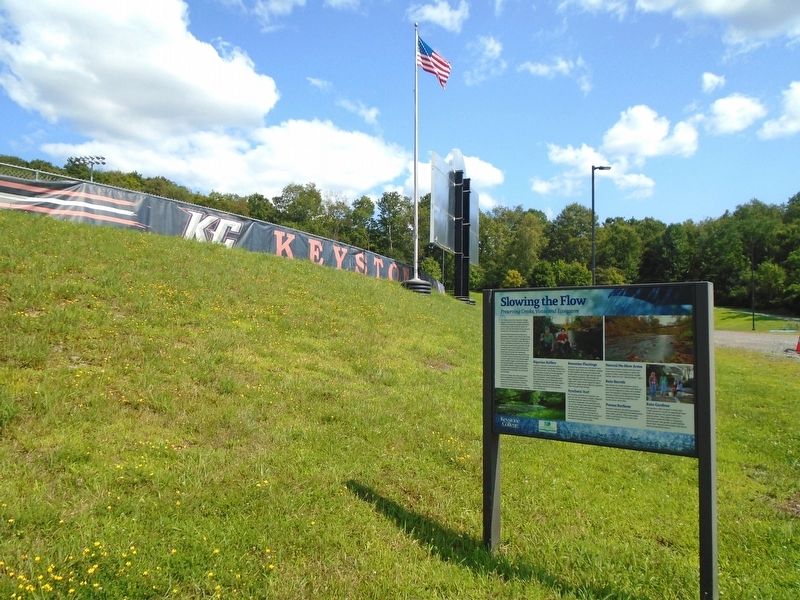
Location. 41° 33.502′ N, 75° 46.218′ W. Marker is near La Plume, Pennsylvania, in Lackawanna County. It is on Woodland Campus Drive, on the left when traveling south. Marker is on the Keystone College campus, near the athletic stadium and the Eckel Pavilion. Touch for map. Marker is in this post office area: La Plume PA 18440, United States of America. Touch for directions.

Regionally, this marker is in the Wyoming Valley and in Greater Scranton and Wilkes-Barre. It is also in the American Northeast, in the Mid-Atlantic, in Appalachia, and specifically in Northern Appalachia. Globally, it is in North America, the Western Hemisphere, the Western World, and the Anglosphere. Historically, it finds itself in what was once the Haudenosaunee (Iroquois) Confederacy and also one of the original Thirteen Colonies.
Other nearby markers. At least 8 other markers are within walking distance of this marker: Keystone College Sugar Shack (about 500 feet away, measured in a direct line); Fun Maple Syrup Facts (about 500 feet away); History of Maple Syrup (about 500 feet away); From Sap to Syrup: The Making of Maple Sugar (about 500 feet away); Professor Howard D. Jennings (about 500 feet away); Station 17: Maple Sugaring (about 600 feet away); The Northern Electric Interurban Trolley (about 600 feet away); a different marker also named Professor Howard D. Jennings (about 700 feet away). Touch for a list and map of all markers in La Plume.
Regarding Slowing the Flow. Although primarily focused on ecological practices, there are tidbits of historical information included.
Credits. This page was last revised on August 5, 2024. It was originally submitted on August 5, 2024, by William Fischer, Jr. of Reynoldsburg, Ohio. This page has been viewed 158 times since then and 14 times this year. Photos: 1, 2. submitted on August 5, 2024, by William Fischer, Jr. of Reynoldsburg, Ohio.
