Near Fingal in Elgin County, Ontario — Central Canada (North America)
The Talbot Settlement
⎯⎯⎯
La Colonie de Talbot
Photographed by Tim Boyd, July 27, 2024
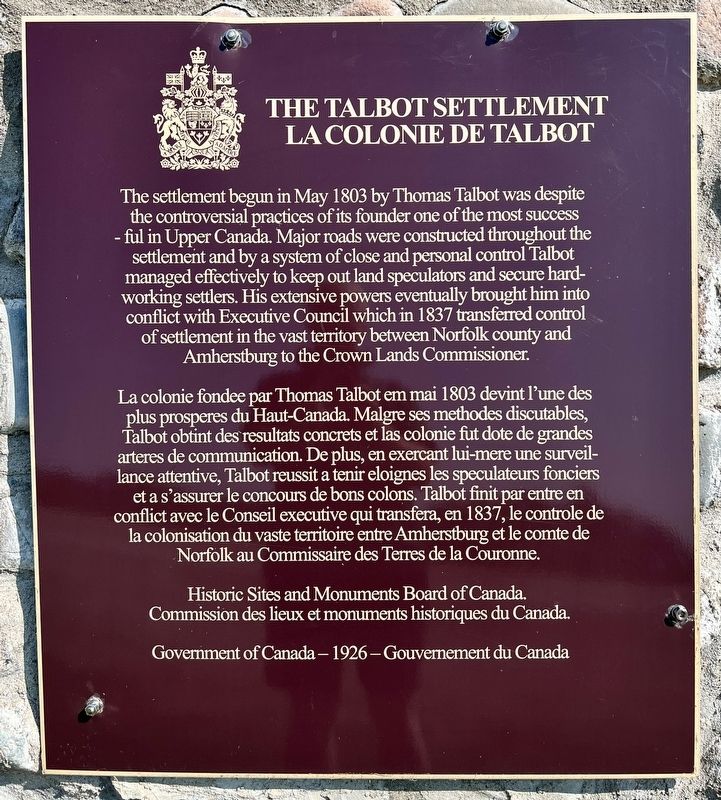
1. The Talbot Settlement/ La Colonie de Talbot Marker

The settlement begun in May 1803 by Thomas Talbot was despite the controversial practices of its founder one of the most successful in Upper Canada. Major roads were constructed throughout the settlement and by a system of close and personal control Talbot managed effectively to keep out land speculators and secure hard-working settlers. His extensive powers eventually brought him into conflict with Executive Council which in 1837 transferred control of settlement in the vast territory between Norfolk county and Amherstburg to the Crown Lands Commissioner.
La colonie fondee par Thomas Talbot en mai 1803 devint l'une des plus prosperes du Haut-Canada. Malgre ses methodes discutables, Talbot obtint des resultats concrets et las colonie fut dote de grandes arteres de communication. De plus, en exerçant lui-meme une surveillance attentive, Talbot reussit a tenir eloignes les speculateurs fonciers et a s'assurer le concours de bons colons. Talbot finit par entre en conflict avec le Conseil executive qui transfera, en 1837, le contrôle de la colonisation du vaste territoire
this page online
Historic Sites and Monuments Board of Canada.
Commission des lieux et monuments historiques du Canada.
Government of Canada - 1926 - Gouvernement du Canada
Erected 1926 by Historic Sites and Monuments Board of Canada.
Topics and series. This historical marker is listed in these topic lists: Roads & Vehicles • Settlements & Settlers. In addition, it is included in the Canada, Historic Sites and Monuments Board series list. A significant historical month for this entry is May 1803.
Location. 42° 38.4′ N, 81° 21.963′ W. Marker is near Fingal, Ontario, in Elgin County. It is on Fingal Line 3.3 kilometers west of Iona Road, on the left when traveling west. Touch for map. Marker is at or near this postal address: 32086 Fingal Line, Fingal ON N0L 1K0, Canada. Touch for directions.

Regionally, this marker is in the Southwest Ontario Area and in Southwestern Ontario. It is also in Central Canada. Globally, it is in North America, on the Great Lakes, in the Western Hemisphere, in the Western World, and in the Anglosphere. Historically,

Photographed by Tim Boyd, July 27, 2024
2. The Talbot Settlement/ La Colonie de Talbot Marker
Other nearby markers. At least 8 other markers are within 8 kilometers of this marker, measured as the crow flies: Col. Thomas Talbot (here, next to this marker); Col. Mahlon Burwell (approx. 2.8 kilometers away); Burwell’s Corners (approx. 2.8 kilometers away); Southwold: The remains of an indian village/Southwold: Les vestiges d’un village amérindien (approx. 3.7 kilometers away); Southwold Earthworks/Les Fortifications en Terre de Southwold (approx. 3.8 kilometers away); RCAF No. 4 Bombing and Gunnery School (approx. 6.1 kilometers away); Ellis Wellwood Sifton, V.C. (approx. 7.1 kilometers away); St. Peter’s Church 1827 (approx. 7.1 kilometers away). Touch for a list and map of all markers in Fingal.
Also see . . . Dictionary of Canadian Biography - Talbot, Thomas.
The achievements of Thomas Talbot are embodied in the settlement named for him. The vast region he supervised, particularly along the Talbot roads, was better developed in terms of agriculture and commerce than(Submitted on August 5, 2024, by Tim Boyd of Hamilton, Ontario.)most of the rest of the province. The best features of his system of land supervision, such as the roads, were never implemented in settlements elsewhere in Upper Canada. He worked alone and placed himself above everyone, alienating most provincial officials by his apparent avarice for land and by his direct recourse to the imperial government. Nevertheless, for several decades, the benefit to the province which resulted from Talbot’s solitary, honest supervision far outweighed the personal benefits he enjoyed. 3. Col. Thomas Talbot
Credits. This page was last revised on August 6, 2024. It was originally submitted on August 5, 2024, by Tim Boyd of Hamilton, Ontario. This page has been viewed 1,392 times since then and 311 times this year. Photos: 1, 2, 3. submitted on August 5, 2024, by Tim Boyd of Hamilton, Ontario. • Andrew Ruppenstein was the editor who published this page.
