La Plume in Lackawanna County, Pennsylvania — The American Northeast (Mid-Atlantic)
Ticks, Mosquitoes & Gnats
Small but Pesky

Photographed by William Fischer, Jr., July 26, 2024
1. Ticks, Mosquitoes & Gnats Marker
Gnats
Actually Black Flies!
Are you bothered by those little bugs flying around your face? Late spring into early summer brings those pesky little bugs commonly known as "gnats." These "gnats" are actually black flies, part of the Simulium jenningsi species.
Since the 1970s, black flies have been classified as a pest of humans and livestock in Pennsylvania. As efforts to clean up pollutants in the waterways in the state came into effect, this created the perfect breeding ground for black flies to thrive. The larvae of these insects spend much of their time in fast-flowing waters, while feeding on miniature particles.
Black flies are commonly associated with their annoying habit of swarming around the face and persistent biting. Black flies are attracted to the following: carbon dioxide exhaled by humans and animals, perspiration, fragrances, dark clothing, and moving objects.
In particular, female black flies will often enter the eyes, ears, nose, and mouth of humans and animals in an attempt to find a host. A suitable host would be one that could provide the blood needed for egg production
this page online
In the 1980s, Pennsylvania initiated the PA Black Fly Suppression Program. This program uses helicopters to spray Bacillus thuringiensis israelensis (Bti), a naturally occurring soil bacterium, over affected areas. This bacterium selectively targets four of the black fly species that are most bothersome for humans and livestock.
Erected by Keystone College, Overlook Estate Foundation, PA DCNR, Endless Mountains Visitors Bureau, and Endless Mountains Heritage Region.
Topics. This historical marker is listed in these topic lists: Animals • Environment.
Location. 41° 33.334′ N, 75° 46.392′ W. Marker is in La Plume, Pennsylvania, in Lackawanna County. It can be reached from Nokomis Forest Stewardship Trail. Marker is along the Countryside Trolley Trail, about one fifth mile west of the Whitney Chamberlin Memorial Trailhead, on the Keystone College campus. Touch for map. Marker is in this post office area: La Plume PA 18440, United States of America. Touch for directions.

Regionally, this marker is in the Wyoming Valley and in

Photographed by William Fischer, Jr., July 26, 2024
2. Ticks, Mosquitoes & Gnats Marker
Other nearby markers. At least 8 other markers are within walking distance of this marker: After 25 Years...The Final Chapter (within shouting distance of this marker); Eastern Hemlock (Tsuga canadensis) (about 400 feet away, measured in a direct line); The Northern Electric Interurban Trolley (approx. 0.2 miles away); Slowing the Flow (approx. ¼ mile away); Veterans Memorial (approx. ¼ mile away); Harris Hall Bell Memorial (approx. 0.3 miles away); Keystone College Sugar Shack (approx. 0.3 miles away); Christy Mathewson (approx. 0.3 miles away). Touch for a list and map of all markers in La Plume.
Regarding Ticks, Mosquitoes & Gnats. The marker is primarily nature related but the Gnats section provides limited historical information, and is
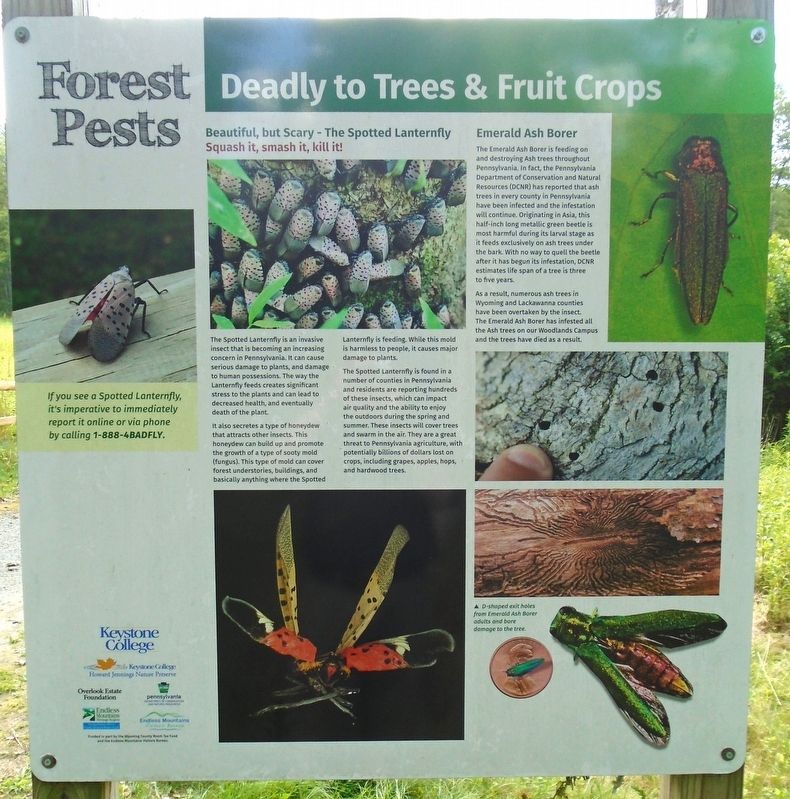
Photographed by William Fischer, Jr., July 26, 2024
3. Forest Pests Marker (nearby)
invasive pests. No historical info, so not transcribed.
Credits. This page was last revised on August 6, 2024. It was originally submitted on August 6, 2024, by William Fischer, Jr. of Reynoldsburg, Ohio. This page has been viewed 148 times since then and 12 times this year. Photos: 1, 2, 3. submitted on August 6, 2024, by William Fischer, Jr. of Reynoldsburg, Ohio.
