Bozeman Cannery
Oak Street Pathway
| — | Great American Rail-Trail | — |
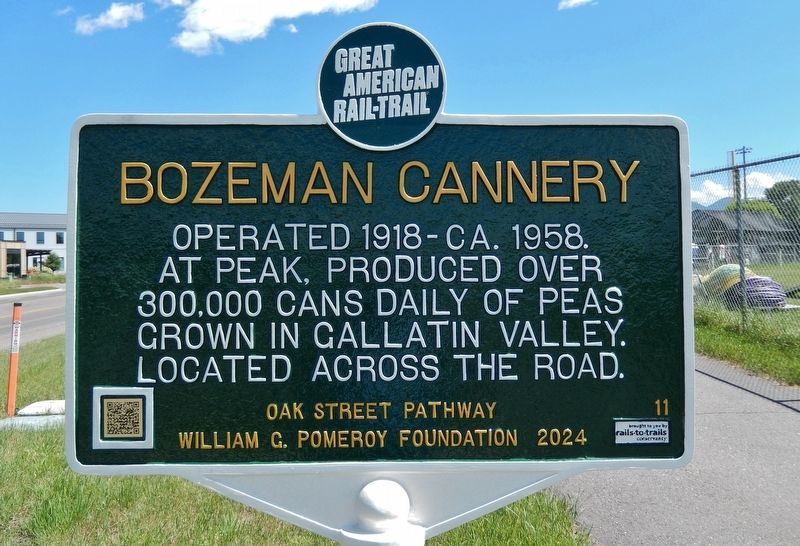
Operated 1918-ca. 1958. At peak, produced over 300,000 cans daily of peas grown in Gallatin Valley. Located across the road.
Erected 2024 by William G. Pomeroy Foundation. (Marker Number 11.)
Topics and series. This historical marker is listed in these topic lists: Agriculture • Industry & Commerce. In addition, it is included in the William G. Pomeroy Foundation series list. A significant historical year for this entry is 1918.
Location. 45° 41.538′ N, 111° 2.092′ W. Marker is in Bozeman, Montana, in Gallatin County. It is at the intersection of East Oak Street and North Bozeman Avenue, on the left when traveling east on East Oak Street. Touch for map. Marker is in this post office area: Bozeman MT 59715, United States of America. Touch for directions.

Regionally, this marker is in Yellowstone Country. It is also in the American Mountain West and in the Lewis & Clark Corridor. Globally, it is in North America, the Rocky Mountains, the Western Hemisphere, the Western World, and the Anglosphere. Historically, it finds itself in what was once Rupert’s Land and also the Louisiana Purchase.
Other nearby markers. At
this page online
Also see . . .
1. Bozeman Cannery District: History. Excerpt:
Over a century ago, the Bozeman Canning Company produced more than 75% of the nation’s pea supply. Original buildings from more than a century ago still stand and have been adaptively redesigned into shops, restaurants, gyms, and more.(Submitted on August 7, 2024, by Cosmos Mariner of Cape Canaveral, Florida.)The Bozeman Canning Company was founded in 1917 and opened in the summer of 1918, canning peas, beans, and carrots. Between 3,000 and 3,500 acres were contracted by three to four growers to feed the cannery. On average the facility produced 13,000 cases of peas each day.
They were marketed as “peas that please” and distributed across
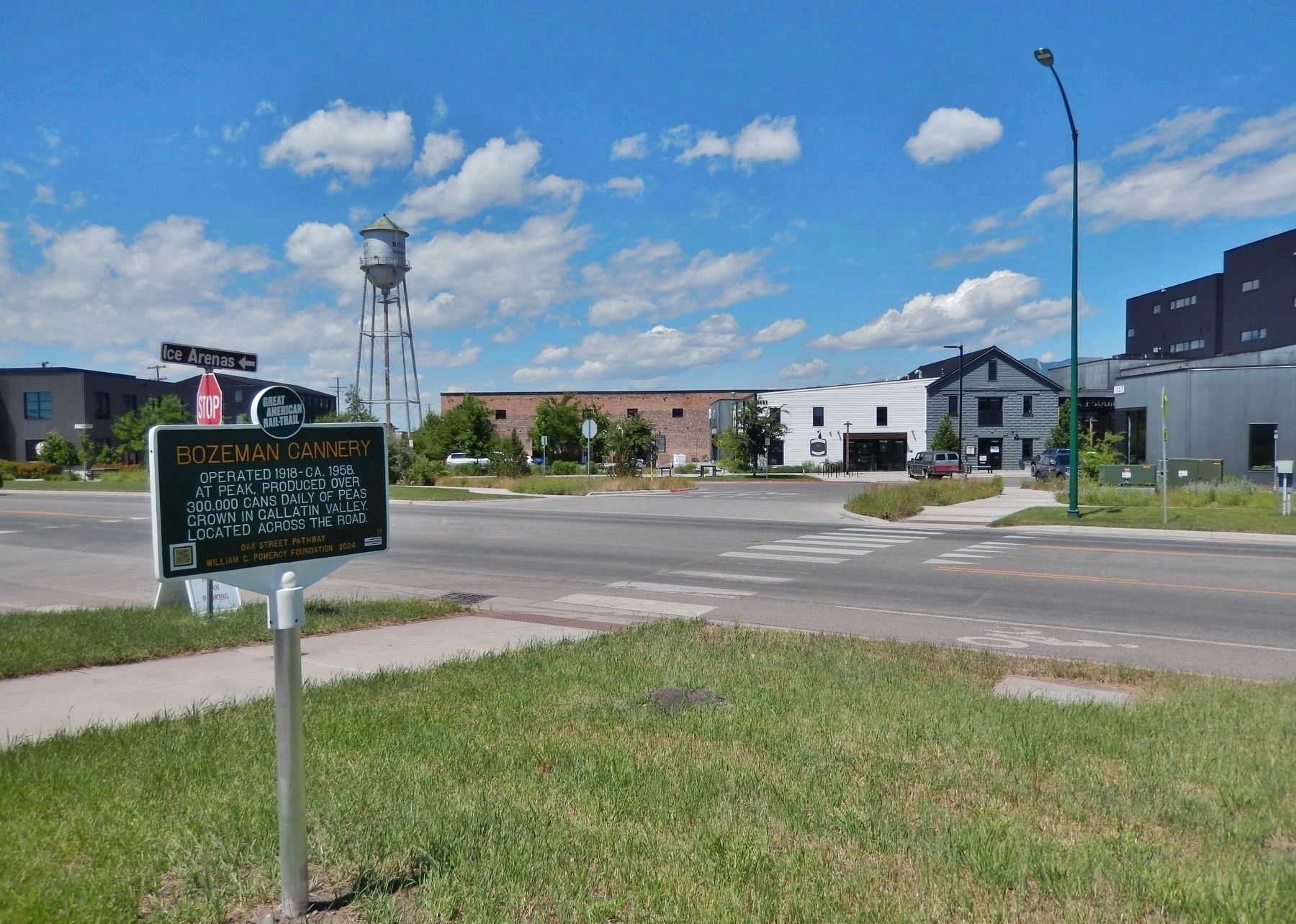
the nation with brand names such as “Gallatin Valley” and “Bridger Canyon.” The cannery was open 15-20 hours a day during peak harvest, employing 250-275 people. Because of the selective service draft during World War II, high school students and housewives were the backbone of the cannery workforce along with retirees, migrant workers, the not yet drafted, and hoboes.Photographed by Cosmos Mariner, July 5, 20242. Bozeman Cannery MarkerLooking north across East Oak Street; the former Bozeman Cannery site is in the background.The still-standing original steel water tower is symbolic of the Cannery District’s roots in old Bozeman, overlooking the original canning warehouse, powerhouse and canning building. Originally it was used as a water source for an early 1900s fire suppression system.
2. Gallatin Agricultural History (bozemanmagazine.com). Excerpt:
From 1918 until 1951, the pea cannery operated under the name of Pict-Sweet, and in 1951 the name changed to Bozeman Canning Company. Limitations on wheat acreage made the cannery very important to local farmers. Growers were able to raise a green pea crop on lands which otherwise lie idle for the year in summer fallow.(Submitted on August 7, 2024, by Cosmos Mariner of Cape Canaveral, Florida.)In 1956, 1,600 acres of peas were being grown by local farmers for the cannery and many other acres were used for raising seed peas. In 1955, the plant capacity was eight to ten tons of peas an hour. It was the development of a new method of preserving foods — freezing them — that brought about the closing
of the Bozeman Canning Company.
Credits. This page was last revised on March 5, 2026. It was originally submitted on August 6, 2024, by Cosmos Mariner of Cape Canaveral, Florida. This page has been viewed 399 times since then and 78 times this year. Photos: 1, 2. submitted on August 7, 2024, by Cosmos Mariner of Cape Canaveral, Florida.
