Silver Bow Park in Butte in Silver Bow County, Montana — The American West (Mountains)
Socialist Hall
Photographed by Cosmos Mariner, July 5, 2024
1. Socialist Hall Marker
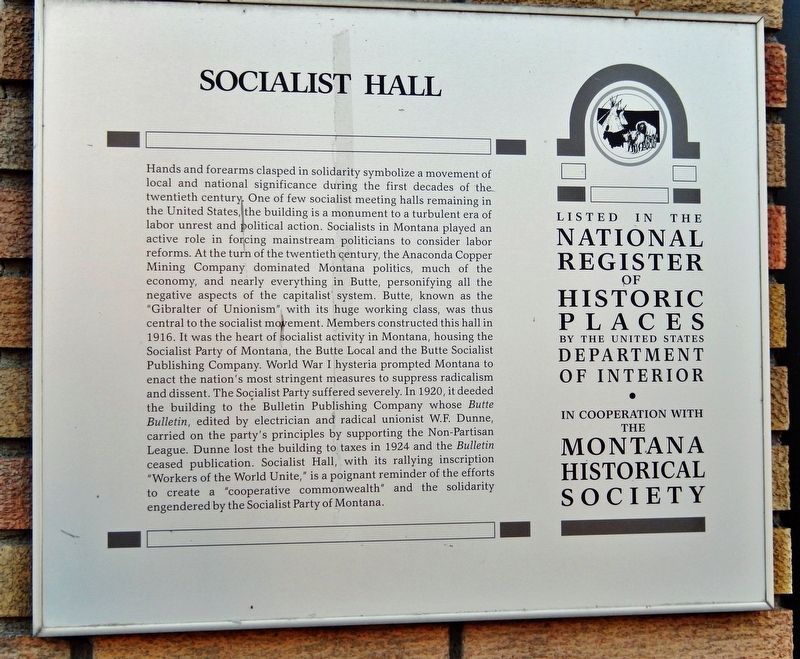
Hands and forearms clasped in solidarity symbolize a movement of local and national significance during the first decades of the twentieth century. One of few socialist meeting halls remaining in the United States, the building is a monument to a turbulent era of labor unrest and political action. Socialists in Montana played an active role in forcing mainstream politicians to consider labor reforms. At the turn of the twentieth century, the Anaconda Copper Mining Company dominated Montana politics, much of the economy, and nearly everything in Butte, personifying all the negative aspects of the capitalist system. Butte, known as the “Gibralter of Unionism” with its huge working class, was thus central to the socialist movement. Members constructed this hall in 1916. It was the heart of socialist activity in Montana, housing the Socialist Party of Montana, the Butte Local and the Butte Socialist Publishing Company. World War I hysteria prompted Montana to enact the nation's most stringent measures to suppress radicalism and dissent. The Socialist Party suffered severely. In 1920, it deeded the building to the Bulletin
this page online
Erected by Montana Historical Society.
Topics and series. This historical marker is listed in these topic lists: Architecture • Government & Politics • Industry & Commerce • Labor Unions. In addition, it is included in the Montana National Register Sign Program, and the National Register of Historic Places (NRHP) series lists. A significant historical year for this entry is 1916.
Location. 45° 59.63′ N, 112° 30.772′ W. Marker is in Butte, Montana, in Silver Bow County. It is in Silver Bow Park. It is on Harrison Avenue (Business Interstate 15/90) just north of Cobban Street, on the left when traveling north. The marker is mounted at eye-level, directly on the

Photographed by Cosmos Mariner, July 5, 2024
2. Socialist Hall Marker
The marker is on the left/south edge of the front facade.

Regionally, this marker is in andspecifically outhwest Montana, in Gold West Country, in Mining Country. It is also in the American Mountain West and in the Lewis & Clark Corridor. Globally, it is in North America, the Rocky Mountains, the Western Hemisphere, the Western World, and the Anglosphere. Historically, it finds itself in what was once Rupert’s Land and also the Louisiana Purchase.
Other nearby markers. At least 8 other markers are within 2 miles of this marker, measured as the crow flies: 9-11-01 All Gave Some, Some Gave All (about 400 feet away, measured in a direct line); Town Pump Trail (approx. 0.6 miles away); Northern Pacific Locomotive 25 (approx. 0.6 miles away); St. Joseph's Catholic Church (approx. one mile away); Mining The Berkeley Pit 1955-1982 (approx. 1.3 miles away); The Berkeley Pit: The Water Returns (approx. 1.3 miles away); The Berkeley Pit Threatens the Water (approx. 1.3 miles away);
Photographed by Cosmos Mariner, July 5, 2024
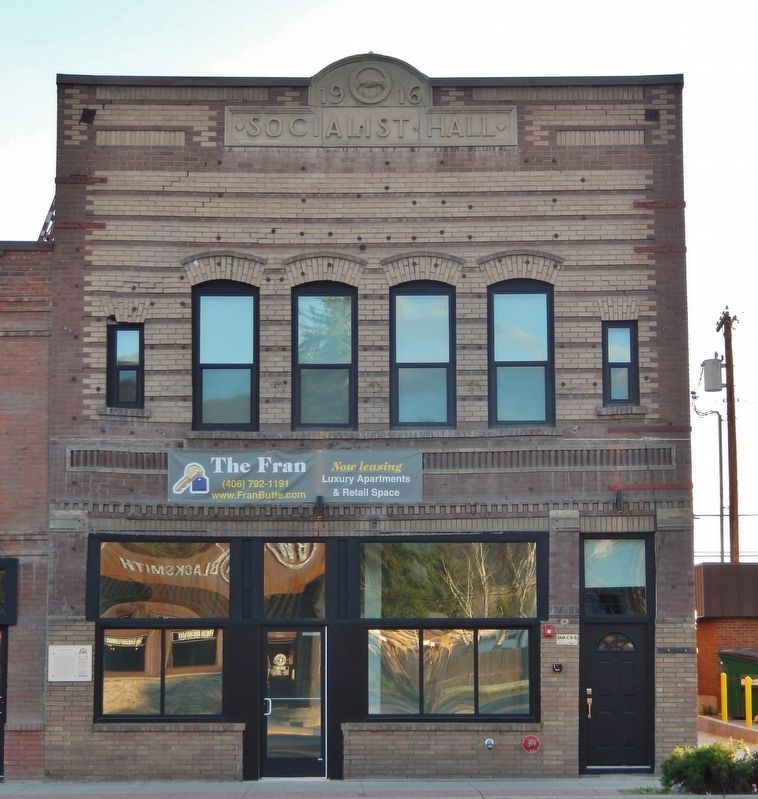
3. Socialist Hall (front/east elevation)
Regarding Socialist Hall. National Register of Historic Places #95000661.
From the National Register Nomination prepared by John Phillips, History Intern, SHPO, 10/29/1994:
Socialist Hall was built in the summer of 1916. The women's committee of the Butte Local raised funds for the purchase of the lot and the money and labor needed for its construction were donated. Frank Mabie was in charge of construction and the total project, including the lot, was estimated to cost $6,000. Socialist Hall is an important historic resource linked to the unique political events and turmoil that took place in Butte during the era of the First World War. Despite first floor alterations, the building maintains a large measure of original integrity. The original design and intent are vividly represented, including such important details as the decorative brick work, inscriptions and party symbols. Overall Socialist Hall retains its original integrity in location, design, materials, and most importantly in the feeling it conveys when you readthe inscription “Socialist Hall.”Photographed by Cosmos Mariner, July 5, 20244. Socialist Hall (central pediment panel)From the National Register Nomination:
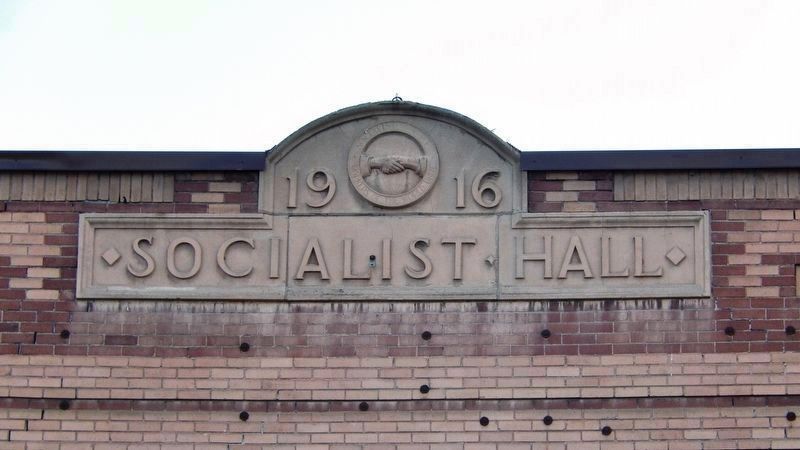
Projecting beyond the brick parapet cap is the arched top of the sandstone pediment. Within the central panel is a circular logo containing two hands and forearms clasped in a handshake. Surrounding the clasped hands, printed in relief is "* Socialist Party * Workers of the World Unite." Flanking the circle are large numerals, to the left "19" and on the right "16," indicating the date of construction. Below the circular portion of the panel is a horizontal panel with relief encryption "Socialist Hall."
Also see . . .
1. Socialist Hall (Wikipedia).
Excerpt: The Socialist Hall in Butte, Montana is one of the few socialist halls remaining in the United States. Erected in 1916, when the Socialist movement was strong in the city, it was active for only a few years until socialism fell out of favor amidst persecution of socialists and labor unionists including the Anaconda Road Massacre and the lynching of Frank Little. During its brief time of service, the Industrial Workers of the World met here, also holding meetings in Butte's Finlander Hall.(Submitted on August 7, 2024, by Cosmos Mariner of Cape Canaveral, Florida.)
2. Socialist Hall (Historic Montana). (Submitted on August 7, 2024, by Cosmos Mariner of Cape Canaveral, Florida.)
3. Historic Butte Socialist Hall now features luxury apartments, retail space.
Excerpt: Built in 1916, the Socialist Hall on Harrison Avenue had been in disarray since the closure of Fran Johnson’s in 2011, but after a new owner put more than $2 million into the building, it now boasts eight luxury apartments, two retail spaces, and(Submitted on August 7, 2024, by Cosmos Mariner of Cape Canaveral, Florida.)a new name – The Fran.Photographed by Cosmos Mariner, July 5, 20245. Socialist Hall (north elevation)From the National Register Nomination:
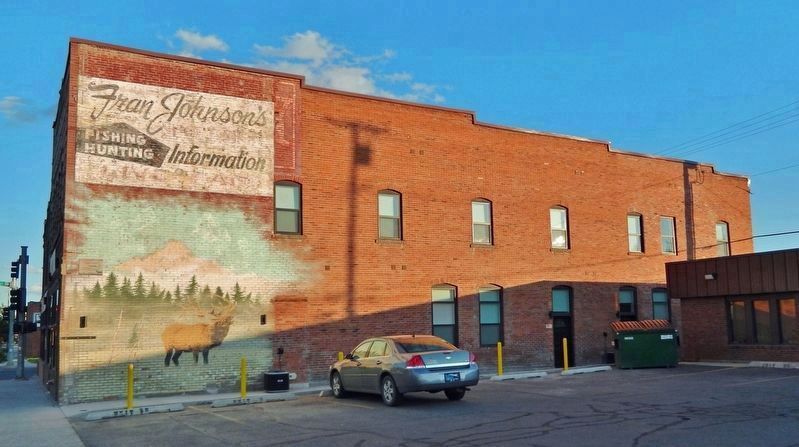
There are nine large window openings, six open to the second floor and three open to the first floor, all of which have lug sills and semi-elliptical arches above. There appears to be one door opening in the northeast corner. There is also a billboard and wildlife painting on the northeast section of the building.

Photographed by Cosmos Mariner, July 5, 2024
6. Socialist Hall (northeast elevation)
From the National Register Nomination:
Socialist Hall is an excellent example of craftsmanship and design in a two-part commercial block style building. It is a two story building with highly decorative dichromatic brickwork and varied details visible on the upper portion of the main facade. The primary facade (east elevation) faces Harrison Avenue and is clad with chocolate colored and beige brick, all with a high fired face. Brick coursing is running bond, the main body is defined by the horizontal banding of four courses of beige brick with one recessed course of chocolate brick. The horizontal banding is terminated at each side with a vertical area of chocolate brick with a quoin detailing.
Socialist Hall is an excellent example of craftsmanship and design in a two-part commercial block style building. It is a two story building with highly decorative dichromatic brickwork and varied details visible on the upper portion of the main facade. The primary facade (east elevation) faces Harrison Avenue and is clad with chocolate colored and beige brick, all with a high fired face. Brick coursing is running bond, the main body is defined by the horizontal banding of four courses of beige brick with one recessed course of chocolate brick. The horizontal banding is terminated at each side with a vertical area of chocolate brick with a quoin detailing.
Credits. This page was last revised on August 19, 2026. It was originally submitted on August 7, 2024, by Cosmos Mariner of Cape Canaveral, Florida. This page has been viewed 723 times since then and 95 times this year. Photos: 1, 2, 3, 4, 5, 6. submitted on August 7, 2024, by Cosmos Mariner of Cape Canaveral, Florida.
