Shelbyville in Shelby County, Illinois — The American Midwest (Great Lakes)
The Horace M. Tallman House
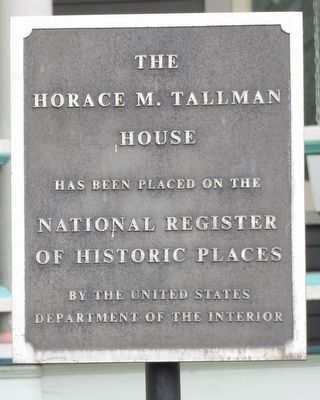
Photographed by Duane and Tracy Marsteller, March 30, 2019
1. Horace M. Tallman House Marker
Topics and series. This historical marker is listed in this topic list: Agriculture. In addition, it is included in the National Register of Historic Places (NRHP) series list. A significant historical year for this entry is 1905.
Location. 39° 24.387′ N, 88° 48.197′ W. Marker is in Shelbyville, Illinois, in Shelby County. It is at the intersection of West Main Street (Illinois Route 16) and South Douglass Street, on the right when traveling east on West Main Street. Touch for map. Marker is at or near this postal address: 816 W Main St, Shelbyville IL 62565, United States of America. Touch for directions.

Regionally, this marker is in Central Illinois. It is also in the American Midwest and in the Corn Belt. Globally, it is in North America, the Western Hemisphere, the Western World, and the Anglosphere. Historically, it finds itself in what was once the territory of the Mississippian Culture and also the Northwest Territory.
Other nearby markers. At least 8 other markers are within walking distance
this page online
Regarding The Horace M. Tallman House. Excerpt from the National Register nomination:
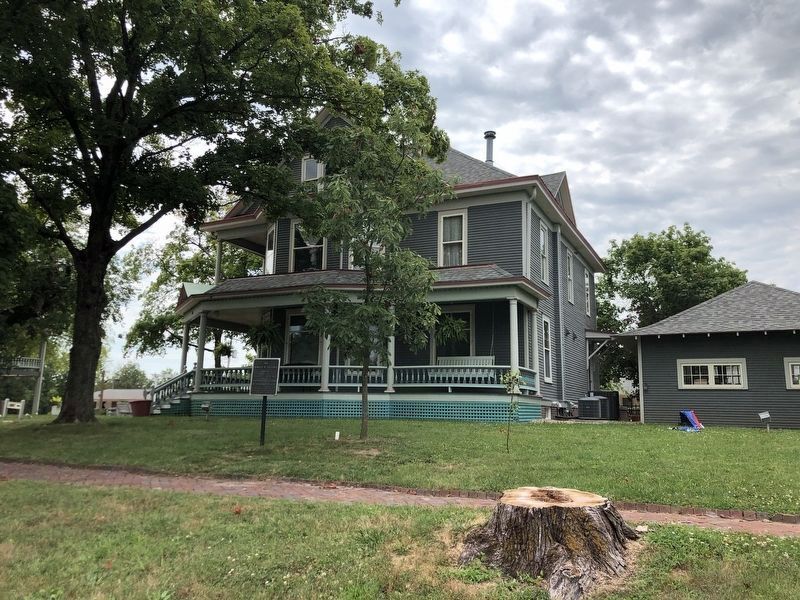
Horace Tallman and his sons moved the Ann Arbor Machine Company from Ann Arbor, Michigan to Shelbyville, Illinois in 1922. In 1928-29, Tallman conceived the idea of mounting a windrow pickup on one of the stationary balers that the Ann Arbor Machine Company had been manufacturing since 1882. His invention was tested in May, 1930 and the first one was sold two months later. The invention helped to automate a previously back-breaking process of baling, and quickly became sought-after all over the world. It succeededin making obsolete other hay tools, including the hay fork, loose hay loader, and stationary hay baler. … The Horace M. Tallman House is the only remaining building in Shelbyville closely associated with Tallman and his important invention.Photographed by Duane and Tracy Marsteller, July 8, 20242. Horace M. Tallman House and Marker
Also see . . . Horace M. Tallman House (PDF). National Register nomination for the property, which was listed in 1988. (Prepared by Charles Kirchner; via National Archives) (Submitted on August 7, 2024, by Duane and Tracy Marsteller of Murfreesboro, Tennessee.)
Credits. This page was last revised on August 14, 2024. It was originally submitted on August 7, 2024, by Duane and Tracy Marsteller of Murfreesboro, Tennessee. This page has been viewed 218 times since then and 19 times this year. Photos: 1, 2. submitted on August 7, 2024, by Duane and Tracy Marsteller of Murfreesboro, Tennessee.
