
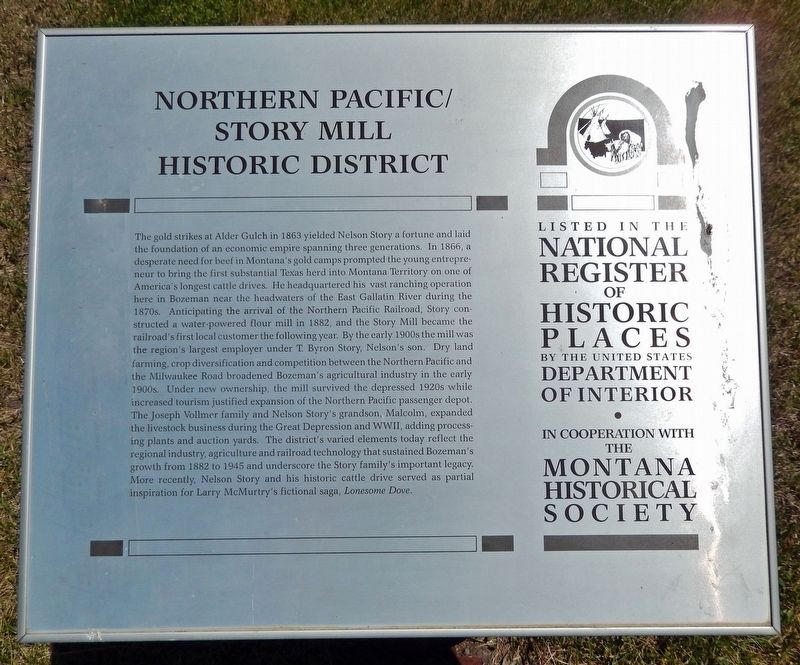
Northern Pacific/Story Mill Historic District
this page online
Erected by Montana Historical Society.
Topics and series. This historical marker is listed in these topic lists: Agriculture • Architecture • Industry & Commerce • Railroads & Streetcars. In addition, it is included in the Chicago, Milwaukee, St. Paul and Pacific Railroad, and the National Register of Historic Places (NRHP) series lists. A significant historical year for this entry is 1863.
Location. 45° 42.072′ N, 111° 1.255′ W. Marker is in Bozeman, Montana, in Gallatin County. It can be reached from the intersection of Story Mill Road and Hillside Lane, on the left when traveling south. The marker is located near the northwest corner of the Story Mill Complex grounds.


Regionally, this marker is in Montana’s Yellowstone Country. It is also in the American Mountain West and in the Lewis & Clark Corridor. Globally, it is in North America, the Rocky Mountains, the Western Hemisphere, the Western World, and the Anglosphere. Historically, it finds itself in what was once Rupert’s Land and also the Louisiana Purchase.
Other nearby markers. At least 8 other markers are within 2 miles of this marker, measured as the crow flies: Story Mill (about 300 feet away, measured in a direct line); Bozeman Cannery (approx. 0.9 miles away); Lindsay Fruit Company (approx. one mile away); Brewery Historic District (approx. one mile away); Misco Grain Elevator (approx. 1.1 miles away); Bohart House (approx. 1.2 miles away); Peterson House (approx. 1.4 miles away); Apollo J. Busch House (approx. 1.4 miles away). Touch for a list and map of all markers in Bozeman.
Regarding Northern Pacific/Story Mill Historic District. National Register of Historic Places

From the National Register Nomination prepared by Derek Strahn, Bozeman City County Planning Office, 11/1994:
The Northern Pacific/Story Mill Historic District is located in the northeast corner of Bozeman, Montana, and contains the Northern Pacific Main Line, the Northern Pacific Rail Yard, the Story Mill Spur Line, the Story Mill Complex and many associated buildings, structures and sites.Bozeman's steady growth from the time of its settlement in 1863 through World War II is largely attributable to three significant factors: the tremendous fertility of the Gallatin Valley, the economic influence of the Nelson Story family, and the presence of the Northern Pacific and the Milwaukee Railroads. The geographic nexus for these interrelated influences was the Northern Pacific/Story Mill Historic District — the earliest and most active commercial/industrial center in the region.
The life of Nelson Story Sr. (1838-1926), epitomizes the means and manner in which capitalism was introduced and eventually flourished in the American West during the late nineteenth and early twentieth centuries. Indeed, more than any other single individual, Story molded the community of Bozeman in its infancy, playing a prolonged and significant role in its transformation from a frontier town to a thriving center of commerce and cultural refinement. His influence, together with that of his descendants, dramatically shaped the architectural and historic character of the region, and particularly the Northern Pacific/Story Mill Historic District.
Related markers.

Also see . . .
1. Northern Pacific / Story Mill Historic District (Historic Montana).
Roughly bounded by the Northern Pacific RR right-of-way and the Story Mill spur line from Wye to Bridger Canyon Road, Bozeman, Montana(Submitted on August 8, 2024, by Cosmos Mariner of Cape Canaveral, Florida.)
2. Nelson Story Sr. (Wikipedia). Excerpt:
Nelson Story Sr. was a pioneer Montana entrepreneur, cattle rancher, miner and vigilante, who was a notable resident of Bozeman, Montana. He was best known for his 1866 cattle drive from Texas with approximately 1000 head of Texas Longhorns to Montana along the Bozeman Trail — the first major cattle drive from Texas into Montana. This cattle drive inspired Larry McMurtry's Pulitzer Prize-winning novel Lonesome Dove.(Submitted on August 8, 2024, by Cosmos Mariner of Cape Canaveral, Florida.)By 1870, when placer mining in Montana was starting to decline, Story and his ranch in the Paradise Valley had become the leading cattleman in the northern plains. Some credit Story with naming the now famous Paradise Valley for its grand scenery and abundant wildlife.
In 1882, Story opened the Story Flour Mill at the mouth of Bridger Creek. This mill produced up to 100 bushels a day and was a major source of flour for the U.S. Army at Fort Ellis and for the Crow Indian Reservation in southeastern Montana. His business activities made him Bozeman's first millionaire.
In 2008, Story was inducted into the Montana Cowboy Hall of Fame as a founding, Legacy member. Nelson and Ellen Story are buried in Sunset Hills Cemetery, Bozeman, Montana along with several of their children.
Credits. This page was last revised on December 27, 2024. It was originally submitted on August 7, 2024, by Cosmos Mariner of Cape Canaveral, Florida. This page has been viewed 623 times since then and 47 times this year. Photos: 1, 2, 3, 4. submitted on August 7, 2024, by Cosmos Mariner of Cape Canaveral, Florida.
