Big Timber in Sweet Grass County, Montana — The American West (Mountains)
Sweet Grass Woolen Mill
Photographed by Cosmos Mariner, July 5, 2024
1. Sweet Grass Woolen Mill Marker
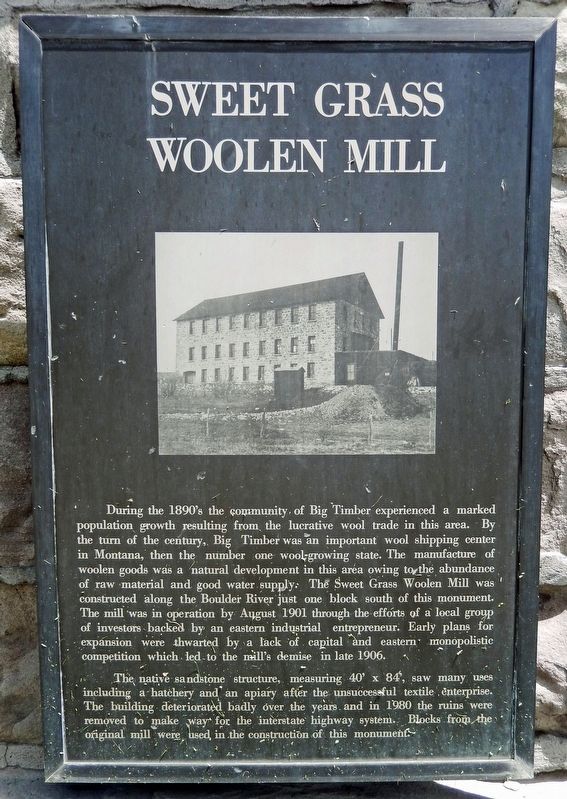
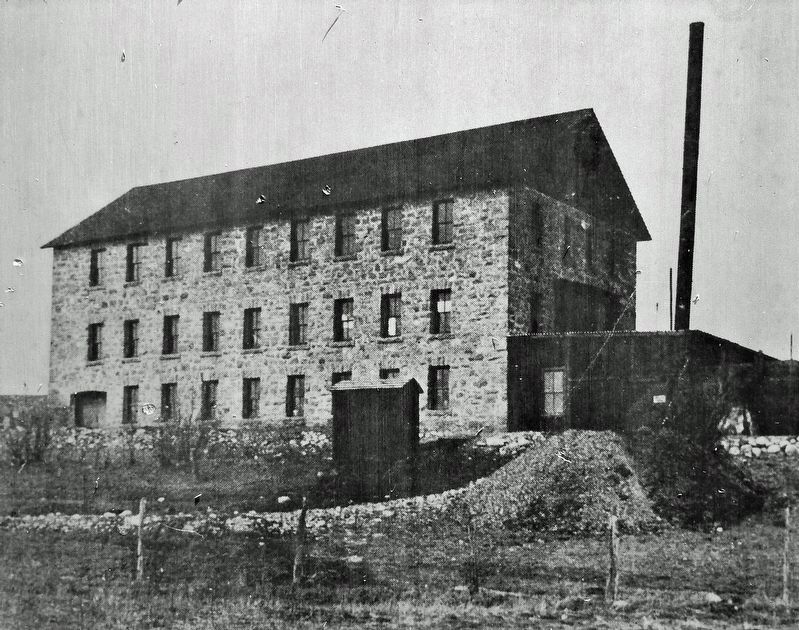
During the 1890's the community of Big Timber experienced a marked population growth resulting from the lucrative wool trade in this area. By the turn of the century, Big Timber was an important wool shipping center in Montana, then the number one wool-growing state. The manufacture of woolen goods was a natural development in this area owing to the abundance of raw material and good water supply. The Sweet Grass Woolen Mill was constructed along the Boulder River just one block south of this monument. The mill was in operation by August 1901 through the efforts of a local group of investors backed by an eastern industrial entrepreneur. Early plans for expansion were thwarted by a lack of capital and eastern monopolistic competition which led to the mill’s demise in late 1906.
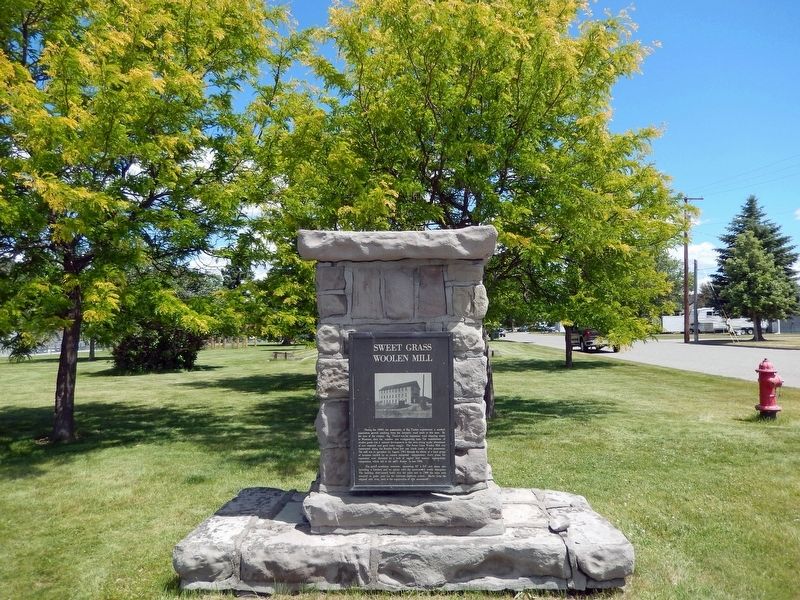
The native sandstone structure, measuring 40’ x 84’, saw many uses including a hatchery and an apiary after the unsuccessful textile enterprise. The building deteriorated badly over the years and in 1980 the ruins were removed to make way for the interstate highway system. Blocks from the original mill were used in the construction of this monument.
Topics.
this page online
Location. 45° 49.723′ N, 109° 56.863′ W. Marker is in Big Timber, Montana, in Sweet Grass County. It is at the intersection of McLeod Street and East 9th Avenue, on the left when traveling south on McLeod Street. The marker is located near the southwest corner of Lions Club Park. Touch for map. Marker is at or near this postal address: 103 East 8th Avenue, Big Timber MT 59011, United States of America. Touch for directions.

Regionally, this marker is in Yellowstone Country. It is also in the American Mountain West and in the Lewis & Clark Corridor. Globally, it is in North America, the Rocky Mountains, the Western Hemisphere, the Western World, and the Anglosphere. Historically, it finds itself in what was once Rupert’s Land and also the Louisiana Purchase.
Other nearby markers. At least 8 other markers are within walking distance of this marker: Captain William Clark (a few steps from this marker); St. Mark's Episcopal Church (approx.
2. Marker detail: Sweet Grass Woolen Mill
Also see . . . City of Big Timber, Montana. Excerpt:
In 1880, two Irishmen, Charles McDonnell, and Edward Veasey drove 3,000 head of sheep from California to Montana, beginning a long history of sheep and cattle ranching in the area. In 1901 the first woolen mill in Montana was built in Big Timber, and at one time Big Timber shipped more wool than any other city in the United States.(Submitted on August 8, 2024, by Cosmos Mariner of Cape Canaveral, Florida.)
Photographed by Cosmos Mariner, July 5, 2024
3. Sweet Grass Woolen Mill Monument
Looking northeast from McLeod Street. Lions Club Park is in the background. East 9th Avenue is on the right.
Credits. This page was last revised on August 10, 2024. It was originally submitted on August 8, 2024, by Cosmos Mariner of Cape Canaveral, Florida. This page has been viewed 505 times since then and 83 times this year. Photos: 1, 2, 3. submitted on August 8, 2024, by Cosmos Mariner of Cape Canaveral, Florida.
