York Harbor in York County, Maine — The American Northeast (New England)
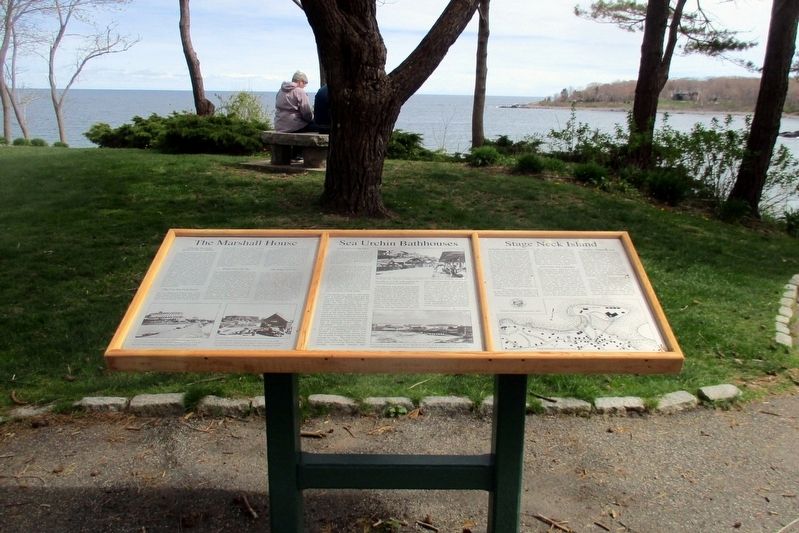
The Marshall House
⎯⎯⎯
Sea Urchin Bathhouses
⎯⎯⎯
Stage Neck Island
Photographed by Larry Gertner, May 11, 2024
1. The Marshall House / Sea Urchin Bathhouses / Stage Neck Island wayside
The Marshall House
Nathanial Marshall, an Early Life of Tragedy
The first Marshall House was built by Nathanial G. Marshall in 1871. Nathanial was born in 1812, the son of John and Eunice Marshall. His early life was one of tragedy. His father mysteriously disappeared when he was five years old and his mother died just two years later. He was raised by his maternal grandparents, the Grants, until the age of fifteen when, following their death, he was forced to go out on his own. He taught school and clerked at a store in York Village during the summer months until he had acquired sufficient capital and credit to go into business for himself. For most of his life he was active in local government holding no less than ten different positions over a 38 year period including Town Sheriff, Town Treasurer, Maine State Senator and Town Clerk.
The First Marshall House
The first Marshall House was a four story frame building with wonderful verandas overlooking the harbor and York harbor Beach. This was an era of great hotels in York. York’s unique summer tourist business was flourishing. Over the years, the first Marshall House
this page online
Rooms $2.50 Per Day
The rates were $2.50 to $3.00 per day for rooms and $10.00 to $18.00 per week for board. It was the largest hotel complex in York. Its facilities included a telephone and telegraph office, a livery stable, a barber shop, billiard room and dance hall. The Marshall House’s own four horse drawn “bus” made two round trips daily to Portsmouth. On January 25th, 1918 the first Marshall House burned to the ground in a fire that was said to have been visible from as far away as Portland, Maine. After the fire, Frank D. Marshall built a “fireproof” four story brick hotel on the same site.
The second Marshall House was larger and more opulent in its style and appointments. The complex included the hotel, cottages, a beach, heated pool, bath houses, two tennis courts and boat docking facilities. There were also large

Photographed by Larry Gertner, May 11, 2024
2. The Marshall House panel
The Stage Neck Inn
In 1971, a group of York Harbor residents led by Alexander Warwick, raised $616,000 and obtained a bank loan of $1,250,000. Known as the “Stage Neck, Inc.”, the group bought the Marshall House Complex except for the tip of the island which was retained by Richard Tufts, who was the last owner of the Marshall House. Stage Neck, Inc. led later by Charles L. Harding, demolished the complex and conceived a plan for forty condominium units and the Stage Neck Inn as we see them today. The Inn was owned by the Warwick family until 1981 when it was sold to Hal Field and Mark Foster.
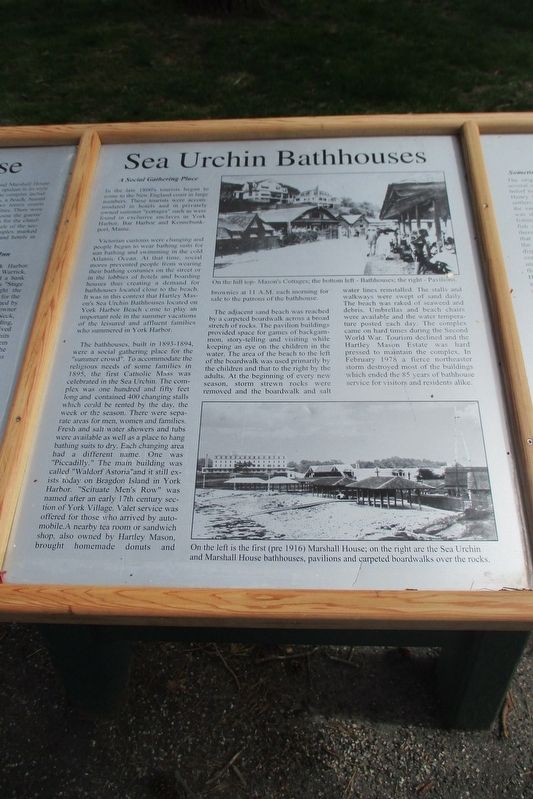
Sea Urchin Bathhouses
A Social Gathering Place
In the late 1800’s tourists began to come to the New England coast in large numbers. These tourists were accommodated in hotels and in privately owned summer “cottages” such as were found in exclusive enclaves in York Harbor, Bar harbor and Kennebunkport, Maine>
Victorian customs were changing and people began to wear bathing suits for sun bathing and swimming in the cold Atlantic Ocean. At that time, social mores prevented people from wearing their bathing suits on the street or in the lobbies of hotels or boarding houses thus creating a demand for bathhouses located close to the beach. It was in this context that Hartley Mason’s Sea Urchin Bathhouses located on York Harbor Beach came to play an important part in the summer vacations of the leisured and affluent families who summered in York Harbor.
The bathhouses, built in 1893-1894, were a social gathering place for the “summer crowd”. To accommodate the religious need of some families in 1895, the first Catholic Mass was celebrated in the Sea
Photographed by Larry Gertner, May 11, 2024
3. Sea Urchin Bathhouses panel
The adjacent sand beach was reached by a carpeted boardwalk across a broad stretch of rocks. The pavilion buildings provided space for games of backgammon, story-telling and visiting while keeping an eye on the children in the water. The area of the beach to the left of the boardwalk was used primarily by the children and that to the right by the adults. At the beginning of every new season, storm strewn rocks were removed and the boardwalk and salt water lines reinstalled. The stalls and walkways were swept of sand daily. The beach was raked of seaweed and debris. Umbrellas and beach chairs were available and the water temperature posted each day. The complex came on hard times during the Second World War. Tourism declined and the Hartley Mason was hard pressed to maintain the complex. In February 1978 a fierce northeaster storm destroyed most of the buildings which ended the 85 years of bathhouse service for visitors and residents alike.
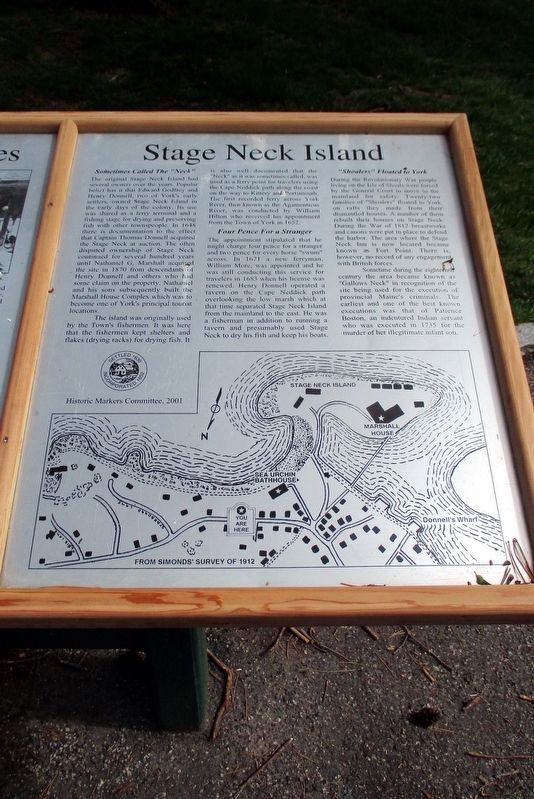
Stage Neck Island
Sometimes called “The Neck” The original Stage Neck Island had several owners of the years.
Photographed by Larry Gertner, May 11, 2024
4. Stage Neck Island panel
The island was originally used by the Town’s fishermen. It was here that the fishermen kept shelters and flakes (drying racks) for drying fish. It is also well documented that the “Neck” as it was sometimes called, was used as a ferry point for travelers using the Cape Neddick path along the coast on the way to Kittery and Portsmouth. The first recorded ferry across York River, then know as the Agamenticus River, was conducted by William Hilton, who received his appointment from the Town of York in 1652.
Four Pence For a Stranger
The appointment stipulated that he might charge four pence for a stranger and two pence for every horse :swum” across. In 1671, a new ferryman, William More, was appointed and he was still conducting this service for travelers in 1683 when his license was renewed. Henry Donnell operated a tavern on the Cape Neddick path overlooking the low marsh which at the time separated Stage Neck Island from the mainland to the east. He was a fisherman in addition to running a tavern and presumably used Stage neck to dry his fish and keep his boats.
”Shoalers” Floated to York
During the Revolutionary War people
Photographed by Larry Gertner, May 11, 2024
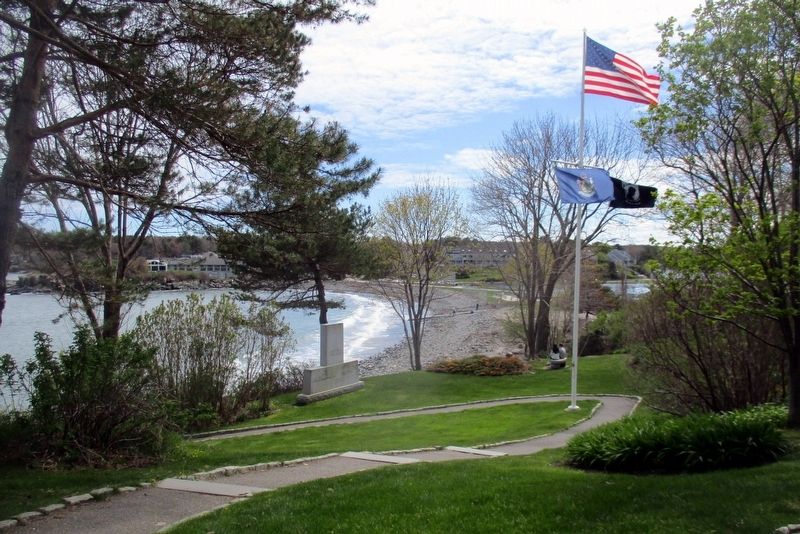
5. The view from the waysides towards Stage Neck Island
Sometime during the eighteenth century the area became known as “Gallows Neck” in recognition of the site being used for the execution of Maine’s criminals. The earliest and one of the best known executions was that of patience Boston, an indentured Indian servant who was executed in 1735 for the murder of her illegitimate infant son.
Erected 2001 by Historical Markers Committee.
Topics. This historical marker is listed in this topic list: Parks & Recreational Areas. A significant historical date for this entry is January 25, 1918.
Location. 43° 8.013′ N, 70° 38.298′ W. Marker is in York, Maine, in York County. It is in the York Harbor. It is on York Street (U.S. 1A)
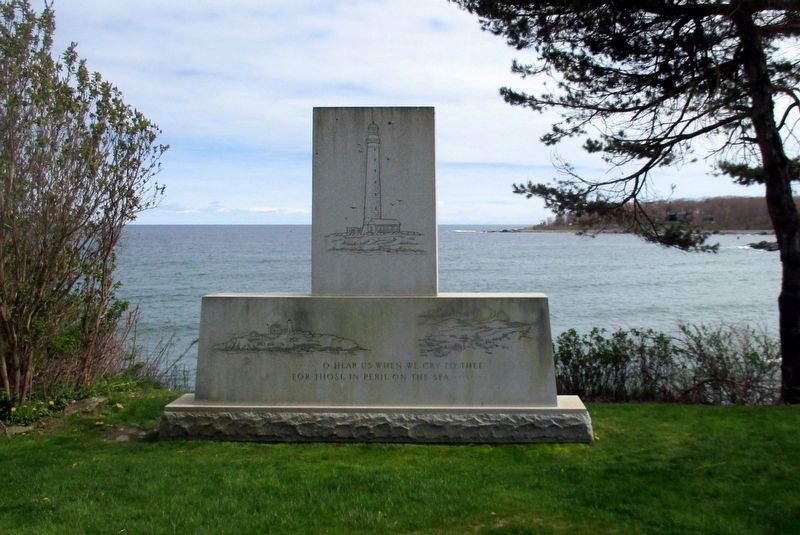
Photographed by Larry Gertner, May 11, 2024
6. York Fishermen's Memorial

Regionally, this marker is on Southern Maine Coast. It is also in the American Northeast, in New England, and on the Eastern Seaboard. Globally, it is in the North Atlantic Region, North America, the Western Hemisphere, the Western World, and the Anglosphere.
Other nearby markers. At least 8 other markers are within 2 miles of this marker, measured as the crow flies: Hartley Mason (a few steps from this marker); Hartley Mason Reservation (a few steps from this marker); The History of Harbor Hill (within shouting distance of this marker); York Village & Corner Fire Department (about 300 feet away, measured in a direct line); The Redshirts of York (about 300 feet away); Historic York Then and Now (approx. one mile away); Candlemas Massacre (approx. one mile away); Sewall's Bridge (approx. 1.1 miles away). Touch for a list and map of all markers in York.
Also see . . . Hartley Mason Reservation & York Harbor Beach (York, ME).
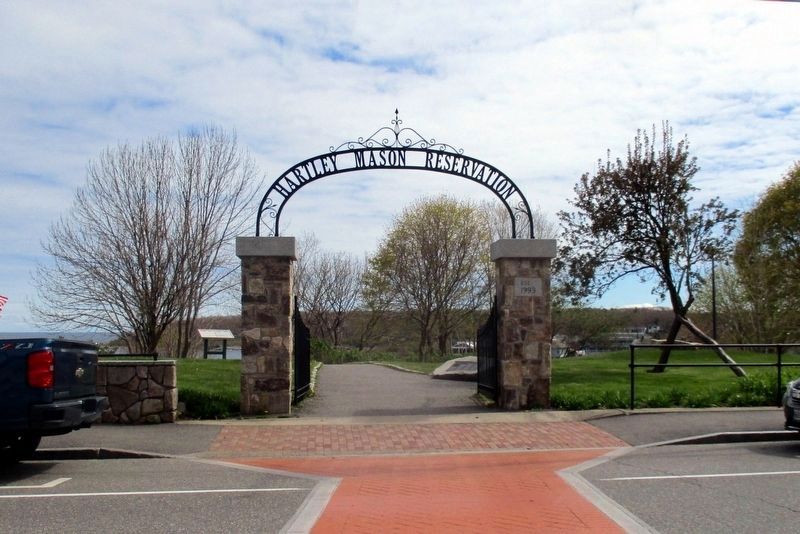
Photographed by Larry Gertner, May 11, 2024
7. Hartley Mason Reservation entrance
Credits. This page was last revised on January 30, 2026. It was originally submitted on August 8, 2024, by Larry Gertner of New York, New York. This page has been viewed 1,348 times since then and 189 times this year. Photos: 1, 2, 3, 4, 5, 6, 7. submitted on August 8, 2024, by Larry Gertner of New York, New York.
