Near Stanton in Mercer County, North Dakota — The American Midwest (Upper Plains)
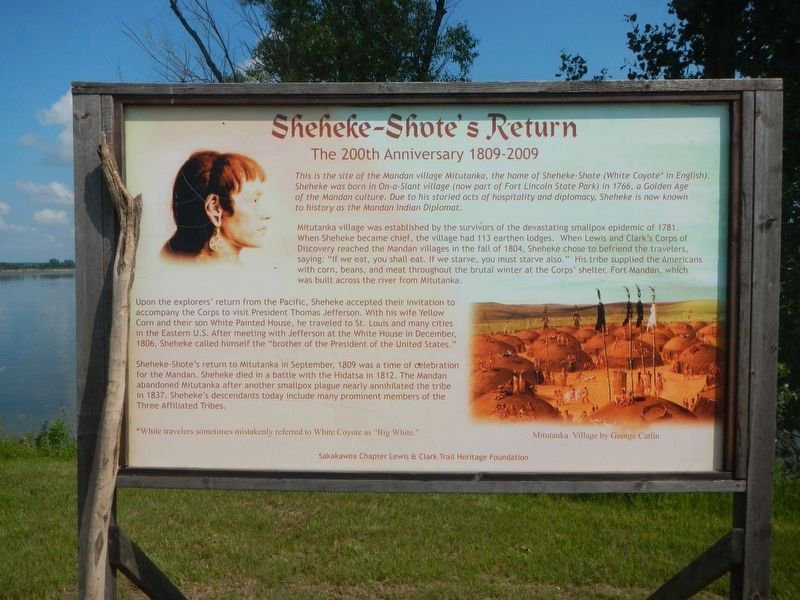
Sheheke-Shote's Return
The 200th Anniversary 1809-2009
Photographed by Barry Swackhamer
1. Sheheke-Shote's Return Marker
Mitutanka village was established by the survivors of the devastating smallpox epidemic of 1781. When Sheheka became chief, the village had 113 earthen lodges. When Lewis and Clark's Corps of Discovery reached the Mandan villages in the fall of 1804. Sheheke chose to befriend the travelers, saying: "If we eat, you shall eat. If we starve, you must starve also." His tribe supplied the Americans with corn, beans, and meat throughout the brutal winter at the Corps' shelter, Fort Mandan, which was built across the river from Mitutanka.
Upon the explorers' return from the Pacific, Sheheke accepted their invitation to accompany the Corps to visit President Thomas Jefferson. With his wife Yellow Corn and their son White Painted Horse, he traveled to St. Louis and many cities in
this page online
Sheheke-Shote's return to Mitutanka in September was a time of celebration for the Mandan. Sheheke died in battle with the Hidatsa in 1812. The Mandan abandoned Mitutanka after another smallpox plaque nearly annihilated the tribe in 1837. Shehke's descendants today include many prominent members of the Three Affiliated Tribes.
* White travelers sometimes mistakenly referred to White Coyote as "Big White."
Erected by Sakakawea Chapter Lewis & Clark Trail Heritage Foundation.
Topics and series. This historical marker is listed in these topic lists: Exploration • Indigenous Peoples and Communities. In addition, it is included in the Lewis & Clark Expedition series list.
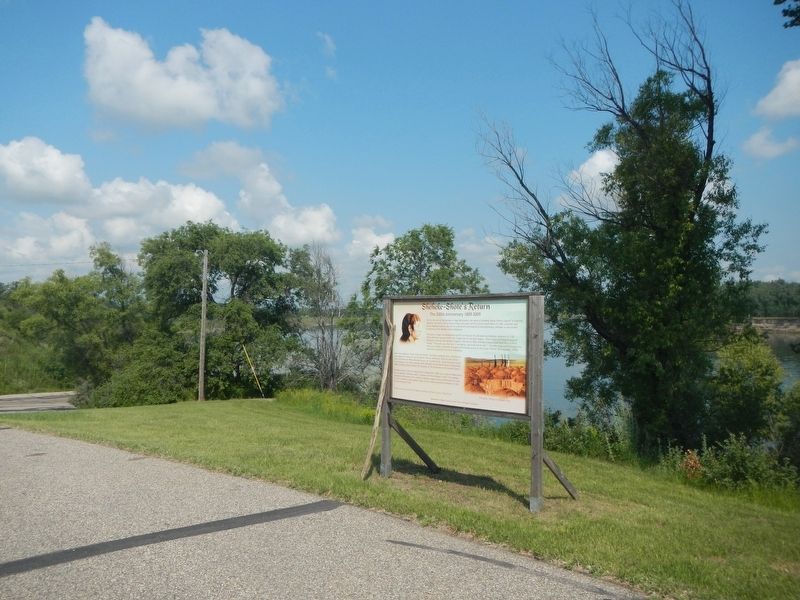
Location. 47° 17.253′ N, 101° 20.322′ W. Marker is near Stanton, North Dakota, in Mercer County. It can be reached from Alternate State Highway 200 near 40th Avenue Southwest. The marker is located at the boat launch just north of the Leyland
Photographed by Barry Swackhamer, February 4, 2011
2. Sheheke-Shote's Return Marker

Regionally, this marker is in the Mandan, Hidatsa, and Arikara Nation, in the Standing Rock Sioux Tribe, and on the Missouri Plateau. It is also in the American Lewis & Clark Corridor, on the prairies, and on the Northern Plains. Globally, it is in North America, the Western Hemisphere, the Western World, and the Anglosphere. Historically, it finds itself in what was once Rupert’s Land and also the Louisiana Purchase.
Other nearby markers. At least 8 other markers are within 4 miles of this marker, measured as the crow flies: Matootnha (about 400 feet away, measured in a direct line); Lewis and Clark Expedition (approx. 2.6 miles away); Fort Mandan Historic Site (approx. 2.6 miles away); Fort Clark Historic Site (approx. 3.7 miles away); Lewis & Clark at the Knife River Indian Villages (approx. 3.7 miles away); Hidatsa Garden (approx. 3.7 miles away); Tobacco (approx. 3.7 miles away); Palisade Wall (approx. 3.8 miles away). Touch for a list and map of all markers in Stanton.
Also see . . . Sheheke’s Delegation -- Discover Lewis & Clark. ≤i≥Because of aggressive interference from Sioux and Arikara warriors, Sheheke’s return home required two attempts in two years, involving a collective force of more than 600 soldiers, cost a total of $20,000 plus four American lives and one limb (of George Shannon), and brought down the careers of at least two great leaders—himself, and Meriwether Lewis. The trip cost him his once respectable reputation among his people, perhaps because of his long absence, but also because his people didn’t believe his tales of the wonders he had seen. (Submitted on August 8, 2024, by Barry Swackhamer of Brentwood, California.)
Credits. This page was last revised on August 8, 2024. It was originally submitted on August 8, 2024, by Barry Swackhamer of Brentwood, California. This page has been viewed 189 times since then and 35 times this year. Photos: 1, 2. submitted on August 8, 2024, by Barry Swackhamer of Brentwood, California.
