Ipswich in Essex County, Massachusetts — The American Northeast (New England)
Meetinghouse Green
Photographed by Marc Posner, July 8, 2024
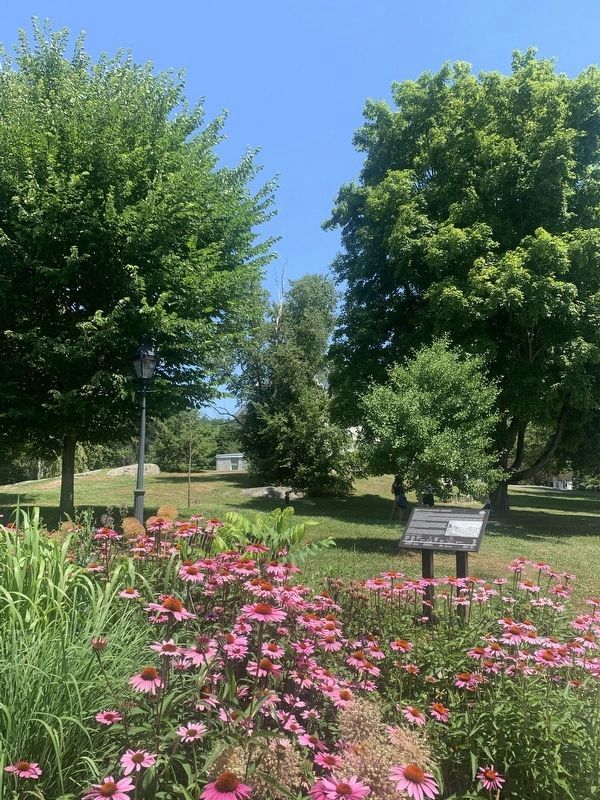
1. Meetinghouse Green Marker
The Original Center of the Ipswich Community
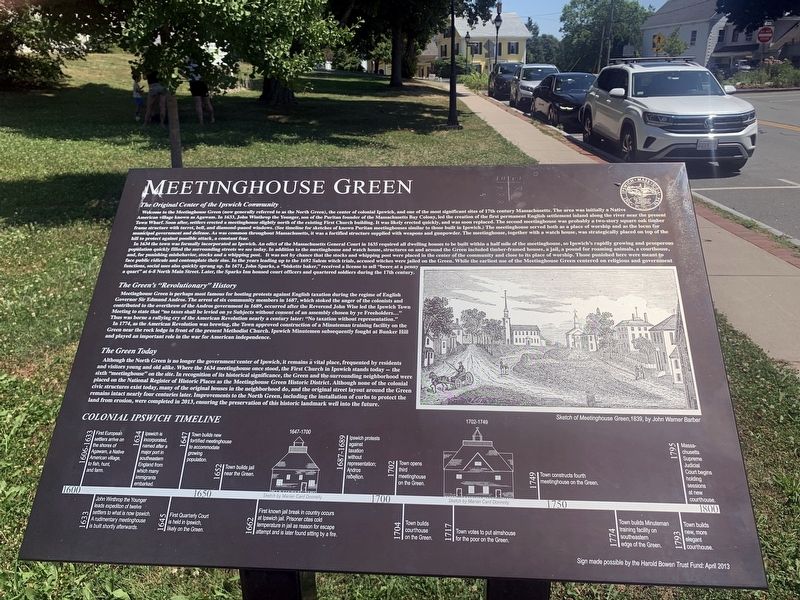
Welcome to the Meetinghouse Green (now generally referred to as the North Green), the center of colonial Ipswich, and one of the most significant sites of 17th century Massachusetts. The area was initially a Native American village known as Agawam. In 1633, John Winthrop the Younger, son of the Puritan founder of the Massachusetts Bay Colony, led the creation of the first permanent English settlement inland along the river near the present Town Wharf. Soon after, settlers erected a meetinghouse slightly north of the existing First Church building. It was likely erected quickly and was soon replaced. The second meetinghouse was probably a two-story square oak timber frame structure with turret, bell, and diamond-paned windows. (See timeline for sketches of known Puritan meetinghouses similar to those built in Ipswich.) The meetinghouse served both as a place of worship and as the locus for municipal government and defense. As was common throughout Massachusetts, it was a fortified structure supplied with weapons and gunpowder. The meetinghouse, together with a watch house,
this page online
In 1634 the town was formally incorporated as Ipswich. An edict of the Massachusetts General Court in 1635 required all dwelling house to be built within a half mile of the meetinghouse, so Ipswich's rapidly growing and prosperous population quickly filled the surrounding streets we see today. In addition to the meetinghouse and watch house, structures on and around the Green included timber-framed houses, a jail, a pound for roaming animals, a courthouse, and, for punishing misbehavior, stocks and a whipping post. It was not by chance that the stocks and whipping post were placed in the center of the community and close to its place of worship. Those punished here were meant to face public ridicule and contemplate their sins. In the years leading up to the 1692 Salem witch trials, accused witches were jailed on the Green. While the earliest use of the Meetinghouse Green centered on religious and government functions, social uses also quickly sprang up. In 1671, John Sparks, a "biskette baker," received a license to sell "beere at a penny
Photographed by Marc Posner, July 8, 2024
2. Meetinghouse Green Marker
The Green's "Revolutionary" History
Meetinghouse Green is perhaps most famous for hosting protests against English taxation during the regime of English Governor Sir Edmund Andros. The arrest of six community members in 1687, which stoked the anger of the of the colonists and contributed to the overthrow of the Andros government in 1689, occurred after the Reverend John Wise led the Ipswich Town Meeting to state that "no taxes shall be levied on ye Subjects without consent of an assembly chose by ye Freeholders..." Thus was borne a rallying cry of the American Revolution nearly a century later: "No taxation without representation." In 1774, as the American Revolution was brewing, the Town approved construction of a Minuteman training facility on the Green near the rock ledge in front of the present Methodist Church. Ipswich Minutemen subsequently fought at Bunker Hill and played an important role in the war for American independence.
The Green Today
Although the North Green is no longer the government
Photographed by Marc Posner, July 8, 2024
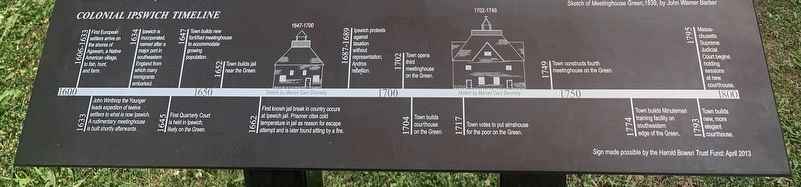
3. Colonial Ipswich Timeline
Erected 2013 by Howard Bowen Trust Fund.
Topics. This historical marker is listed in these topic lists: Colonial Era • War, US Revolutionary. A significant historical year for this entry is 1633.
Location. 42° 40.855′ N, 70° 50.177′ W. Marker is in Ipswich, Massachusetts, in Essex County. It is on North Main Street south
Photographed by Marc Posner, July 8, 2024
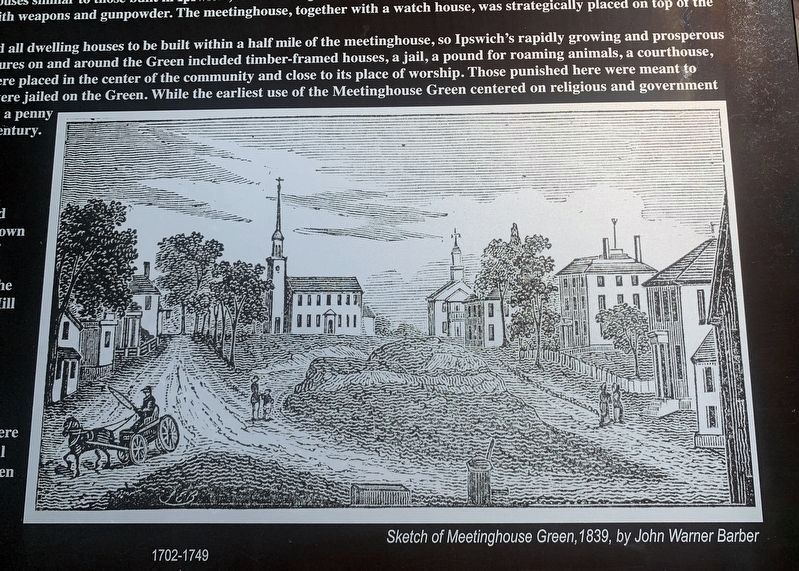
4. Sketch of Meetinghouse Green, 1839

Regionally, this marker is on the North Shore, in Greater Boston, and in the Merrimack Valley. It is also in the American Northeast, in New England, and on the Eastern Seaboard. Globally, it is in the North Atlantic Region, North America, the Western Hemisphere, the Western World, and the Anglosphere. Historically, it finds itself in what was once one of the original Thirteen Colonies.
Other nearby markers. At least 8 other markers are within walking distance of this marker: In Memory of Ipswich Soldiers and Sailors (within shouting distance of this marker); American Legion Auxiliary Unit No 80 (within shouting distance of this marker); Ipswich Civil War Monument (within shouting distance of this marker); Lafayette's Tour (within shouting distance of this marker); Revolution of 1689 (within shouting distance of this marker); The Unknown Dead (about 400 feet away, measured in a direct line); Market Street (about 400 feet away); The District (approx. 0.2 miles away). Touch for a list and map of all markers in Ipswich.
Credits. This page was last revised on August 15, 2024. It was originally submitted on August 10, 2024, by Marc Posner of Somerville, Massachusetts. This page has been viewed 385 times since then and 54 times this year. Photos: 1, 2, 3, 4. submitted on August 10, 2024, by Marc Posner of Somerville, Massachusetts. • Michael Herrick was the editor who published this page.
