
Edinburg in Shenandoah County, Virginia — The American South (Mid-Atlantic)
Edinburg Mill
Saved During “The Burning”
| — | 1864 Valley Campaign | — |
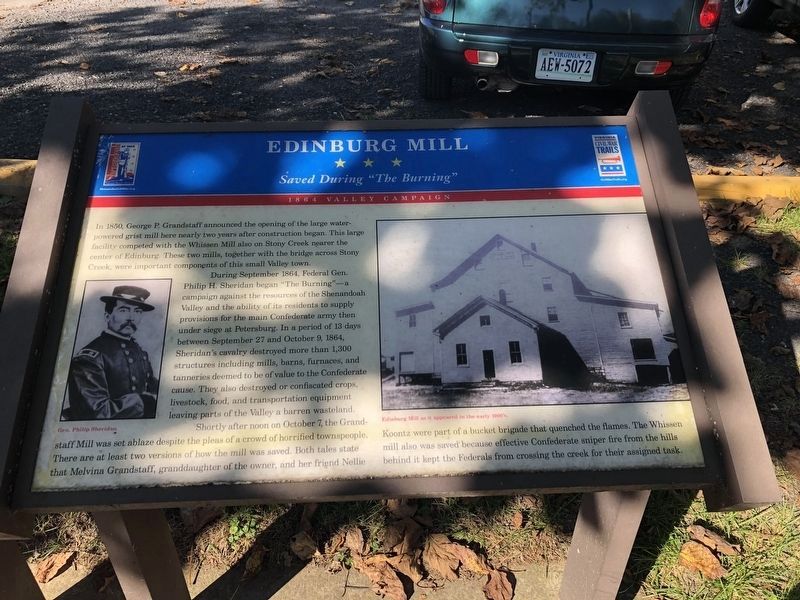
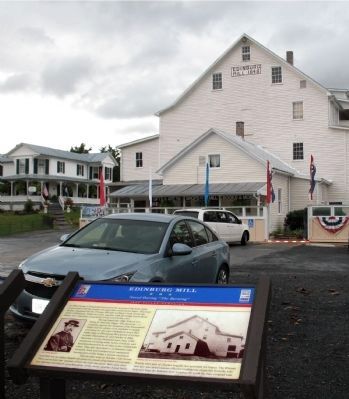
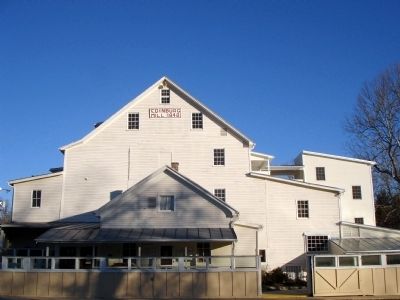
In 1850, George P. Grandstaff announced the opening of the large water-powered grist mill here nearly two years after construction began. This large facility competed with the Whissen Mill also on Stony Creek nearer the center of Edinburg. These two mills, together with the bridge across Stony Creek, were important components of this small Valley town.
During September 1864, Federal Gen. Philip H. Sheridan began “The Burning” – a campaign against the resources of the Shenandoah Valley and the ability of its residents to supply provisions for the main Confederate army then under siege at Petersburg. In a period of 13 days between September 27 and October 9, 1864, Sheridan’s cavalry destroyed more than 1300 structures including mills, barns, furnaces, and tanneries deemed to be of value to the Confederate cause. They also destroyed or confiscated crops, livestock, food, and transportation equipment leaving parts of the Valley a barren wasteland.
Shortly after noon on October 7, the Grandstaff Mill was set ablaze despite the pleas of a crowd of horrified townspeople. There are at least two versions of how the mill was saved.
this page online
Erected by Virginia Civil War Trails.
Topics and series. This historical marker is listed in this topic list: War, US Civil. In addition, it is included in the Virginia Civil War Trails series list. A significant historical date for this entry is September 9, 1864.
Location. 38° 49.251′ N, 78° 34.091′ W. Marker is in Edinburg, Virginia, in Shenandoah County. It is at the intersection of Old Valley Turnpike (U.S. 11) and Massie Farm Lane, on the right when traveling south on Old Valley Turnpike. Marker is located in the parking lot of the Historic Edinburg Mill. Touch for map. Marker is in this post office area: Edinburg VA 22824, United States of America. Touch for directions.

Regionally, this marker is in Virginia’s Shenandoah Valley. It is also in the American South, specifically in the Upper South, and in the Mid-Atlantic.
February 2, 2007
2. Edinburg Mill Marker
This is a previous iteration of the marker with slightly different formatting.
Other nearby markers. At least 8 other markers are within walking distance of this marker: The Stony Creek Line (here, next to this marker); Stoney Creek Flood Water Level (within shouting distance of this marker); Edinburg Mill Rain Garden (within shouting distance of this marker); Schoolhouse Bench (within shouting distance of this marker); Wheat Fan (within shouting distance of this marker); Charred Timbers (within shouting distance of this marker); a different marker also named Wheat Fan (within shouting distance of this marker); Civil War Action in Edinburg (about 600 feet away, measured in a direct line). Touch for a list and map of all markers in Edinburg.
More about this marker. On the right side of the marker is a photo captioned Edinburg Mill as it appeared in the early 1900s. On the left side of the marker is a portrait
Photographed by Allen C. Browne, October 14, 2014
3. Edinburg Mill Marker
Also see . . .
1. Edinburg. Town website homepage (Submitted on December 11, 2009.)
2. History of the Edinburg Mill. Shenandoah County GenWeb Project website entry (Submitted on December 11, 2009.)
3. Edinburg Mill. Virginia Department of Historic Resources website entry (Submitted on December 11, 2009.)
December 11, 2009
4. Historic Edinburg Mill
Photographed by Allen C. Browne, October 14, 2014
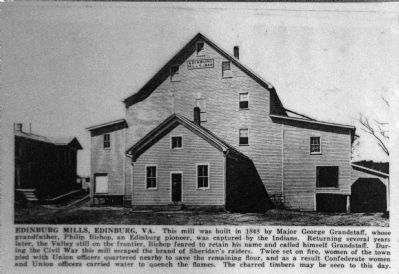
5. Edinburg Mills
Edinburg Mills, Edinburg, VA. This mill was built in 1848 by Major George Grandstaff, whose grandfather, Philip Bishop, an Edinburg pioneer, was captured by the Indians. Returning Several years later , the Valley still on the frontier, Bishop feared to retain his name and called himself Grandstaff. During the Civil War the mill escaped the brand of Sheridan's raiders. Twice set on fire, women of the town pled with Union officers, quartered nearby to save the remaining flour, and as a result Confederate women and Union officers carried water to quench the flames. The charred timbers may be seen this day. Close-up of photo on display at Edinburg Mill
Photographed by Allen C. Browne, October 14, 2014
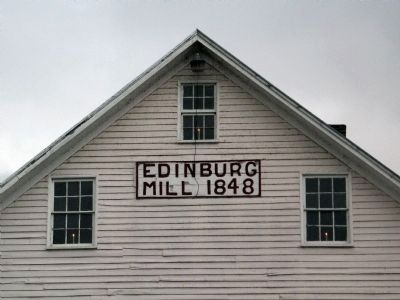
6. Edinburg Mill 1848

Photographed by Bradley Owen, October 17, 2017
7. Inside Edinburg Mill
The charred timbers may be seen to this day.
Photographed by Allen C. Browne, October 14, 2014
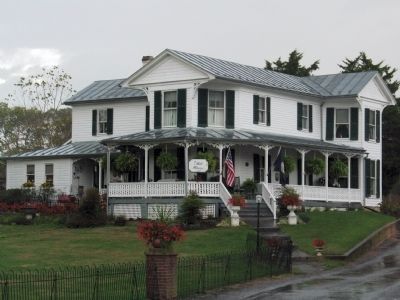
8. The Mill House, 1850
Credits. This page was last revised on August 2, 2025. It was originally submitted on December 11, 2009. This page has been viewed 2,732 times since then and 97 times this year. Photos: 1. submitted on October 19, 2020, by Devry Becker Jones of Washington, District of Columbia. 2. submitted on December 11, 2009. 3. submitted on October 15, 2014, by Allen C. Browne of Silver Spring, Maryland. 4. submitted on December 11, 2009. 5. submitted on October 15, 2014, by Allen C. Browne of Silver Spring, Maryland. 6. submitted on October 16, 2014, by Allen C. Browne of Silver Spring, Maryland. 7. submitted on April 2, 2021, by Bradley Owen of Morgantown, West Virginia. 8. submitted on October 15, 2014, by Allen C. Browne of Silver Spring, Maryland. • Craig Swain was the editor who published this page.
