Burt Township in Grand Marais in Alger County, Michigan — The American Midwest (Great Lakes)
Bay Shore Park Anchor
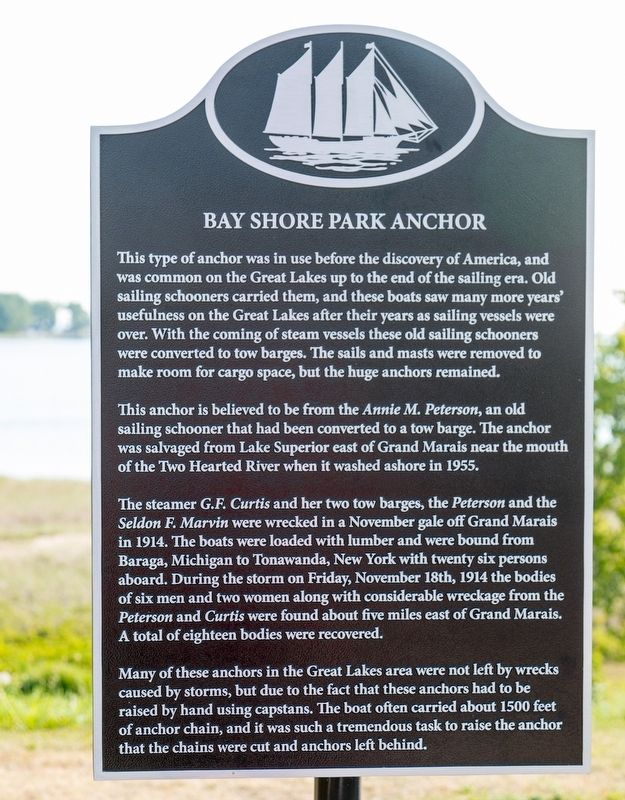
Photographed by J. J. Prats, August 3, 2024
1. Bay Shore Park Anchor Marker
This anchor is believed to be from the Annie M. Peterson, an old sailing schooner that had been converted to a tow barge. The anchor was salvaged from Lake Superior east of Grand Marais near the mouth of the Two Hearted River when it washed ashore in 1955.
The steamer G.F. Curtis and her two tow barges, the Peterson and the Seldon F. Marvin were wrecked in a November gale off Grand Marais in 1914. The boats were loaded with lumber and were bound from Baraga, Michigan. to Tonawanda, New York, with twenty six persons aboard. During the storm on Friday, November 18th, 1914, the bodies of six men and two women along with considerable wreckage from
this page online
Many of these anchors in the Great Lakes area were not left by wrecks caused by storms, but due to the fact that these anchors had to be raised by hand using capstans. The boat often carried about 1500 feet of anchor chain, and it was such a tremendous task to raise the anchor that the chains were cut and anchors left behind.
Topics and series. This historical marker is listed in these topic lists: Disasters • Waterways & Vessels. In addition, it is included in the Lost at Sea series list. A significant historical year for this entry is 1955.
Location. 46° 40.251′ N, 85° 58.984′ W. Marker is in Grand Marais, Michigan, in Alger County. It is in Burt Township. It is at the intersection of Grand Marais Avenue (County Road H-58) and Randolph Street and Crawford Street, on the right when traveling north on Grand Marais Avenue. It is in Bay Shore Park. Touch for map. Marker is in this post office area: Grand Marais MI 49839, United States of America. Touch for directions.

Regionally, this marker is on Michigan’s

Photographed by J. J. Prats, August 3, 2024
2. The Annie M. Peterson Anchor and Marker
Other nearby markers. At least 7 other markers are within 9 miles of this marker, measured as the crow flies: Grand Marais (a few steps from this marker); In Honor of Our Country’s Defenders (within shouting distance of this marker); Grand Marais Greenspace (about 300 feet away, measured in a direct line); Pickle Barrel House / The Teenie Weenies (about 400 feet away); Tools of the Trade (approx. 6.2 miles away); Cabin in the Clearing (approx. 6.2 miles away); Final Solution for a Long and Difficult Issue (approx. 8.7 miles away).
Also see . . . Once lost, Lake Superior shipwrecks are found, giving 100-year-plus story a new ending. 2023 article by Frank Witsil in the Detroit Free Press. Excerpt:
The story of three tragic shipwrecks on Lake Superior got a new ending Thursday, more than a century after the vessels were lost, with the announcement that the Great Lakes Shipwreck Historical Society had finally found two of them.(Submitted on August 11, 2024.)
All three ships — the steamer C.F. Curtis, which was being towed by two schooner barges, Selden E. Marvin and Annie M. Peterson, from Baraga to Tonawanda, New York, all with loads of lumber — went down in a violent storm on Nov. 18, 1914.
There were no survivors. The final tally of the dead: 28.
In many ways, the historical society said, the discovery of these shipwrecks, sunk beneath the lake's surface, offers a window to the past, because the cold water preserves the artifacts for decades. The wrecks also, to the families of the mariners and passengers who vanished, provide peace, and a glimpse of their lost loved ones' watery graves.
Credits. This page was last revised on August 11, 2024. It was originally submitted on August 11, 2024, by J. J. Prats of Powell, Ohio. This page has been viewed 286 times since then and 40 times this year. Photos: 1, 2. submitted on August 11, 2024, by J. J. Prats of Powell, Ohio.
