Brooklyn Heights in Kings County, New York — The American Northeast (Mid-Atlantic)
Brooklyn War Memorial
Cadman Plaza
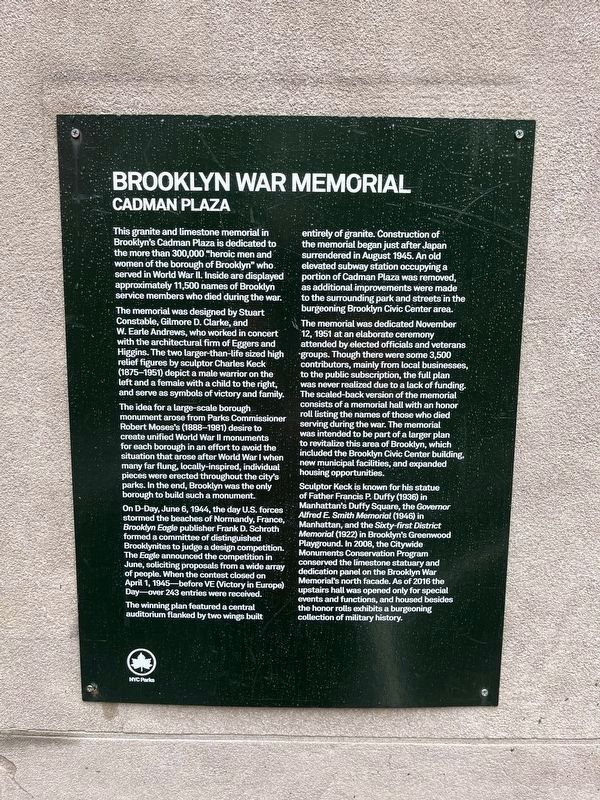
This granite and limestone memorial in Brooklyn's Cadman Plaza is dedicated to the more than 300,000 "heroic men and women of the borough of Brooklyn" who served in World War II. Inside are displayed approximately 11,500 names of Brooklyn service members who died during the war.
The memorial was designed by Stuart Constable, Gilmore D. Clarke, and W. Earle Andrews, who worked in concert with the architectural firm of Eggers and Higgins. The two larger-than-life sized high relief figures by sculptor Charles Keck (1875-1951) depict a male warrior on the left and a female with a child on the right, and serve as symbols of victory and family.
The idea for a large-scale borough monument arose from Parks Commissioner Robert Moses's (1888-1981) desire to create unified World War II monuments for each borough in an effort to avoid the situation that arose after World War I when many far flung, locally-inspired, individual pieces were erected throughout the city's parks. In the end, Brooklyn was the only borough to build such a monument.
On D-Day, June 6, 1944, the day U.S. forces stormed the beaches of Normandy, France,
this page online
The winning plan featured a central auditorium flanked by two wings built entirely of granite. Construction of the memorial began just after Japan surrendered in August 1945. An old elevated subway station occupying a portion of Cadman Plaza was removed, as additional improvements were made to the surrounding park and streets in the burgeoning Brooklyn Civic Center area.
The memorial was dedicated November 12, 1951 at an elaborate ceremony attended by elected officials and veterans groups. Though there were some 3,500 contributors, mainly from local businesses, to the public subscription, the full plan was never realized due to a lack of funding. The scaled-back version of the memorial consists of a memorial hall with an honor roll listing the names of those who died serving during the war. The memorial was intended
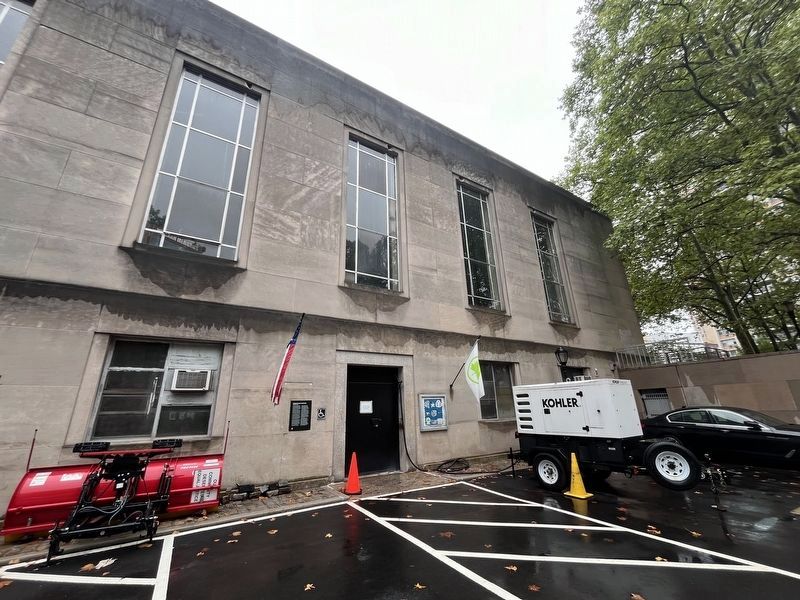
Sculptor Keck is known for his statue of Father Francis P. Duffy (1936) in Manhattan's Duffy Square, the Governor Alfred E. Smith Memorial (1946) in Manhattan, and the Sixty-first District Memorial (1922) in Brooklyn's Greenwood Playground. In 2008, the Citywide Monuments Conservation Program conserved the limestone statuary and dedication panel on the Brooklyn War Memorial's north facade. As of 2016 the upstairs hall was opened only for special events and functions, and housed besides the honor roll exhibits a burgeoning collection of military history.
Erected by NYC Parks.
Topics and series. This historical marker and memorial is listed in these topic lists: Architecture • Arts, Letters, Music • Parks & Recreational Areas • War, World II. In addition, it is included in the NYC Parks series list. A significant historical date for this entry is April 1, 1944.
Location. 40° 41.912′ N, 73° 59.437′ W. Marker is in Brooklyn, New York, in Kings County. It is in Brooklyn Heights. It is on Cadman Plaza East south of Red Cross Place, on the right when traveling south. Touch for map. Marker is at or near this postal address: 172 Cadman Plaza E, Brooklyn NY 11201, United States of America. Touch for directions.

Regionally, this marker and memorial is in New York City and on Long Island. It is also in the American Northeast, in the Mid-Atlantic, and on the Eastern Seaboard. Globally, it is in the North Atlantic Region, North America, the Western Hemisphere, the Western World, and the Anglosphere. Historically, it finds itself in what was once New Netherland and also one of the original Thirteen Colonies.
Other nearby markers. At least 8 other markers are within walking distance of this marker: A different marker also named Brooklyn War Memorial (a few steps from this marker); William Jay Gaynor (about 400 feet away, measured in a direct line); The Plymouth Bell (about 700 feet away); Plymouth Church of the Pilgrims (about 700 feet away); Brooklyn Heights / Downtown Brooklyn (about 800 feet away); "Old P.S. 8" - 1846 (about 800 feet away); Brooklyn Heights Historic District (approx. 0.2 miles away); a different marker also named Plymouth Church of the Pilgrims (approx. 0.2 miles away). Touch for a list and map of all markers in Brooklyn.
Credits. This page was last revised on August 11, 2024. It was originally submitted on August 11, 2024, by Devry Becker Jones of Washington, District of Columbia. This page has been viewed 560 times since then and 70 times this year. Photos: 1, 2. submitted on August 11, 2024, by Devry Becker Jones of Washington, District of Columbia.
