Sault Ste. Marie in Algoma District, Ontario — Central Canada (North America)
To The Voyageurs
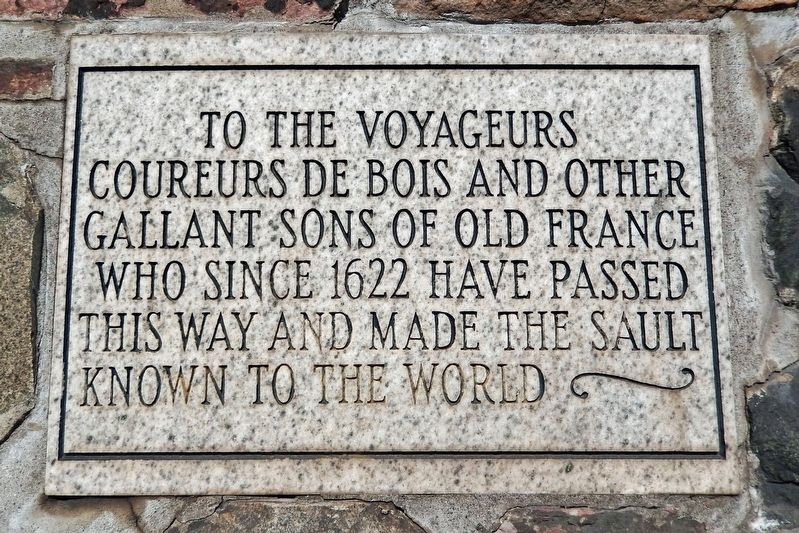
Photographed by Cosmos Mariner, June 10, 2024
1. To The Voyageurs Marker
Topics. This historical marker is listed in these topic lists: Exploration • Industry & Commerce • Waterways & Vessels. A significant historical year for this entry is 1622.
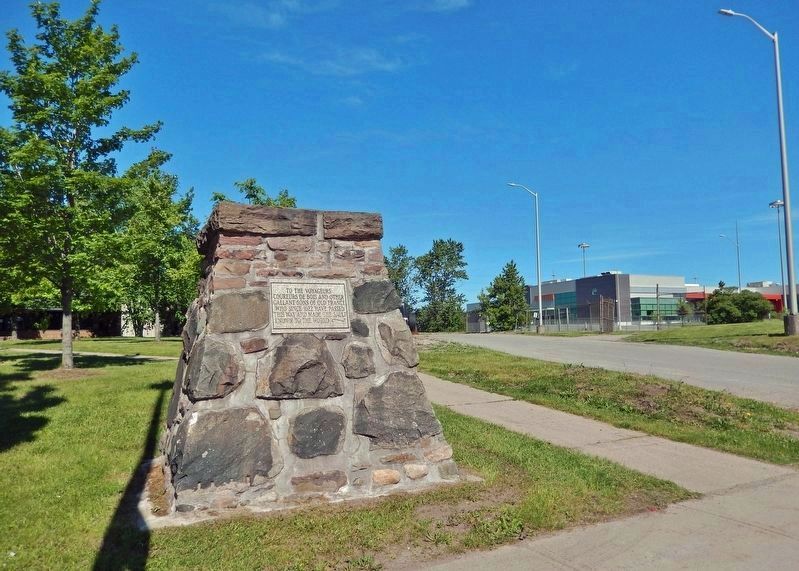
Location. 46° 31.072′ N, 84° 20.889′ W. Marker is in Sault Ste. Marie, Ontario, in Algoma District. It is on Huron Street just south of Queen Street West, on the right when traveling south. The marker is located beside the sidewalk, on the east side of the City of Sault Ste. Marie Transit Facility. Touch for map. Marker is at or near this postal address: 111 Huron Street, Sault Ste Marie ON P6A 5P9, Canada. Touch for directions.

Regionally, this marker is in the Sault Ste. Marie and Algoma Area and in Northern Ontario. It is also in Central Canada. Globally, it is in North America, in the Great North Woods, on the Great Lakes, on Lake Superior’s North Shore, in the Western Hemisphere, in the Western World, and in the Anglosphere. Historically, it finds itself in what was once a British colony, the
this page online
Other nearby markers. At least 8 other markers are within walking distance of this marker: 1870 (within shouting distance of this marker); The First Sault Ste. Marie Canal (about 240 meters away, measured in a direct line); Sault Ste. Marie World War II Memorial (approx. 0.3 kilometers away); 1783 (approx. 0.3 kilometers away); 1821 (approx. 0.3 kilometers away); Francis Hector Clergue (approx. 0.3 kilometers away); The North West Company Post (approx. 0.4 kilometers away); 70th Anniversary Dutch-Canadian Friendship Tulip Garden (approx. 0.4 kilometers away). Touch for a list and map of all markers in Sault Ste. Marie.
Also see . . .
1. Coureur des bois (Wikipedia).
Excerpt: Coureur des bois ("runner of the woods") were independent entrepreneurial French Canadian traders who travelled in New France and the interior of North America, usually to trade with First Nations peoples by exchanging various European items for furs. Some learned the trades and practices of the indigenous peoples. These expeditions were part of the beginning(Submitted on August 12, 2024, by Cosmos Mariner of Cape Canaveral, Florida.)of the fur trade in the North American interior. While French settlers had lived and traded alongside Indigenous people since the earliest days of New France, coureurs des bois reached their apex during the second half of the 17th century. After 1681, the independent coureur des bois was gradually replaced by state-sponsored voyageurs, who were workers associated with licensed fur traders.Photographed by Cosmos Mariner, June 10, 20242. To The Voyageurs Marker CairnLooking west from Huron Street; the City of Sault Ste. Marie Transit Facility is in the left background.
2. Voyageurs (Wikipedia).
Excerpt: Voyageurs ("travellers") were 18th- and 19th-century French and later French Canadians and others who transported furs by canoe at the peak of the North American fur trade. They traversed and explored many regions in what is now Canada and the United States. From the beginning of the fur trade in the 1680s until the late 1870s, the voyageurs were the blue-collar workers of the Montreal fur trade. At their height in the 1810s, they numbered as many as three thousand. For the most part, voyageurs were the crews hired to man the canoes that carried trade goods and supplies to trading locations where they were exchanged for furs, and "rendezvous posts," such as Grand Portage at the western end of Lake Superior. They then transported the furs back to Lachine near Montreal, and later also to points on the route to Hudson Bay.(Submitted on August 12, 2024, by Cosmos Mariner of Cape Canaveral, Florida.)
Credits. This page was last revised on August 12, 2024. It was originally submitted on August 12, 2024, by Cosmos Mariner of Cape Canaveral, Florida. This page has been viewed 227 times since then and 20 times this year. Photos: 1, 2. submitted on August 12, 2024, by Cosmos Mariner of Cape Canaveral, Florida.
