Fullerton in Orange County, California — The American West (Pacific Coastal)
The First Valencia Orchard in California
Photographed by Tatiana Zavala, August 13, 2024
1. The First Valencia Orchard in California Marker
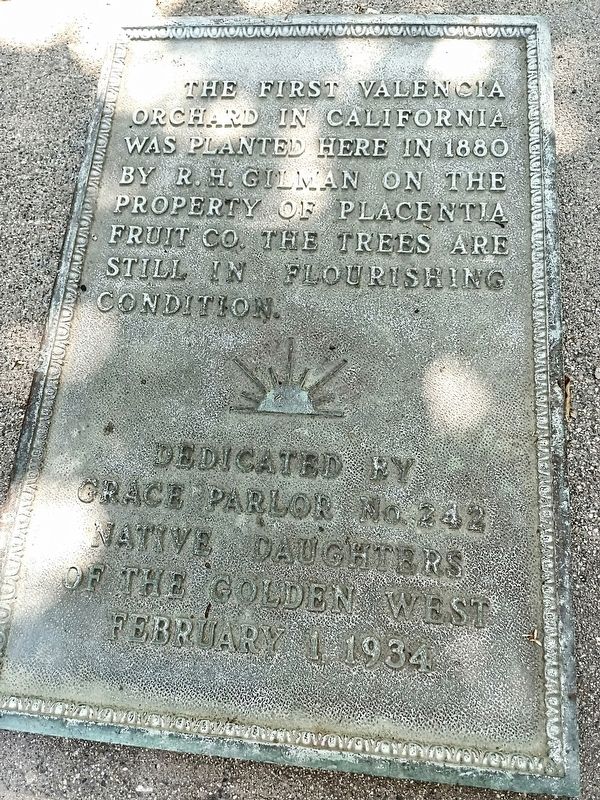
The first Valencia Orchard in California was planted here in 1880 by R.H. Gilman on the property of Placentia Fruit Co. The trees are still in flourishing condition.
Dedicated by Grace Parlor No. 242
Native Daughters of the Golden West
February 1, 1934
Erected 1934 by Native Daughters of the Golden West.
Topics and series. This historical marker is listed in this topic list: Agriculture. In addition, it is included in the Native Sons/Daughters of the Golden West series list. A significant historical year for this entry is 1880.
Location. 33° 52.817′ N, 117° 53.09′ W. Marker is in Fullerton, California, in Orange County. It can be reached from North State College Boulevard. Marker is on Cal State Fullerton university campus, north east of McCarthy Hall, east of the promenade walkway. Touch for map. Marker is at or near this postal address: 800 N State College Blvd, Fullerton CA 92831, United States of America. Touch for directions.

Regionally, this marker is in Greater Los Angeles and in the Peninsular Ranges. It is also on the American Pacific Coast. Globally, it is in North America, on the Ring of
this page online
Other nearby markers. At least 8 other markers are within one mile of this marker, measured as the crow flies: Dr. George C. Clark Family Home (approx. 0.4 miles away); Lewis Lemke House (approx. half a mile away); Macadamia Tree (approx. 0.9 miles away); Original Placentia District Library (approx. one mile away); First City Hall and Police Station (approx. one mile away); Placentia National Bank (approx. 1.1 miles away); Stradley Building No. 2 (approx. 1.1 miles away); Marjie Building (approx. 1.1 miles away).
Also see . . .
1. King Citrus & Queen Valencia. Excerpt from 2011 Orange County Historical Society article by Phil Brigandi
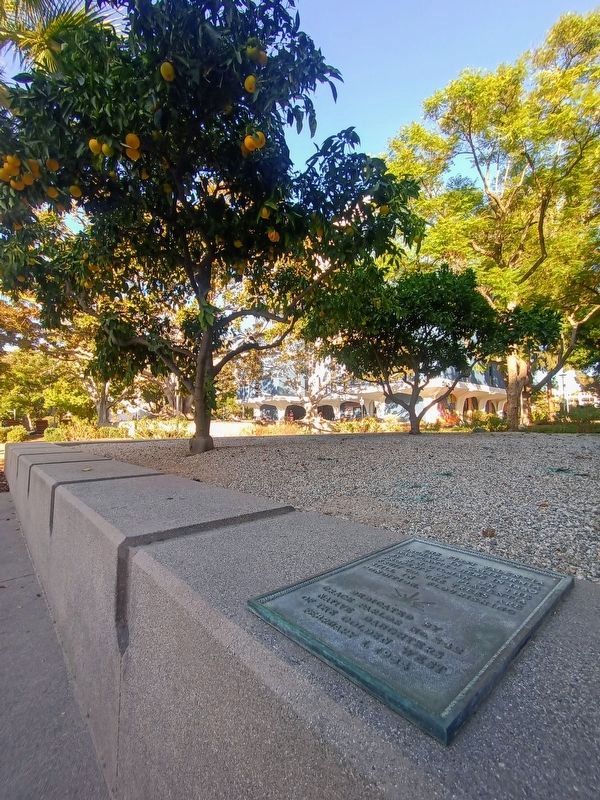
"Once upon a time in Orange County, money grew on trees. Citrus was the crop that made Orange County orange. Citrus—primarily Valencia oranges—once cascaded in green and gold down out of the mountains and along the rich coastal plain in neat, orderly rows, divided by windbreaks of eucalyptus trees.(Submitted on August 13, 2024, by Tatiana Zavala of Orange County, California.)Sixty ago, much of central Orange County was a vast orchard, dotted with little towns like Santa Ana, Tustin, Anaheim, and, of course, Orange. The crop fueled the local economy for decades, creating an Easterner’s image of paradise: a sunny, fertile land, where health grew on trees.Photographed by Tatiana Zavala, October 23, 20242. Marker with orange trees in background
The first small seedling groves were planted here in the early 1870s, at a time when scores of new crops were being tried—most unsuccessfully. In 1875, the first commercial grove of hearty, spring-ripening Valencia oranges was planted by R. H. Gilman on what is now the Cal State Fullerton campus.
In those days, the biggest crop in the area was grapes, grown for wine or raisins. But in the 1880s, local vineyards were ravaged by a mysterious blight, clearing the way for thousands of new citrus plantings."
2. History of Placentia Fruit Company Explored at CSUF Library. Article from The Fullerton Observer by Emerson Little on October 30, 2022
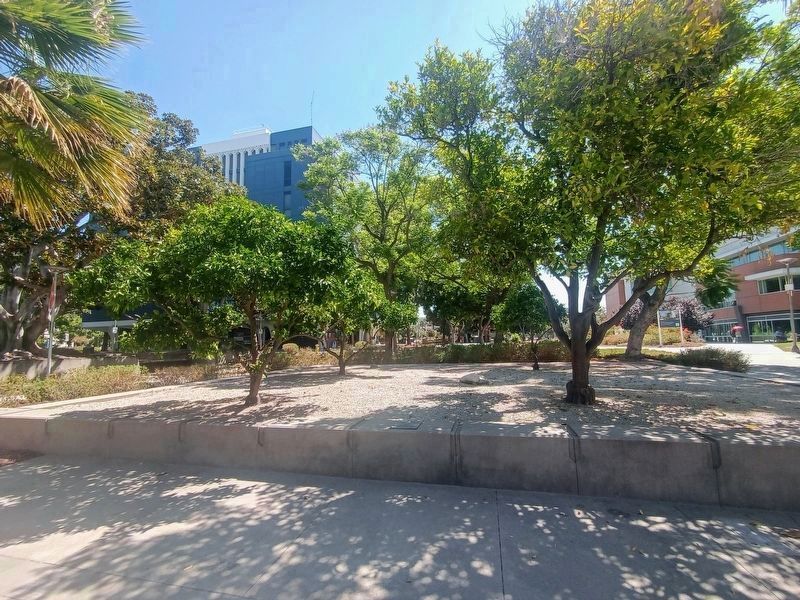
Climbing up the stairs of the CSUF Pollak Library, I stopped at the fourth floor...I encountered a small exhibit that focused(Submitted on August 13, 2024, by Tatiana Zavala of Orange County, California.)on the history of the Placentia Fruit Company and how it related to the state’s oldest Valencia Orange orchard, originally planted in the middle of what is now the CSUF campus.Photographed by Tatiana Zavala, August 13, 20243. The First Valencia Orchard in California
Curated by Trish Campbell, Exhibit Program Coordinator at CSUF’s Pollak Library and Adjunct Professor in the Division of Anthropology, this small display was one component of a larger exhibition that marked the Fullerton Arboretum’s 40th anniversary. The full display was initially shown in the Orange County Agricultural & Nikkei Heritage Museum at the Fullerton Arboretum from 2018 to 2019... Housing orange crates and their labels, the display begins by explaining who Richard H. Gilman was, and how his history relates to the planting of the first Valencia orange grove in Southern California.
“Richard Gilman, a native of New Hampshire, arrived in Sonoma County, California, where he joined with a group in 1872 in forming the Southern California Semi-Tropical Fruit Company (SCSFC),” reads the exhibit wall text. The company was searching for fertile citrus-producing land to develop. “Gilman, on behalf of the corporation, purchased for them a tract [in Southern California] consisting of 110 acres at a rate of $17.50 per acre from the Sterns Land Company. Returning north, he reported the deal. Gilman returned in 1873, arriving in Placentia equipped with a four-horse team and a wagon loaded with farming tools to begin the development of one of the earliest citrus ranches in the southland.”
Interestingly, Gilman received a delivery of “orange trees of ‘unlabeled’ varieties” from a place called the River Brothers nursery in London, England, according to the wall text. Reading on, I found out that “one variety” of oranges “was a late producer and Gilman pioneered the development of groves from buds from this tree known as the Valencia late.” In 1880, Gilman went on to plant the first 5-acre grove of Valencia oranges. This location on the Gilman Ranch, which is now part of CSUF, became known as the birthplace of the world-famous Valencia orange, a widely popular summer-time fruit that helped boost Placentia’s economy.
What I didn’t know until encountering the exhibit was that all strains of this type of orange can be traced back to the River Brothers nursery. From the research on display, I learned that the strains of Valencia Orange are all believed to have entered the U.S. in about 1876, and some were developed in hothouse conditions in a nursery in New York, before arriving in Florida and California.
Credits. This page was last revised on October 27, 2024. It was originally submitted on August 13, 2024, by Tatiana Zavala of Orange County, California. This page has been viewed 538 times since then and 96 times this year. Photos: 1. submitted on August 13, 2024, by Tatiana Zavala of Orange County, California. 2. submitted on October 23, 2024, by Tatiana Zavala of Orange County, California. 3. submitted on August 14, 2024, by Tatiana Zavala of Orange County, California. • Andrew Ruppenstein was the editor who published this page.
