Near Augusta in St. Charles County, Missouri — The American Midwest (Upper Plains)
The Missouri River During The Lewis & Clark (Corps of Discovery) Expedition

Photographed by Duane and Tracy Marsteller, July 20, 2024
1. The Missouri River During The Lewis & Clark (Corps of Discovery) Expedition Marker
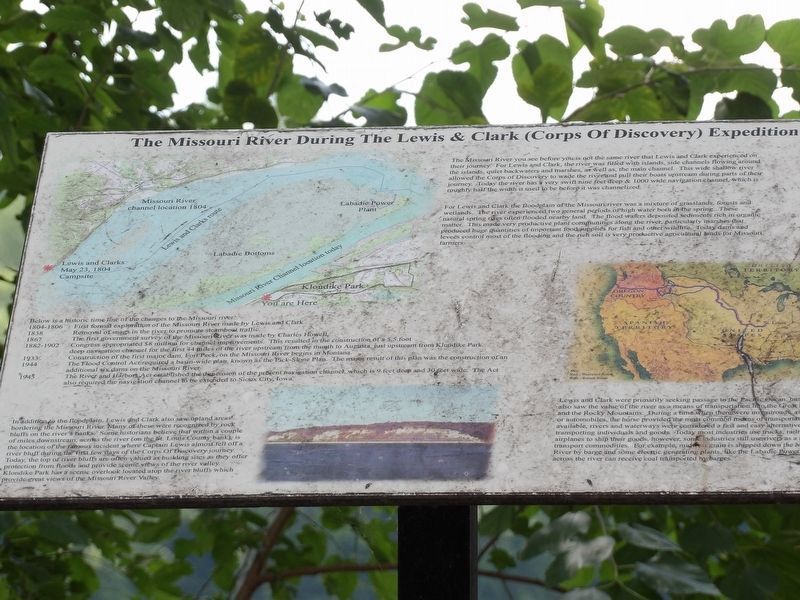
For Lewis and Clark the floodplain of the Missouri River was a mixture of grasslands, forests and wetlands. The river experienced two general periods of high water both in the spring. These natural spring rises often flooded nearby land. The flood waters deposited sediments rich in organic matter. This made very productive plant communities along the river, particularly marshes that produced huge quantities of important food supplies for fish and other wildlife. Today dams and levees control most of the flooding and the rich soil is very productive agricultural lands for
this page online
In addition to the floodplain, Lewis and Clark also saw upland areas bordering the Missouri River. Many of these were recognized by rock bluffs on the river's banks. Some historians believe that within a couple of miles downstream, across the river (on the St. Louis County bank), is the location of the famous incident where Captain Lewis almost fell off a river bluff during the first few days of the Corps of Discovery journey. Today, the top of river bluffs are often valued as building sites as they offer protection from floods and provide scenic views of the river valley. Klondike Park has a scenic overlook located atop the river bluffs which provide great views of the Missouri River Valley.
Lewis and Clark were primarily seeking passage to the Pacific Ocean, but they also saw the value of the river as a means of transportation into the Great Plains and the Rocky Mountains. During a time when there were no railroads, airplanes or automobiles, the horse provided the most common means of transportation. If available, rivers and waterways were considered a fast and easy alternative way for transporting individuals
Photographed by Duane and Tracy Marsteller, July 20, 2024
2. The Missouri River During The Lewis & Clark (Corps of Discovery) Expedition Marker
Below is a historic time line of the changes to the Missouri River:
1804-1806: First formal exploration of the Missouri River made by Lewis and Clark.
1838: Removal of snags in the river to promote steamboat traffic.
1867: The first government survey of the Missouri River made by Charles Howell.
1882-1902: Congress appropriated $8 million for channel improvements. This resulted in the construction of a 5.5 foot deep navigation channel for the first 44 miles of the river upstream from the mouth to Augusta, just upstream from Klondike Park.
1933: Construction of the first major dam, Fort Peck, on the Missouri River begins in Montana.
1944: The Flood Control Act required a basin-wide plan, known as the Pick-Stone Plan. The major result of the plan was the construction of
Photographed by Duane and Tracy Marsteller, July 20, 2024
3. The Missouri River During The Lewis & Clark (Corps of Discovery) Expedition Marker
1945: The Rivers and Harbors Act established the dimension of the present navigation channel, which is 9 feet deep and 30 feet wide. The Act also required the navigation channel to be extended to Sioux City, Iowa.
Topics and series. This historical marker is listed in these topic lists: Exploration • Industry & Commerce • Waterways & Vessels. In addition, it is included in the Lewis & Clark Expedition series list. A significant historical date for this entry is May 23, 1804.
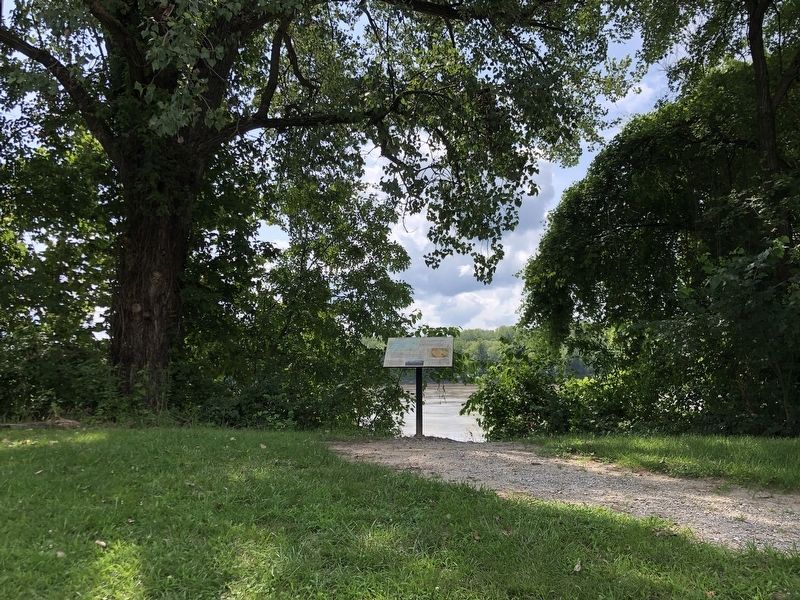
Location. 38° 35.042′ N, 90° 49.184′ W. Marker is near Augusta, Missouri, in St. Charles County. It can be reached from Missouri Route 94 0.6 miles east of Berg Crossing Drive, on the right when traveling east. Marker is by the boat ramp in Klondike Park. Touch for map. Marker is at or near this postal address: 4450 S MO-94, Augusta MO 63332, United States of America. Touch for directions.

Regionally, this marker is in the Missouri River Corridor and in Greater St. Louis. It is also in the American Midwest, in the Lewis & Clark Corridor, in the Corn Belt, and in the Great River Road Region. Globally, it is in North America, the Western Hemisphere, the Western World, and the Anglosphere. Historically, it finds itself in what was once the territory of the Mississippian Culture, the Louisiana Purchase, and the Antebellum South.
Other nearby markers. At least 8 other markers are within 4 miles of this marker, measured as the crow flies: The Lewis and Clark Expedition Across Missouri (about 500 feet away, measured in a direct line); The Boone Trace (approx. 2.1 miles away); Matson to Augusta (approx. 2.2 miles away); Daniel Boone's Missouri Golden Years (approx. 2.2 miles away); Matson to Weldon Spring (approx. 2.2 miles away); Daniel Boone Judgment Tree Memorial (approx. 2.2 miles away); Head's Store (approx. 2.6 miles away); Staudinger-Grumke House-Store (approx. 3.3 miles away). Touch for a list and map of all markers in Augusta.
Credits. This page was last revised on August 15, 2024. It was originally submitted on August 13, 2024, by Duane and Tracy Marsteller of Murfreesboro, Tennessee. This page has been viewed 414 times since then and 80 times this year. Photos: 1, 2, 3. submitted on August 13, 2024, by Duane and Tracy Marsteller of Murfreesboro, Tennessee.
