
Alliston in New Tecumseth in Simcoe County, Ontario — Central Canada (North America)
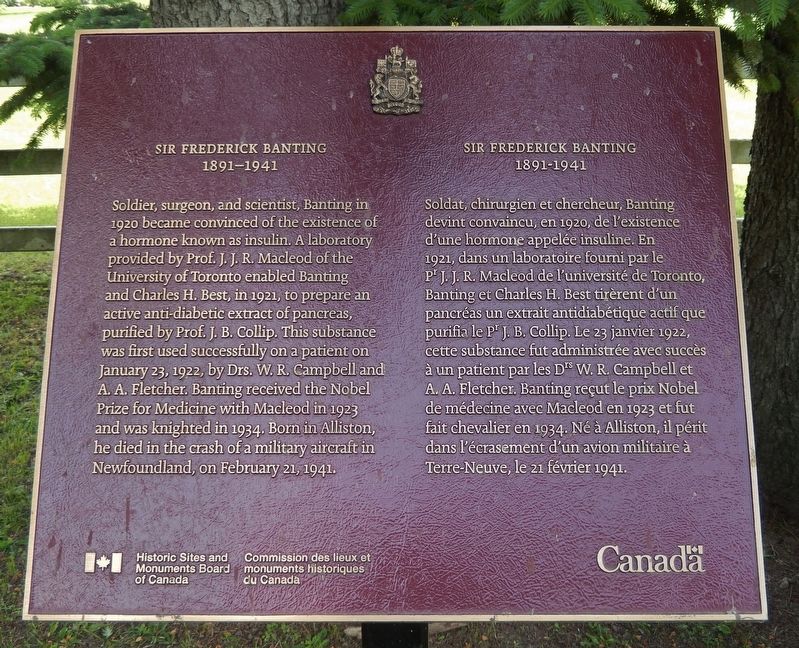
Sir Frederick Banting
1891-1941
Photographed by Cosmos Mariner, June 4, 2024
1. Sir Frederick Banting Marker

this page online
Erected by Historic Sites and Monuments Board of Canada/Commission des lieux et monuments historiques du Canada.
Topics and series. This historical marker is listed in this topic list: Science & Medicine. In addition, it is included in the Canada, Historic Sites and Monuments Board series list. A significant historical date for this entry is January 23, 1922.
Location. 44° 10.037′ N, 79° 50.781′ W. Marker is in New Tecumseth, Ontario, in Simcoe County. It is in Alliston. It is on Sir Frederick Banting Road 0.4 kilometers north of John W Taylor Avenue, on the left when traveling north. The marker is located on the east side of the Banting Homestead and Heritage Park grounds, just north of the main entrance. Touch for map. Marker is at or near this postal address: 5116 Sir Frederick Banting Road, New Tecumseth ON L9R 1V2, Canada. Touch for directions.

Regionally, this marker is in Central Ontario Cottage Country and specifically in Georgian Bay Country. It is also in Central
Photographed by Cosmos Mariner, June 4, 2024
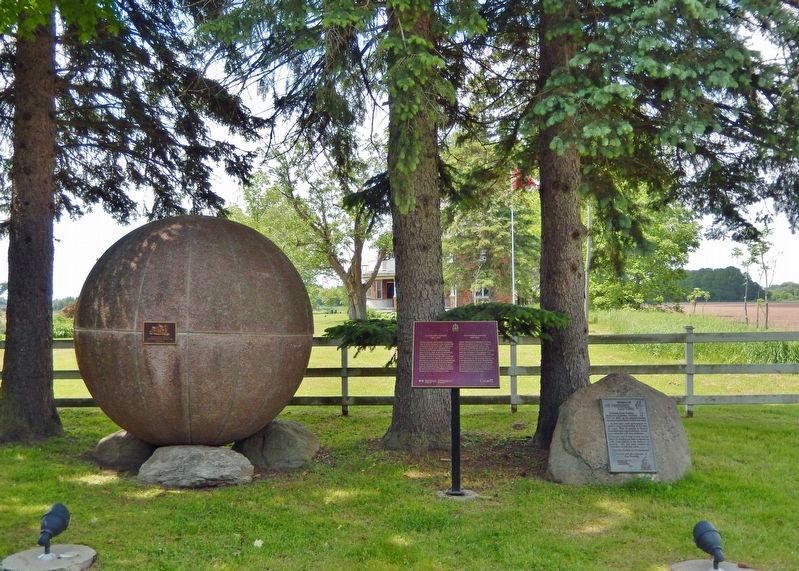
2. Sir Frederick Banting Marker
Looking west from Sir Frederick Banting Road. A birthplace monument (sphere) is on the left. A related historical marker is on the right. The Sir Frederick Banting Birthplace and Homestead is in the background.
Other nearby markers. At least 8 other markers are within 3 kilometers of this marker, measured as the crow flies: Birthplace of Sir Frederick Banting (here, next to this marker); Canada's Gift to the World (within shouting distance of this marker); Sir Frederick Grant Banting (approx. 1.7 kilometers away); The Alliston Monument Works (approx. 2.2 kilometers away); The Revere House and Brown Building (approx. 2.2 kilometers away); Founding of Elmgrove (approx. 2.4 kilometers away); The Barn (approx. 2.8 kilometers away); Agricultural Exhibit Hall (approx. 2.8 kilometers away). Touch for a list and map of all markers in New Tecumseth.
Related markers. Click here for a list of markers that are related to this marker. Sir Frederick Banting Homestead Heritage Park
Also see . . .
1. Sir Frederick Grant Banting (Wikipedia).
Photographed by Cosmos Mariner, June 4, 2024
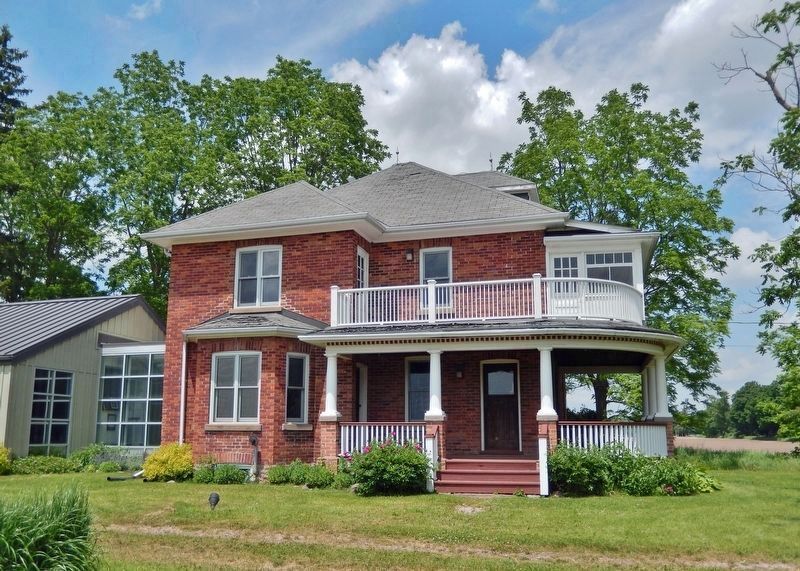
3. Sir Frederick Banting Birthplace & Homestead
Located about 50 meters behind (west of) this historical marker.
Excerpt: Sir Frederick Banting, Canadian pharmacologist, orthopedist, and field surgeon, was born on November 14, 1891, in his family's farmhouse in Essa, Ontario, two miles from nearby Alliston. For his co-discovery of insulin and its therapeutic potential, Banting was awarded the Nobel Prize in Physiology or Medicine with John Macleod. Banting and his student, Charles Best, isolated insulin at the University of Toronto in the lab of Scottish physiologist John Macleod. When he and Macleod received the 1923 Nobel Prize in Physiology or Medicine, Banting shared the honours and award money with Best. That same year, the government of Canada granted Banting a lifetime annuity to continue his work. To this day, Frederick Banting, who received the Nobel Prize at age 32, remains the youngest Nobel laureate for Physiology/Medicine.(Submitted on August 14, 2024, by Cosmos Mariner of Cape Canaveral, Florida.)
2. Frederick G. Banting, The Nobel Prize in Physiology or Medicine 1923.
Excerpt: In 1916 he took his M.B. degree and at once joined the Canadian Army Medical Corps, and served, during the First World War, in(Submitted on August 14, 2024, by Cosmos Mariner of Cape Canaveral, Florida.)France. In 1918 he was wounded at the battle of Cambrai and in 1919 he was awarded the Military Cross for heroism under fire. When the war ended in 1919, Banting returned to Canada and was for a short time a medical practitioner at London, Ontario. He studied orthopaedic medicine and was, during the year 1919-1920, Resident Surgeon at the Hospital for Sick Children, Toronto. From 1920 until 1921 he did part-time teaching in orthopaedics at the University of Western Ontario at London, Canada, besides his general practice, and from 1921 until 1922 he was Lecturer in Pharmacology at the University of Toronto. In 1922 he was awarded his M.D. degree, together with a gold medal.Photographed by Cosmos Mariner, June 4, 20244. Banting Homestead Heritage Park EntranceLocated about 15 meters south of this historical marker.Banting had become deeply interested in diabetes. The work of Naunyn, Minkowski, Opie, Schafer, and others had indicated that diabetes was caused by lack of a protein hormone secreted by the islets of Langerhans in the pancreas. Determined to investigate this possibility, Banting discussed it with various people, among whom was J.J.R. Macleod, Professor of Physiology at the University of Toronto, and Macleod gave him facilities for experimental work upon it. Dr. Charles
Best, then a medical student, was appointed as Banting’s assistant, and together, Banting and Best started the work which was to lead to the discovery of insulin.

Credits. This page was last revised on August 15, 2024. It was originally submitted on August 14, 2024, by Cosmos Mariner of Cape Canaveral, Florida. This page has been viewed 244 times since then and 23 times this year. Photos: 1, 2, 3, 4. submitted on August 14, 2024, by Cosmos Mariner of Cape Canaveral, Florida.
