Memphis in Shelby County, Tennessee — The American South (East South Central)
Plant Use in the Southeast
Photographed by Jason Voigt, August 1, 2024
1. Plant Use in the Southeast Marker
(top panel:)
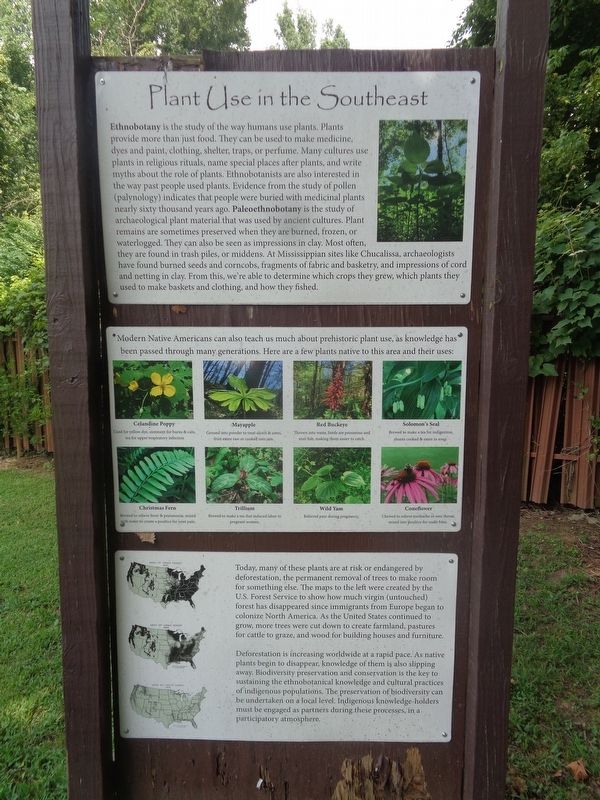
Ethnobotany is the study of the way humans use plants. Plants provide more than just food. They can be used to make medicine, dyes and paint, clothing, shelter, traps, or perfume. Many cultures use plants in religious rituals, name special places after plants, and write myths about the role of plants. Ethnobotanists are also interested in the way past people used plants. Evidence from the study of pollen (palynology) indicates that people were buried with medicinal plants nearly sixty thousand years ago. Paleoethnobotany is the study of archaeological plant material that was used by ancient cultures. Plant remains are sometimes preserved when they are burned, frozen, or waterlogged. They can also be seen as impressions in clay. Most often, they are found in trash piles, or middens. At Mississippian sites like Chucalissa, archaeologists have found burned seeds and corncobs, fragments of fabric and basketry, and impressions of cord and netting in clay. From this, we're able to determine which crops they grew, which plants they used to make baskets and clothing, and how they fished.
(middle:)
Modern Native
this page online
Celandine Poppy - Used for yellow dyed, ointment for burns & cuts, tea for upper respiratory infection
Mayapple - Ground into powder to treat ulcers & sores, fruit eaten raw or cooked into jam.
Red Buckeye - Thrown into water. Seeds are poisonous and stun fish, making them easier to catch.
Solomon's Seal - Brewed to make a tea for indigestion, shoots cooked & eaten in soup
Christmas Fern - Brewed to relieve fever & pneumonia, mixed with water to create a poultice for joint pain.
Trillium - Brewed to make a tea that induced labor in pregnant women.
Wild Yam - Relieved pain during pregnancy.
Coneflower - Chewed to relieve toothache or sore throat, mixed into poultice for snake bites.
(bottom:)
Today, many of these plants are at risk or endangered by deforestation, the permanent removal of trees to make room for something else. The maps to the left were created by the U.S. Forest Service to show how much virgin (untouched) forest has
Photographed by Jason Voigt, August 1, 2024
2. Plant Use in the Southeast Marker
Deforestation is increasing worldwide at a rapid pace. As native plants begin to disappear, knowledge of them is also slipping away. Biodiversity preservation and conservation is the key to sustaining the ethnobotanical knowledge and cultural practices of indigenous populations. The preservation of biodiversity can be undertaken on a local level. Indigenous knowledge-holders must be engaged as partners during these processes, in a participatory atmosphere.
Topics. This historical marker is listed in these topic lists: Horticulture & Forestry • Indigenous Peoples and Communities.
Location. 35° 3.76′ N, 90° 7.815′ W. Marker is in Memphis, Tennessee, in Shelby County. It can be reached from Indian Village Drive. Marker is on the grounds of the Chucalissa village site. Touch for map. Marker is at or near this postal address: 1987 Indian Village Dr, Memphis TN 38109, United States of America. Touch for directions.

Regionally, this marker is in West Tennessee. It is also in the American South, specifically in the Deep South, in the Upper South, in the Mississippi Delta, and in the Great River Road Region. Globally, it is in North America, the Western Hemisphere, the Western World, and the Anglosphere. Historically, it finds itself in what was once the territory of the Mississippian Culture, one of the Confederate States of America, and the Antebellum South.
Other nearby markers. At least 8 other markers are within walking distance of this marker: Welcome to Chucalissa (a few steps from this marker); The Central Plaza (within shouting distance of this marker); Gardening (within shouting distance of this marker); Chucalissa Site (within shouting distance of this marker); Mississippian Mounds (within shouting distance of this marker); Platform Mound (within shouting distance of this marker); Building Mounds (within shouting distance of this marker); Chucalissa in Historic Times (about 300 feet away, measured in a direct line). Touch for a list and map of all markers in Memphis.
Credits. This page was last revised on August 15, 2024. It was originally submitted on August 15, 2024, by Jason Voigt of Glen Carbon, Illinois. This page has been viewed 158 times since then and 29 times this year. Photos: 1, 2. submitted on August 15, 2024, by Jason Voigt of Glen Carbon, Illinois.
