Falls City in Richardson County, Nebraska — The American Midwest (Upper Plains)
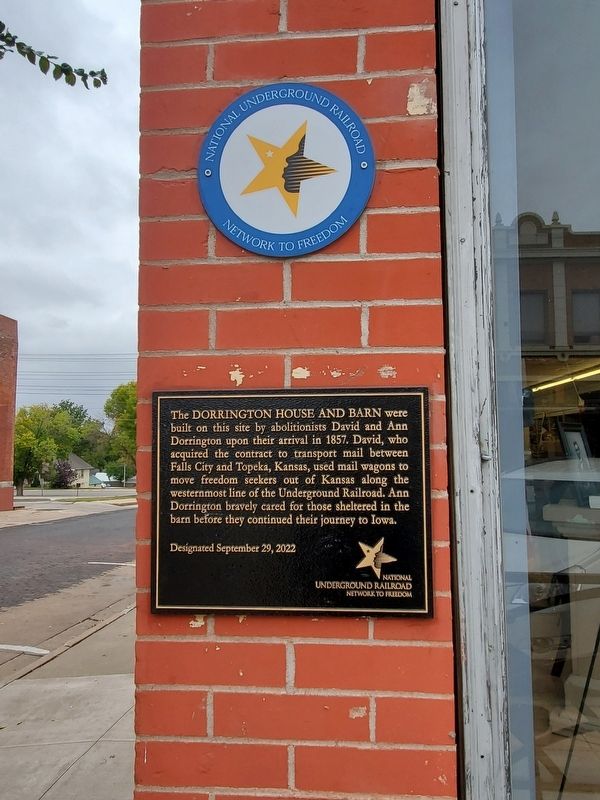
The Dorrington House
| — | National Underground Railroad Network to Freedom | — |
Photographed by Mark Parker, October 14, 2023
1. The Dorrington House Marker
Erected 2022.
Topics and series. This historical marker is listed in these topic lists: Abolition & Underground RR • African Americans. In addition, it is included in the Network to Freedom series list. A significant historical year for this entry is 1857.
Location. 40° 3.65′ N, 95° 36.184′ W. Marker is in Falls City, Nebraska, in Richardson County. It is at the intersection of Stone Street and West 16th Street, on the right when traveling south on Stone Street. The marker hangs on the outside of the Collection Museum at the far left brick post above the south steps up to the elevated walkway. Touch for map. Marker is at or near this postal address: 1601 Stone St, Falls City NE 68355, United
this page online

Regionally, this marker is in Eastern Nebraska. It is also in the American Midwest, in the Lewis & Clark Corridor, in the Corn Belt, and on the prairies. Globally, it is in North America, the Western Hemisphere, the Western World, and the Anglosphere. Historically, it finds itself in what was once the Louisiana Purchase.
Other nearby markers. At least 8 other markers are within 10 miles of this marker, measured as the crow flies: To the Pioneers of Richardson County (about 500 feet away, measured in a direct line); Richardson County Veterans Memorial (about 500 feet away); In Memory of Sgt. Nicholas Santo Nolte (about 500 feet away); Nemaha River Falls (approx. one mile away); First Oil Well (approx. 3.7 miles away); Lewis and Clark Campsite (approx. 9.4 miles away); Missouri River (approx. 9.4 miles away); Lewis and Clark (approx. 9.4 miles away). Touch for a list and map of all markers in Falls City.
Photographed by Mark Parker, October 14, 2023
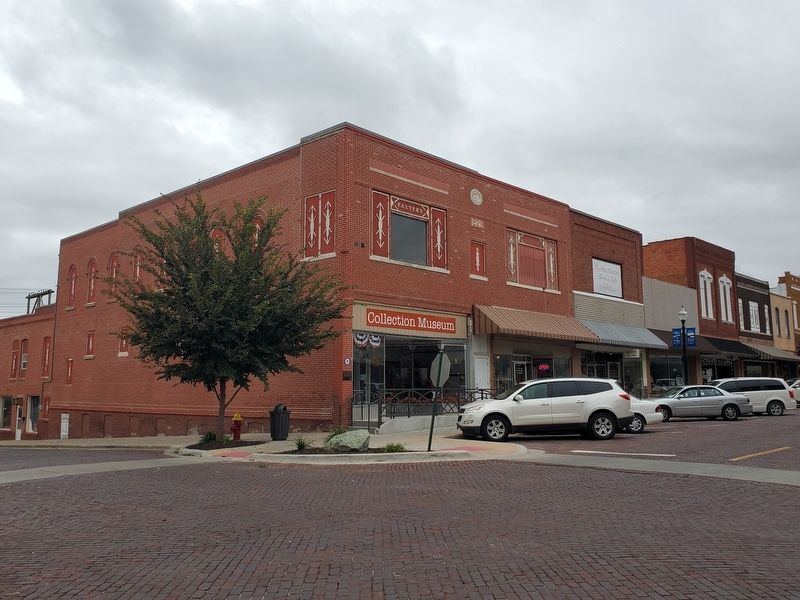
2. The Dorrington House Marker at the Collection Museum
Marker is at the far southeast brick pillar facing Stone Street.
Photographed by Mark Parker, October 14, 2023
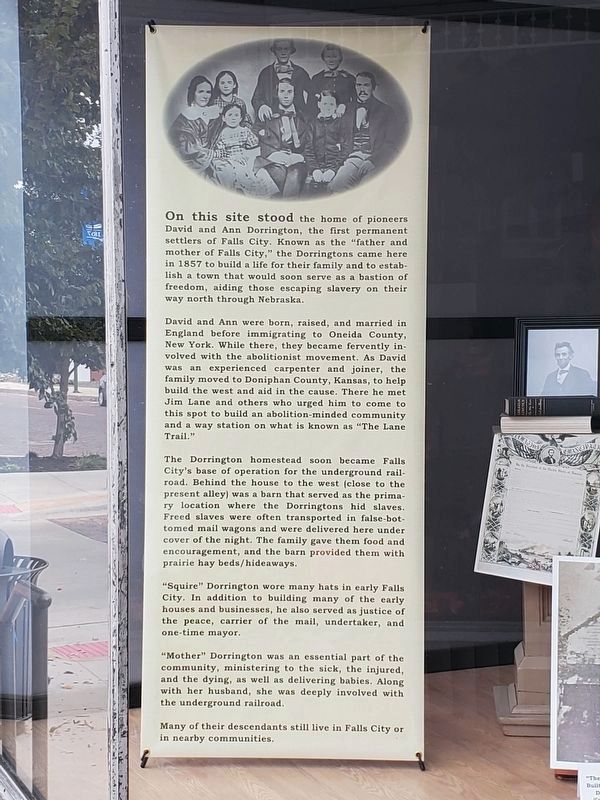
3. Dorrington House display in the Collection Museum window
On this site stood the home of pioneers David and Ann Dorrington, the first permanent settlers of Falls City. Known as the "father and mother of Falls City," the Dorringtons came here in 1857 to build a life for their family and to establish a town that would soon serve as a bastion of freedom, aiding those escaping slavery on their way north through Nebraska.
David and Ann were born, raised, and married in England before immigrating to Oneida County, New York. While there, they became fervently involved with the abolitionist movement. As David was an experienced carpenter and joiner, the family moved to Doniphan County, Kansas, to help build the west and aid in the cause. There he met Jim Lane and others who urged him to come to this spot to build an abolition-minded community and a way station on what is known as "The Lane Trail."
The Dorrington homestead soon became Falls City's base of operation for the underground railroad. Behind the house to the west (close to the present alley) was a barn that served as the primary location where the Dorringtons hid slaves. Freed slaves were often transported in false-bottomed mail wagons and were delivered here under cover of the night. The family gave them food and encouragement, and the barn provided them with prairie hay beds/hideaways.
"Squire" Dorrington wore many hats in early Falls City. In addition to building many of the early houses and businesses, he also served as justice of the peace, carrier of the mail, undertaker, and one-time mayor.
"Mother" Dorrington was an essential part of the community, ministering to the sick, the injured, and the dying, as well as delivering babies. Along with her husband, she was deeply involved with the underground railroad.
Many of their descendants still live in Falls City or in nearby communities.
David and Ann were born, raised, and married in England before immigrating to Oneida County, New York. While there, they became fervently involved with the abolitionist movement. As David was an experienced carpenter and joiner, the family moved to Doniphan County, Kansas, to help build the west and aid in the cause. There he met Jim Lane and others who urged him to come to this spot to build an abolition-minded community and a way station on what is known as "The Lane Trail."
The Dorrington homestead soon became Falls City's base of operation for the underground railroad. Behind the house to the west (close to the present alley) was a barn that served as the primary location where the Dorringtons hid slaves. Freed slaves were often transported in false-bottomed mail wagons and were delivered here under cover of the night. The family gave them food and encouragement, and the barn provided them with prairie hay beds/hideaways.
"Squire" Dorrington wore many hats in early Falls City. In addition to building many of the early houses and businesses, he also served as justice of the peace, carrier of the mail, undertaker, and one-time mayor.
"Mother" Dorrington was an essential part of the community, ministering to the sick, the injured, and the dying, as well as delivering babies. Along with her husband, she was deeply involved with the underground railroad.
Many of their descendants still live in Falls City or in nearby communities.
Photographed by Mark Parker, October 14, 2023
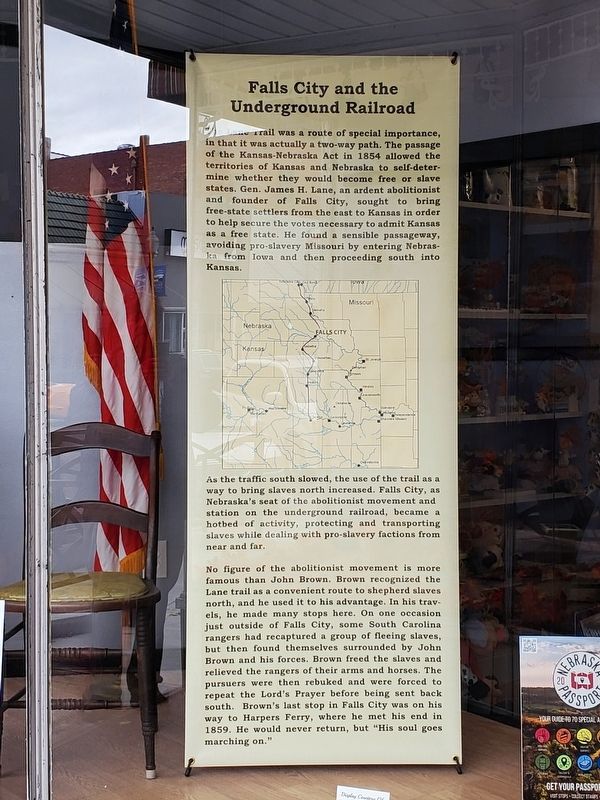
4. Falls City and the Underground Railroad in display window at Collection Museum
The Lane Trail was a route of special importance, in that it was actually a two-way path. The passage of the Kansas-Nebraska Act in 1854 allowed the territories of Kansas and Nebraska to
self-determine whether they would become free or slave states. Gen. James Lane, an ardent abolitionist and founder of Falls City, sought to bring free-state settlers from the east to Kansas in order to help secure the votes necessary to admit Kansas as a free state. He found a sensible passageway, avoiding pro-slavery Missouri by entering Nebraska from Iowa and then proceeding south into Kansas.
As the traffic south slowed, the use of the trail as a way to bring slaves north increased. Falls City, as Nebraska's seat of the abolitionist movement and station on the underground railroad, became a hotbed of activity, protecting and transporting slaves while dealing with pro-slavery factions from near and far.
No figure of the abolitionist movement is more famous than John Brown. Brown recognized the Lane trail as a convenient route to shepherd slaves north, and he used it to his advantage. In his travels, he made many stops here. On one occasion just outside of Falls City, some South Carolina rangers had recaptured a group of fleeing slaves but then found themselves surrounded by John Brown and his forces. Brown freed the slaves and relieved the rangers of their arms and horses. The pursuers were then rebuked and were forced to repeat the Lord's Prayer before being sent back south. Brown's last stop in Falls City was on his way to Harpers Ferry, where he met his end in 1859. He would never return, but "His soul goes marching on."
As the traffic south slowed, the use of the trail as a way to bring slaves north increased. Falls City, as Nebraska's seat of the abolitionist movement and station on the underground railroad, became a hotbed of activity, protecting and transporting slaves while dealing with pro-slavery factions from near and far.
No figure of the abolitionist movement is more famous than John Brown. Brown recognized the Lane trail as a convenient route to shepherd slaves north, and he used it to his advantage. In his travels, he made many stops here. On one occasion just outside of Falls City, some South Carolina rangers had recaptured a group of fleeing slaves but then found themselves surrounded by John Brown and his forces. Brown freed the slaves and relieved the rangers of their arms and horses. The pursuers were then rebuked and were forced to repeat the Lord's Prayer before being sent back south. Brown's last stop in Falls City was on his way to Harpers Ferry, where he met his end in 1859. He would never return, but "His soul goes marching on."
Credits. This page was last revised on August 22, 2024. It was originally submitted on August 22, 2024, by Mark Parker of Hickory, North Carolina. This page has been viewed 498 times since then and 99 times this year. Photos: 1, 2, 3, 4. submitted on August 22, 2024, by Mark Parker of Hickory, North Carolina. • Devry Becker Jones was the editor who published this page.
