Portland in Leeds and Grenville United Counties, Ontario — Central Canada (North America)
Admiral Sir Charles Edmund Kingsmill
1855-1935
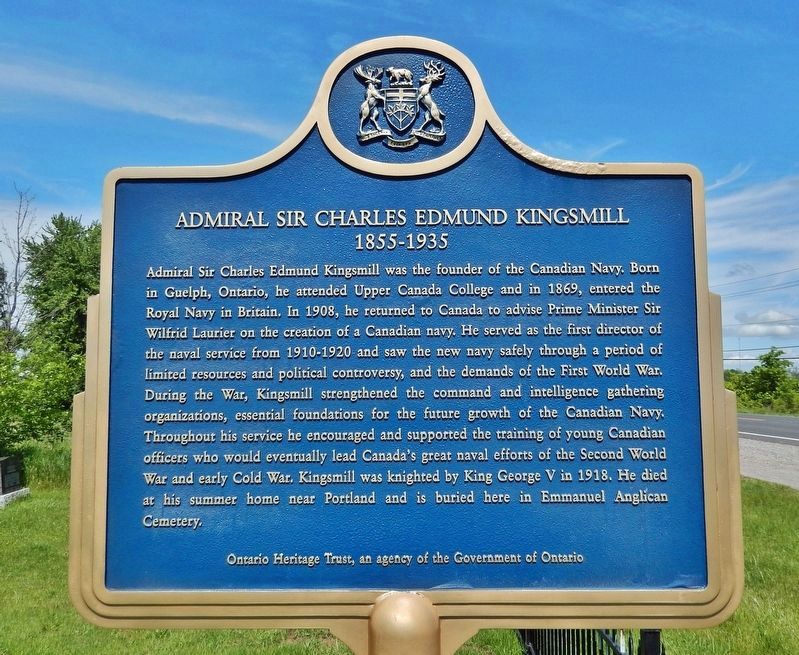
Photographed by Cosmos Mariner, May 29, 2024
1. Admiral Sir Charles Edmund Kingsmill Marker (English)

this page online
Erected 2010 by Ontario
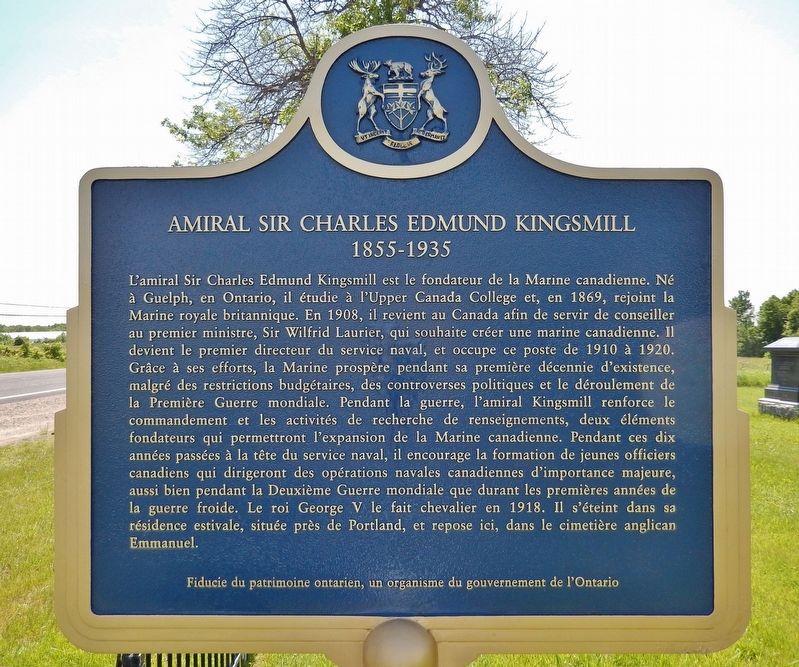
Photographed by Cosmos Mariner, May 29, 2024
2. Admiral Sir Charles Edmund Kingsmill Marker (Français)
Topics and series. This historical marker is listed in these topic lists: Cemeteries & Burial Sites • Patriots & Patriotism • War, World I. In addition, it is included in the Canada, Ontario Heritage Trust series list. A significant historical month for this entry is July 1855.
Location. 44° 41.025′ N, 76° 12.571′ W. Marker is in Portland, Ontario, in Leeds and Grenville United Counties. It is on Provincial Highway 15 0.6 kilometers north of Big Rideau Lake Road, on the left when traveling north. The marker is located at Emmanuel Anglican Cemetery. Touch for map. Marker is in this post office area: Portland ON K0G 1V0, Canada. Touch for directions.

Regionally, this marker is in Eastern Ontario and specifically in Southeastern Ontario. It is also in Central Canada. Globally, it is in North America, the Western Hemisphere, the Western World, and the Anglosphere. Historically, it finds itself in what was once a British colony, the Viceroyalty of New France, the Haudenosaunee (Iroquois) Confederacy, and Rupert’s Land.
Other nearby markers. At least
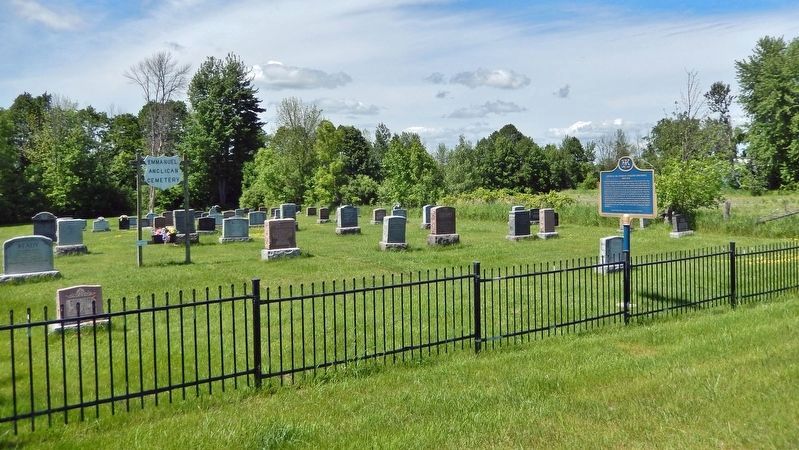
Photographed by Cosmos Mariner, May 29, 2024
3. Admiral Sir Charles Edmund Kingsmill Marker
& Emmanuel Anglican Cemetery (looking north)
& Emmanuel Anglican Cemetery (looking north)
Also see . . .
1. Admiral Sir Charles Edmund Kingsmill (Ontario Heritage Trust).
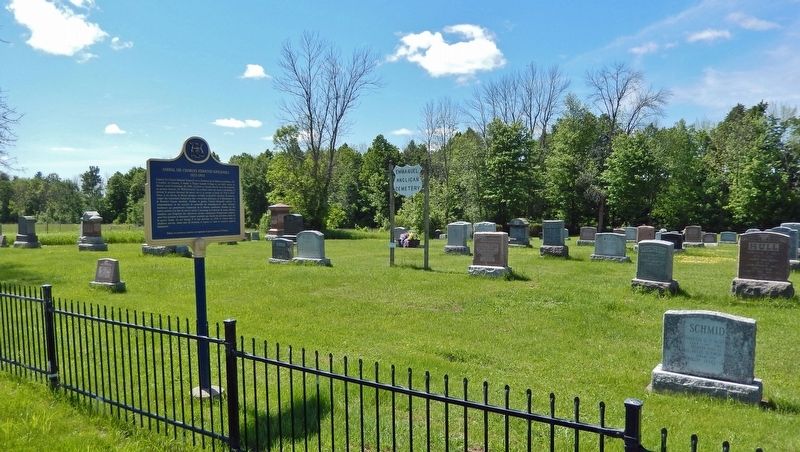
Excerpt: He was the principal technical adviser to the Canadian government in the creation of the navy in 1908-1910 and became the professional head of the new service for its first 10 years, 1910-1920. The government selected Kingsmill because of his naval expertise. Kingsmill’s expertise came from nearly 40 years of service as an officer in Britain’s Royal Navy, the world’s strongest and arguably most effective fighting sea service at the time. He(Submitted on August 23, 2024, by Cosmos Mariner of Cape Canaveral, Florida.)served on most types of warships in most parts of the world. Although Kingsmill, at just 14 years of age, left his native Ontario to join the Royal Navy as a midshipman, his allegiance and outlook was Canadian. At that time, it was not uncommon for Canadians wishing to become professional (that is full-time) members of the armed forces, to join the British services. Canadians — considered British citizens who lived overseas — had the right to join the British armed services on much the same basis as residents of the British Isles.Photographed by Cosmos Mariner, May 29, 20244. Admiral Sir Charles Edmund Kingsmill Marker
& Emmanuel Anglican Cemetery (looking south)
During the course of his expansive career, Kingsmill was well recognized for his impressive service and contributions. He was made an Officer of the French Legion of Honour and a Grand Officer of the Crown of Italy. In 1913, he was promoted on the British Royal Navy’s retired list to vice-admiral, then to full admiral in 1917. Kingsmill was knighted by King George V in 1918.
2. Admiral Kingsmill builds foundation of newly created RCN.
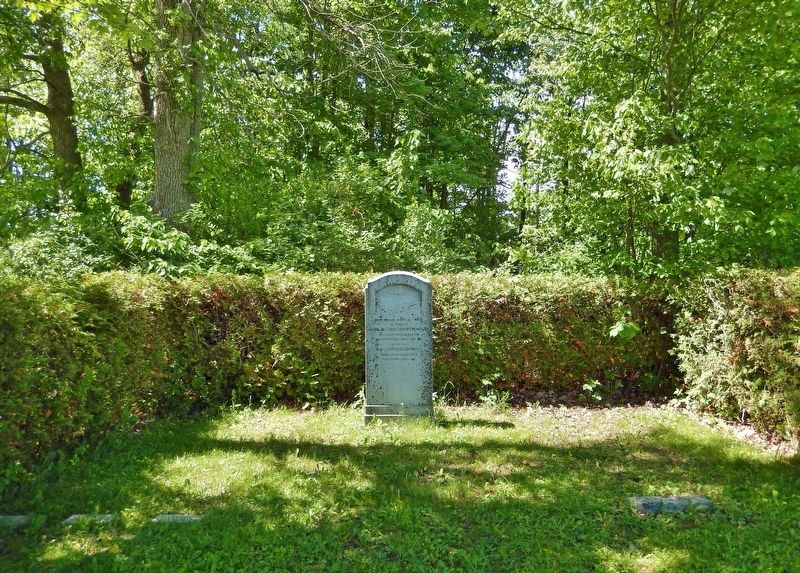
Excerpt: Just four years after its creation on May 4, 1910, Kingsmill was named(Submitted on August 23, 2024, by Cosmos Mariner of Cape Canaveral, Florida.)the first director of the Naval Service of Canada (which later became the RCN). He established a naval college in Halifax and began building Canada’s navy after serving nearly 40 years in Britain’s Royal Navy. Kingsmill firmly grasped the possibilities for a Canadian navy that, although built on British models, would be shaped by Canada’s particular maritime interests, such as the close protection of the coastline and ports, the gathering of marine intelligence for the government in Ottawa, and the enforcement of fisheries regulations.Photographed by Cosmos Mariner, May 29, 20245. Admiral Sir Charles Edmund Kingsmill GravesiteLocated in the northwest corner of Emmanuel Anglican Cemetery.
3. Admiral Sir Charles Edmund Kingsmill (Wikipedia).
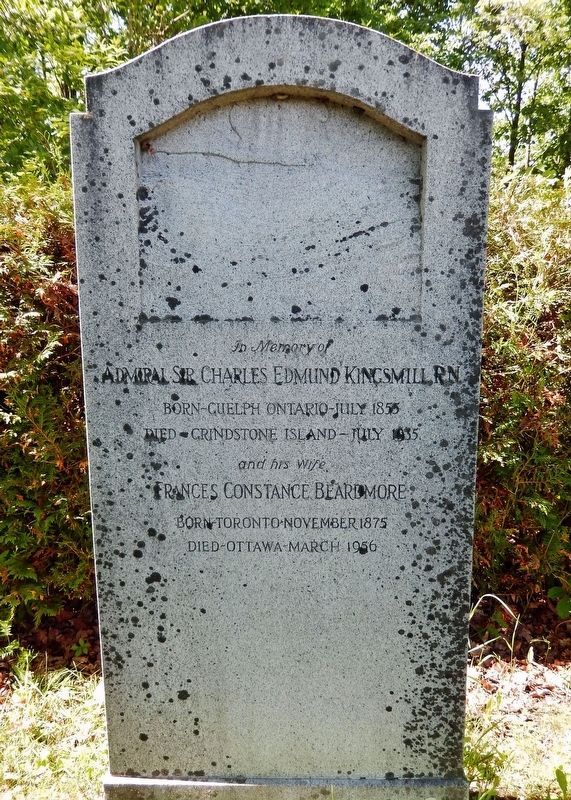
Excerpt: Kingsmill retired on 31 December 1921. He maintained a summer home on Grindstone Island, in Big Rideau Lake, near Portland, Ontario, where he loved to sail. His guests included the Duke of Devonshire, Governor General of Canada from 1916 to 1921; Sir William MacKenzie, railway entrepreneur; and Neville Chamberlain, later Prime Minister of the United Kingdom from 1937–1940. When he died at Grindstone Island on 15 July 1935, a "huge flotilla of boats brought(Submitted on August 23, 2024, by Cosmos Mariner of Cape Canaveral, Florida.)him in from the island". Kingsmill is buried in the Anglican cemetery in Portland, where an Ontario Heritage Trust plaque commemorates his contribution to Canadian naval history.Photographed by Cosmos Mariner, May 29, 20246. Charles Edmund Kingsmill HeadstoneIn Memory of
Admiral Sir Charles Edmund Kingsmill, R.N.
Born — Guelph Ontario — July 1855
Died — Grindstone Island — July 1935,
and his Wife,
Frances Constance Beardmore
Born — Toronto — November 1875
Died — Ottawa — March 1956
Credits. This page was last revised on August 23, 2024. It was originally submitted on August 23, 2024, by Cosmos Mariner of Cape Canaveral, Florida. This page has been viewed 189 times since then and 22 times this year. Photos: 1, 2, 3, 4, 5, 6. submitted on August 23, 2024, by Cosmos Mariner of Cape Canaveral, Florida.
