Mackinaw City in Cheboygan County, Michigan — The American Midwest (Great Lakes)
Anchor
| — | Mackinaw City Historical Pathway | — |
Photographed by J. J. Prats, August 2, 2024
1. Anchor Marker
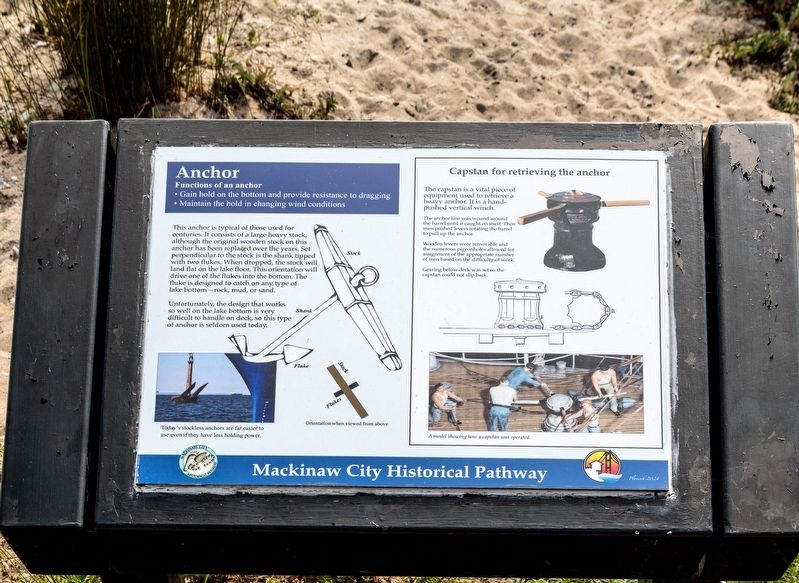
Functions of an anchor.
• Gain hold on the bottom and provide resistance to dragging
• Maintain the hold in changing wind conditions
This anchor is typical of those used for centuries. It consists of a large heavy stock, although the original wooden stock on this anchor has been replaced over the years. Set perpendicular to the stock is the shank tipped with two flukes. When dropped, the stock will land flat on the lake floor. This orientation will drive one of the flakes into the bottom. The fluke is designed to catch on any type of lake bottom—rock, mud, or sand.
Unfortunately, the design that works so well on the lake bottom is very difficult to handle on deck, so this type of anchor is seldom used today.
(sidebar)
Capstan for retrieving the anchor.
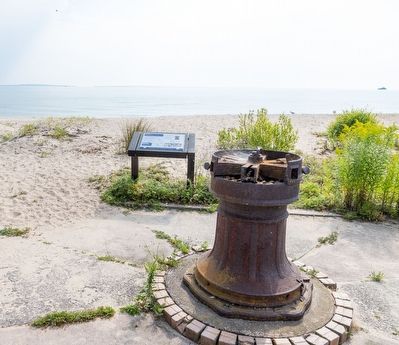
The capstan is a vital piece of equipment used to retrieve a heavy anchor. It is a hand-pushed vertical winch.
The anchor line was wound around the barrel until it caught on itself. Then men pushed levers rotating the barrel to pull up the anchor.
Wooden levers were removable and numerous pigeonholes allowed for assignment of the appropriate
this page online
Gearing below deck was set to the capstan could not slip back.
Erected 2024.
Topics. This historical marker is listed in this topic list: Waterways & Vessels.
Location. 45° 47.15′ N, 84° 43.556′ W. Marker is in Mackinaw City, Michigan, in Cheboygan County. It is at the intersection of North Huron Avenue and East Depeyster Street, on the right when traveling north on North Huron Avenue. It is in Maritime Park. Touch for map. Marker is at or near this postal address: 502 N Huron Ave, Mackinaw City MI 49701, United States of America. Touch for directions.

Regionally, this marker is in Northern Michigan Lower Peninsula, on the Straits of Mackinac, and in one of the Lake Huron Shore counties. It is also in the American Midwest. Globally, it is in North America, in the Great North Woods, on the Great Lakes, in the Western Hemisphere, in the Western World, and in the Anglosphere. Historically, it finds itself in what was once the Northwest Territory.
Other nearby markers. At least 8 other markers are within walking distance
Photographed by J. J. Prats, August 2, 2024
2. The Capstan and Marker
Other markers no longer nearby. Anchors and their retrieval (was here, next to this marker but has been replaced with another marker now near it); Marine & Weather Reporter (was within shouting distance of this marker but has been replaced with another marker now near it); a different marker also named The Lumbering Era (was about 500 feet away but has been replaced with another marker now near it); Graveyard of the Deep (was about 700 feet away but has been replaced with another marker now near it); Building Mighty Mac (was about 700 feet away but has been replaced with another marker now
Photographed by J. J. Prats, August 2, 2024
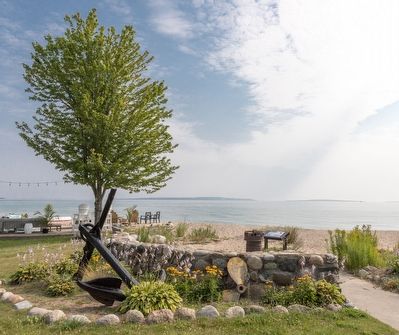
3. Anchor, Propeller, Capstan, and Marker in Maritime Park
More about this marker. This interpretive panel is illustrated with three photographs and three drawings. There is a drawing of an anchor showing its stock, shank and flukes, and a second showing the flukes’ orientation in relations to the shank. A third is a drawing of a capstan showing how the chain wraps around its serrated edges. A photograph of a Buffalo Eagle Iron Works capstan shows it set up with three wooden lever handles. Another photograph is of a model showing four sailors operating a capstan while a fifth feeds the rope. On the lower left is a photograph showing today’s stockless anchors with a caption that states that “stockless anchors are far easier to use even if they have less holding power.”
Credits. This page was last revised on August 24, 2024. It was originally submitted on August 24, 2024, by J. J. Prats of Powell, Ohio. This page has been viewed 155 times since then and 13 times this year. Photos: 1, 2, 3. submitted on August 24, 2024, by J. J. Prats of Powell, Ohio.
